
Notifications
Clear all

Administrative Reform: Bringing Power Closer to Citizens
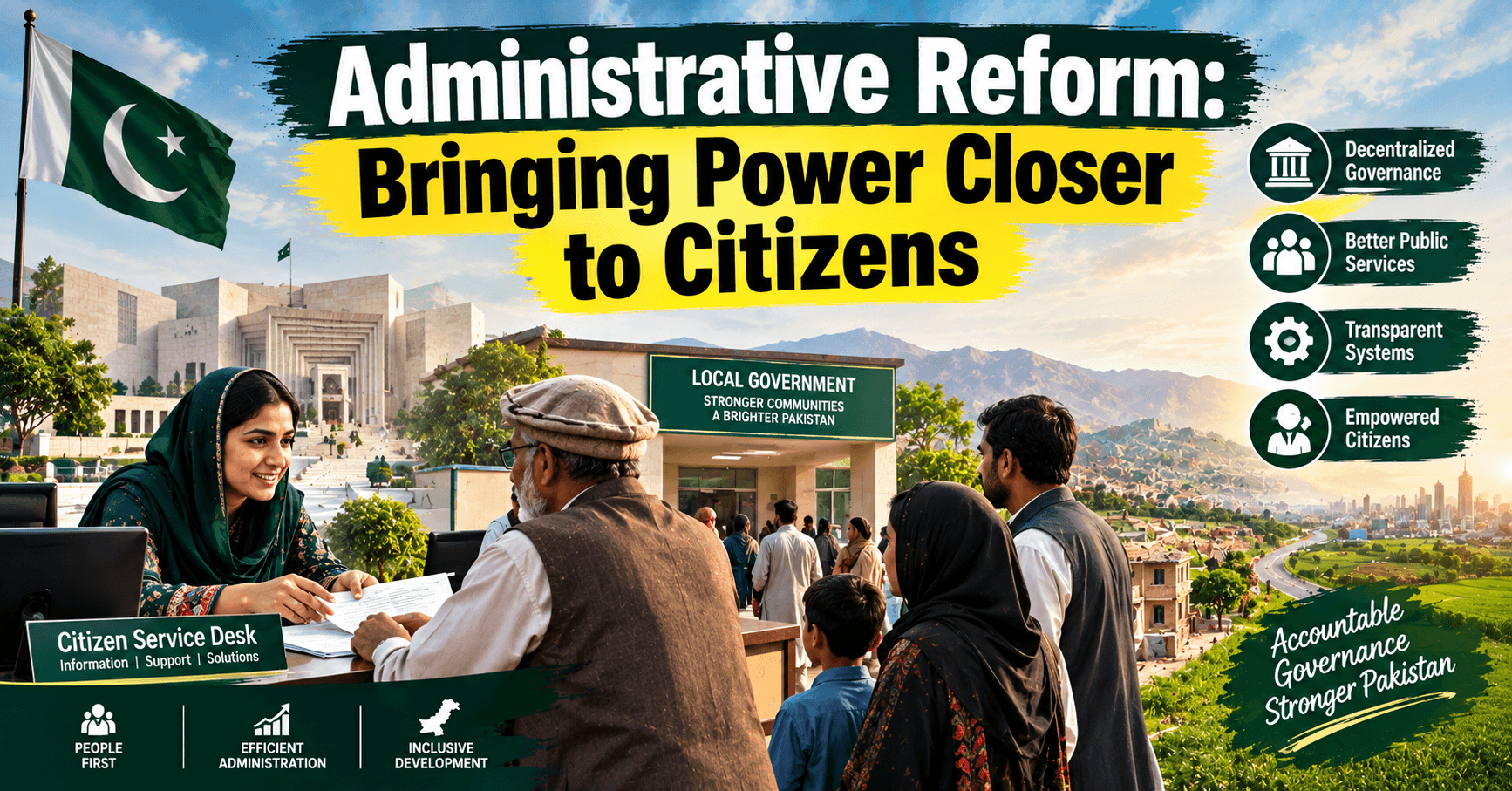
Administrative Reform: Governance by the people and for the people PAKISTAN’S discussion about the administrative system has mainly revolved on how much of the provinces or even new ones will be created. However, this matter is more about rethinking the composition of the State, who really exercises the power and how government can reach the citizens in a better way. Politicians, legislators, and analysts have started to suggest creating more sub-units, local governments being stronger, and increasing devolution of funds. The discussion is now rightly shifting from simply changing the map to talking about governance, service delivery, and institutional reconfiguration.
In this respect, Pakistan has been focusing well. The nation does need another government level located on top; it only needs effective, democratic, accountable institutions operating close to the people. Practical steps that can be taken to this end include converting some existing administrative units into an independent entity of Governance - that is, creating Autonomous Administrative Units or Regions, also called AARs. There is no need for a brand new kind of bureaucracy; existing divisions of administration can be gradually transformed, for instance, into autonomous units, with their population size, geographical location, and economic ties being main criteria, as well as local aspirations.
They wouldn’t be a clone provincial government in a way.
Instead, AARs would be a democratically elected regional development body and service-delivery unit which would be given a budget, define a set of activities, appoint professional managers, and choose the leadership in elections. The rationale of this model is simple: a government closest to the people should have authority and necessary means to tackle challenges which concern such people most. By filling this gap between policymaking at the provincial level and local activities in implementation, AARs will have an additional benefit in that the provincial Governments, for example, will be enabled to maintain existing large structures at that level, and at the same time make political decisions, economic decisions as well as administrative decisions closer to their constituency.
First and foremost, however, the establishment of AARs must not be a bureaucracy’s new exercise.
The new AAR unit needs to be an elected one. Every Region should have a Regional Council which is a direct election by the citizens of the region for a term of five years. It is also possible that a member of the Council might be a Regional Chief Executive, but another option is having someone elect the Chief Executive directly. The details of such an arrangement can still be subject to change while the basic rule: regional governing body should originate from the people only, should not be changed. Also, the Role Council would approve development plans, check operations of Regional Department, review public expenditure and see through Regional Executive.
It has to be easy enough for people in local communities to find out who is responsible for regional transport and roads, secondary healthcare, local agriculture, technical education, and a host of other major regional responsibilities.
District and town committees should have directly elected administrations that are responsible mainly for district and town level services respectively. Each level of the government should be responsible for a clearly separated range of public functions, be funded adequately, and at the same time be held responsible for carrying out the tasks that were assigned to them.
Territorial government is only for those tasks that require national-level coordination such as: defense, foreign relations, the country’s currency, macroeconomic policy, national budget, strategic infrastructure, national energy policy, and setting national standards.
Provinces will keep on doing their current set of work, which will consist of making and passing laws, setting and enforcing standards, regulating various fields, carrying out the province’s income taxes (provincial taxation), collecting equalization and conducting broad surveillance.
AARs would mainly have a regional development and implementation focus through areas such as, but not limited to: economic planning, the facilitation of a business atmosphere for investments, boosting growth of industry, developing tourism, raising agricultural standards, regional level roads, transport, secondary healthcare services, technical and vocational education, skill development programmes, and planning of and investing in the major infrastructure at regional level.
The district administrations should bear the primary responsibility for the provision of services that the common people will feel most affected such as health, schools, provision of water and sanitation, repair of minor roads, social safety nets and citizen services. On the other hand municipal and tehsil administrations should attend to the management of civic matters like collection of waste, condition of the streets, markets, building regulations, maintenance of parks, local transport and other municipal services. It is not about the sharing of work between the layers of governments, the idea also is to clarify the responsibility lines in a way that people should know which authority or a government to blame if there is a problem. If a hospital has not been functioning for a long time, the citizen should not get any information on that through a government press release; rather, the citizen must be able to determine from where the problem is originating and which government is the most relevant in answering for its mismanagement.
The concept of decentralization is pretty meaningless unless accompanied by corresponding financial authority. Therefore, local government units of Pakistan or AARs should receive regular, reliable transfers according to a formula alongside clearly identifying various sources as their major revenue. Districts, urban areas or municipalities should be handed over their shares directly and at specified time frames. In addition to population, poverty, geographical size, infrastructure deficit, revenue effort and developmental requirements the formula for allocation of resources should also take into consideration these factors.
It was observed in a study that local governments consumed a mere less than five per cent of total government spending. The fact remained that district allocations have shown a trend that was, at best, only mildly consistent.
Making a provision from which one will benefit if the other side of an exchange becomes untrustworthy.
The principle is straightforward: a task should not be entrusted to those who have no means with which to fulfill their responsibility, and at the same time, the provision of resources ought to be conditional so that those in receipt are held to account accordingly. All tiers of local government be it the AARs or a district or a city should be required to put the details of their budgets, procurement plans, and other developments as well as the results of measurable achievements on the websites so that all citizens and stakeholders who wish to know will find the information easily available. Not only how much a government received, citizens should also know to what extent the received budget was used, and what have been the results.
Administrative and Revenue Divisions (AARs) should not just be the handmaidens of the higher authorities. More importantly, they should lead and guide the local development in every region.
In order to achieve the objectives of development and human capital, each region of country can prepare and set out a five-year strategy around specific and different capabilities or unique situations of each particular place. What works in one area like Hazara might be a totally different story for Makran, or the city of Karachi or southern Punjab. For example, different regions of Balochistan can be developed through mineral resources, fisheries, port facilities, renewable energy resources, agriculture, and tourism.
One of more important overall intentions will be to substitute one-size-fits-all policies by acknowledging local differences and devising development policies that recognize the diversity among the regions. When developing a plan, it would be a good idea to take advice and inputs from the people.
If it is only the change in the administrative structures that brings out a new government map without any deep-rooted administrative or procedural changes, the transformation is bound to be superficial and not real.
On the one hand, we might be changing some of the old systems of the local government to the new ones in different parts of the country through a new administrative arrangement; yet on the other hand, as a common pattern, the practice of the new government in the newly-created areas is likely to continue and perhaps even to be more refined and perfected the former ones. If administrative restructuring does not lead to a complete overhaul of governance, there will be no changes to talk of. AAR governments, therefore, besides being technically sound and digitally efficient, should focus on getting results for the citizens in terms of tangible development. Moreover, their staff or the AAR team should consist also of economists, engineers, doctors, education planners, urban planners, technology professionals, agricultural experts, project managers, and any other such highly qualified specialists who can really contribute to good governance on the floor of the district level.
On top of the list, the performance of an employee and the outcome produced should be the main criteria for evaluation of the officials. To a degree, the level of development in a district and of its people is reflected in:
the level of education of children;
accessibility of quality health services;
progressively lowering rates of mortality for mothers, children and others;
investment;
expansion in employment opportunities;
and public service user satisfaction;
These indicators may not completely reflect a district’s condition. For instance, if a hospital was not running properly then that fact should have been evident from the hospital’s performance data.
Even the largest shift in administrative functions and boundaries has no chance to overcome the weak state of institutional structures and governance.
Therefore, decentralization has to go hand in hand with real governance reform.
Packages of local democratic initiatives should be made public and open to debate so that a choice as fundamental as this is made by the people and not imposed by a few at the top. If there is a strong and steady public demand for greater autonomy or a different constitutional arrangement, residents deserve a legitimate vehicle through which they can state their views.
One constitutionally recognized referendum or one public opinion poll could be carried out once the new regional structures are well communicated.
What people think and feel can, to a large extent, be the starting point of such a decision. Through this process, democratic elements that are missing, especially in bureaucratic discussions, become evident: the people who are affected by such decisions are given an opportunity to make the decision. Administrative Reform:
Pakistan’s major political parties regularly refer to democracy, people’s rights, and the people’s choice. However, if democracy is just about getting the people’s vote in national-level and provincial-level elections, then it's only democracy at the surface level. A more reliable test would be, is political power really in the hands of ordinary people? Administrative Reform:
Lots of work would be done from the bottom, and as such the provincial governors would lose their power of making decisions all by themselves. There would be greater opportunities and the ability to monitor how different projects in different development areas spend the funds allocated. Patronage would need to be accountable to the public, and elected regional and local officials would have a duty to explain their work to their communities. Administrative Reform:
It might lead to discomfort for certain quarters. But at the same time, what makes it a real test of a government being for the people and their democratic principles.
Fundamentally, when democracy means giving power to others and oneself being held accountable by others, then only such power-sharing is valuable and a demonstration of a democratic state of mind. The power struggle by the politicians is at the cost of the public. Administrative Reform:
Better still, it is not as if the local units will suddenly become completely independent, as is generally thought, without any prior arrangements. In fact, Pakistan has a good administrative setup already that can form the backbone of any decentralization efforts. A reform committee at the national level consisting of an administrative reform and governance panel might be able to determine functions, demarcate boundaries, identify funding mechanisms, and plan electoral arrangements, and also set indicators for performance for administrative region management groups. A few regions as pilot programs can start off at first, while the experience gathered from them can be a guide for expansion later. Administrative Reform:
No big administrative structures need to be set up simultaneously. Rather, it should suffice in the beginning if only one region’s work force, infrastructure, and so on will change. What we are really aiming for is a qualitative change of administration, not an increase of administrative bodies.
Pakistan had been arguing and discussing on its system of administration and governance for quite a long time. Instead of sticking to the traditional approach of ‘Provinces and how many of them?’ question, it has become essential to ask: ‘How can a government in each part of Pakistan understand the problems at the grassroots level, have enough resources to resolve them and keep itself to the people if not, how and whom can it do so with?’ Administrative Reform:
The topic covers much more than redrawing administrative boundaries and offers a great potential of redefining the relationship between citizens and the state in Pakistan. We should not be aiming for a bigger government but a stronger one, closer to the people and easily accountable. Thus, Pakistan's next governance change should start with another map only if a basic democratic principle is adopted: authority must be brought as close to the people as effective government permits, and citizens themselves must have a say in determining how that authority is organized. Administrative Reform:
This topic was modified 2 hours ago by zarnishayat
Topic starter
Posted : September 16, 2026 11:33 am