
Notifications
Clear all

Beyond Denuclearization: Rethinking U.S.–South Korea Policy Toward North Korea
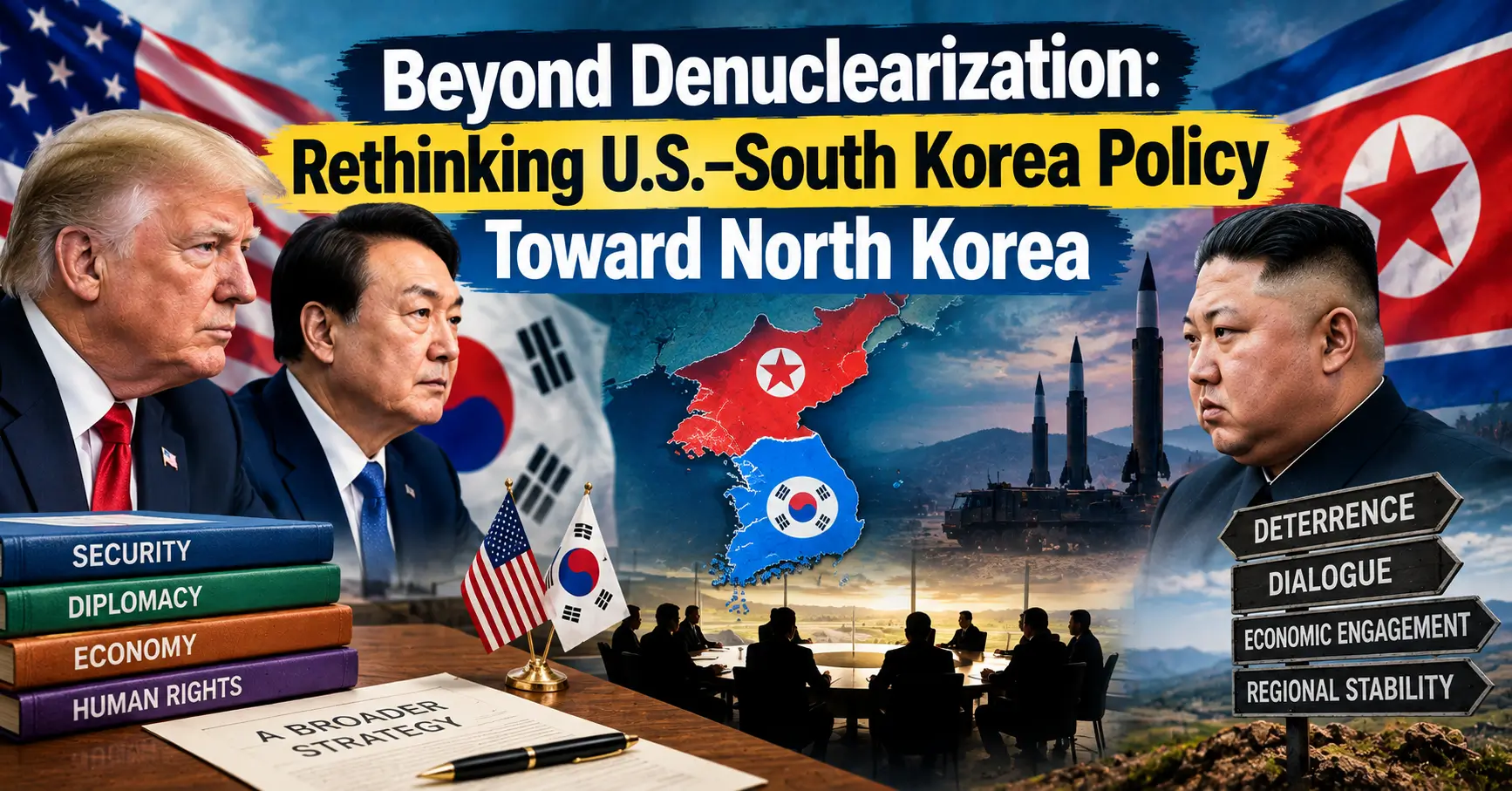
Beyond Denuclearization: Rethinking U.S.–South Korea Policy Toward North Korea
Beyond Denuclearization: Rethinking U.S.–South Korea At best, Washington and Seoul can hope to see the missile and nuclear arsenals on the Korean Peninsula reduced.
For more than 30 years, South Korea and the United States have been trying to form a North Korea policy that eventually might lead to de-nucelear-ization on the Korean Peninsula. In the 90s, North Korea's nuclear program was so limited that dismantling it did not seem very difficult. Also, the 2005 agreement and North Korea-U.S. diplomacy of 2018 left room for the idea that Pyongyang could give up at least some of its nuclear weapons to get a guarantee of safety, some recognition, and a few benefits economically. It was understandable then, given that the final outcome was uncertain, that one would be in favor of that assessment.
North Korea has not only been producing
plutonium and highly enriched uranium but it is also advancing
its missile technology and building weapons for different ranges. The country has also incorporated nuclear weapons
into its laws and state policy documents. One may doubt about Pyongyang’s claim of nuclear status to be “irreversible
” but Kim Jong-un and his entourage are definitely not viewing the nuclear device as a bargaining chip that would be up for disposal if Washington offered the right incentives.
Donald Trump just stated that North Korea has “57 very powerful nuclear weapons
,” as far as he said. However, his support for the figure was not backed up by the data or argument which should be expected from a President to explain such a specific reference. The lack of trustworthy data about North Korea's nuclear capacity, which analysts and policy makers have had to deal with for a long time, is probably why mentioning this figure is a surprise. Regardless of intent, maybe President Trump is just saying that he thinks it is so, but he could be doing more than simply telling what he believes as a fact. Beyond Denuclearization: Rethinking U.S.–South Korea
It seems quite reasonable to suppose that denuclearization is the main objective of North Korea for the long term. Still, even assuming it is quite unlikely to see Trump administration formally acknowledging North Korea as a legitimate possessing nuclear weapons country, setting the removal of North Korea nuclear weapons as the sole condition for any talks is likely to lead to no result. The downside of such a strategy may be allowing the perfect, in our mind, to block the possible ways to get rid of immediate danger here and now. For example, if Washington and Seoul do not have enough power, it really makes little sense.
First, to stop North Korea from gaining more nuclear materials is essential. Yongbyon’s 5MW reactor, used-fuel reprocessing
, and uranium enrichment are all relevant, because they are the source of materials needed for a bigger and even more advanced armory of bombs. Even without decommissioned nuclear weapons already there the stopping any additional weapons-grade material from being made could be a major shift in the direction of the threat. However, the deal cannot be limited to the words “freezing Yongbyon” since unacknowledged enrichment facilities in other areas should always be considered. Beyond Denuclearization: Rethinking U.S.–South Korea
The first step in dealing with North Koreas nuclear issue is to stop them acquiring any more nuclear materials by any means possible. The 5-megawatt reactor at Yongbyon, spent-fuel reprocessing, and uranium enrichment are considered as major methods for the Kim Regime to supply their warhead production. Even if the dismantling of an existing warhead is not done, an agreement banning the production of weapons-grade material that still remains unused will not only reduce the threat but also give the parties a sign of cooperation. However, a trustworthy agreement should not be limited to the concept of freezing the reactor at Yongbyon which implies, among other points, that the freezing of entire nuclear activities in North Korea will be achieved. Other enrichment facilities that may have been kept hidden in secret must also be covered.
Nuclear testing is another big matter of concern. At technical level, the Kim regime could benefit more from nuclear test
.
Stopping the test of nuclear capable missile systems fully would be a significant move even if dismantling of the current weapons is still out of reach. Washington and Seoul need to find an appropriate balancing point.
Of course, Washington is keen on intercontinental missiles because of a threat that might come directly to the American territory. Therefore, the U.S. will naturally have its highest priority on the curtailment of the testing of such a type of missile.
In case of South Korea, a deal must be assessed primarily on whether North Korea's ICBMs are prohibited under its terms or not. The immediate problem for Seoul is the North's use of a system which can strike at any point on the Korean Peninsula, for instance. Korea Northeaster has already created the KN-23, the KN-24 and even the KN-25
weapons, while putting a special emphasis on their tactical nuclear capabilities. If Pyongyang and Washington eventually struck a deal that curbed the launching of missiles which could threaten the U.S., while letting the North Korean military aimed at South Korea continue their development programme, then the more than seventy-year-old alliance would probably face a terminal challenge.
It must be borne in mind that stopping only production of nuclear material, nuclear testing, and missile testing will not bring resolution of the nuclear problem of North Korea alone. Also, limiting of a nuclear arsenal, stronger safeguards against proliferation, etc. are not sufficient on their own. Anyway, these could at least stop some of the problems. And it could lead the way to more serious negotiations in the future!
North Korea's nuclear weapons issue has been there as a part of the security framework of the region for almost 40 years now. It is not really a given that the country's nuclear weapons leverage will simply fade away. However, it is unnecessary both for South Korea and the U.S. to resolve, at this stage of the matter, the question of whether a total denuclearization could possibly be achieved. The two allies should rather take real steps to address some of the key concerns even if the complete elimination of the North Korean nuclear arsenal is still not a realistic goal. Denuclearization, though, is still the endgoal. Therefore, the most important thing that the two parties need to work on is the reduction of the number of warheads so that by the time, they are inherited by President Lee Jae-myung and the President Trump's successors, it would be smaller and thus much safer. The increase of the arsenal has to be halted. Beyond Denuclearization: Rethinking U.S.–South Korea
Topic starter
Posted : September 15, 2026 12:27 pm