
Notifications
Clear all

From independence to responsibility By Abdul Basit Khan
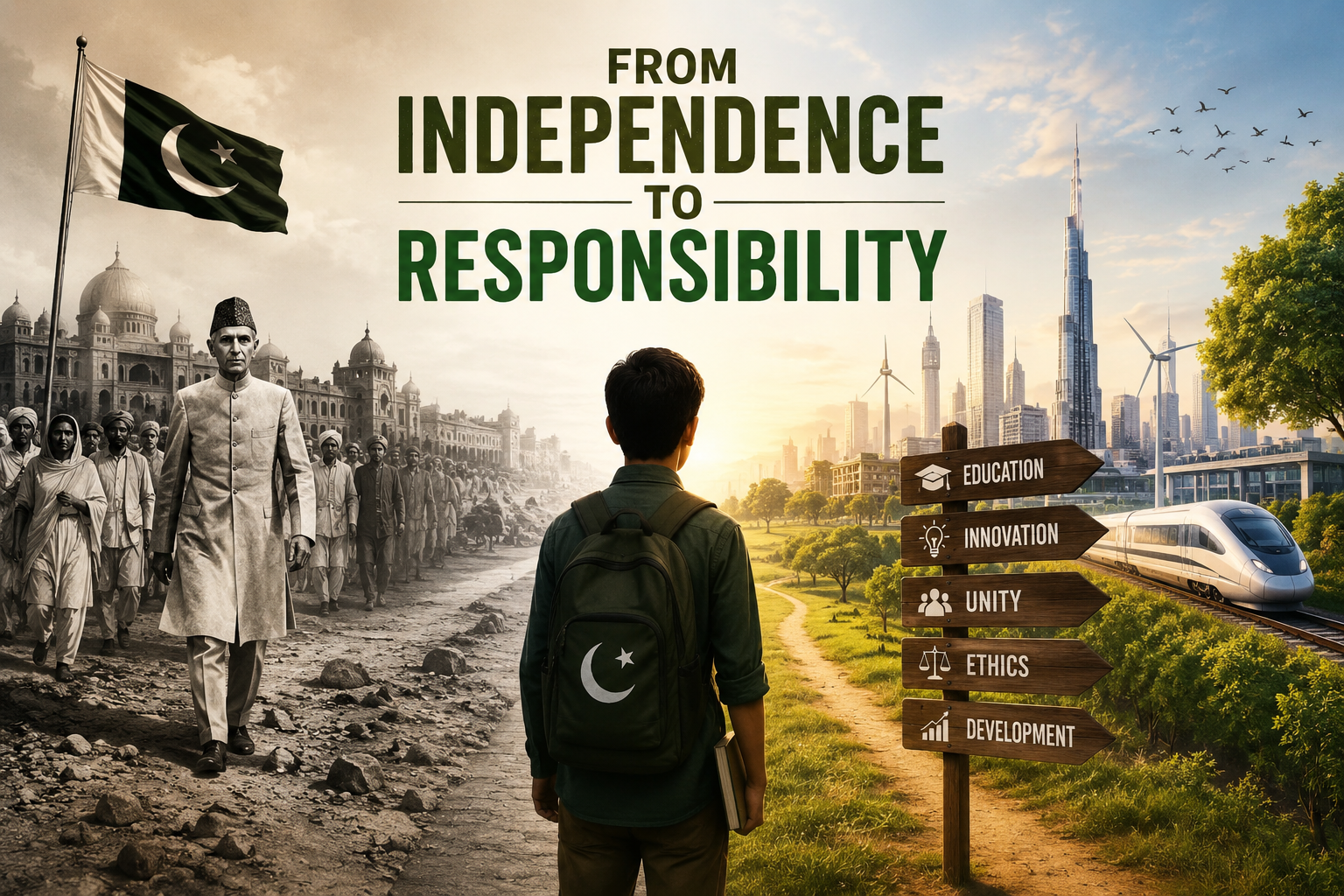
As Pakistan approaches another Independence Day, the familiar celebrations will once again fill our streets with flags, lights, national songs and speeches. Yet Independence Day should not merely be an occasion to remember the sacrifices of our forefathers or to celebrate the creation of Pakistan. It should also be a moment of national introspection: What have we done with the freedom we inherited and what responsibilities does that freedom place upon us? GeographicReference
On August 14, 1947, Pakistan emerged as an independent state after a remarkable political and constitutional struggle led by Quaid-i-Azam Muhammad Ali Jinnah and supported by millions of Muslims of the subcontinent. Independence gave Pakistanis the right to determine their political, economic and social destiny, but freedom was never meant to be freedom from responsibility. It transferred an enormous responsibility to the people themselves. The real meaning of independence therefore goes beyond the absence of foreign rule: a genuinely independent nation must have strong institutions, respect the rule of law, protect citizens’ rights, provide equal opportunities and create an environment where every individual can contribute to national development.
Freedom gives citizens rights, but also demands duties. We have the right to speak, participate politically and criticize governments, but must act responsibly, place national interest above personal and partisan interests, respect constitutional institutions and obey the law. Pakistan’s political history shows that we have often demanded democracy’s benefits without accepting its responsibilities, as political instability, institutional confrontation, corruption, intolerance and weakened democratic traditions have diverted the country from its aspirations. The responsibility for Pakistan’s future cannot rest on governments alone. Political leadership, citizens, institutions, media, business, civil society and the educated class all have vital roles in building a responsible and stable Pakistan.
Independence requires strong institutions: The strength of a country is ultimately measured by the strength of its institutions rather than by the personalities۔ Parliament must per-form its legislative and oversight functions effectively. The judiciary must remain independent and accessible. The executive must be accountable and efficient. Public institutions must serve citizens rather than individuals or political interests. The principle should be simple: no one should be above the law and no citizen should be below its protection. Without the rule of law, political independence cannot be translated into meaningful freedom for ordinary citizens.
Economic independence: Political independence without economic strength remains in-complete. Pakistan therefore needs to move from a consumption-oriented economy towards one based on production, exports, investment, innovation and human capital. Agriculture re-quires modernization; industry needs competitiveness۔ Economic responsibility also requires that the burden of taxation be distributed fairly. A society cannot expect sustainable development if ordinary salaried citizens and compliant taxpayers carry a disproportionate burden while powerful economic groups remain inadequately taxed. GeographicReference
Education is the foundation of responsible freedom: Perhaps, the greatest responsibility of an independent nation is to educate its children. Freedom without education can easily become vulnerable to misinformation, extremism, intolerance and political manipulation. A large and growing young population can become either the country’s greatest asset or one of its greatest challenges. The difference will depend largely on the quality of education, skills, employment opportunities and civic values provided to the younger generation.
Responsibility towards society: Independence also requires social responsibility. We can-not build a strong Pakistan while millions remain deprived of quality education, healthcare, clean water, adequate nutrition and decent employment. Similarly, women, children, minorities, persons with disabilities and marginalized communities must be treated as equal citizens. The Pakistan envisioned at independence cannot be reduced to the privileges.
Patriotism beyond slogans: Perhaps، we need to redefine patriotism. Patriotism is not limited to displaying the national flag, singing national songs or posting messages on social media. These expressions have their place, but genuine patriotism is reflected in conduct. A doctor who serves patients honestly, a teacher who educates children sincerely, a farmer who produces food, a worker who performs his duties diligently, a journalist who reports responsibly, a civil servant who refuses corruption and a citizen who obeys the law are all contributing to Pakistan. Paying taxes honestly, protecting public property, avoiding littering, respecting traffic laws, rejecting corruption and helping fellow citizens are also acts of patriot-ism. From celebration to accountability: Every Independence Day should therefore be an opportunity for national accountability. We should ask ourselves: Have our institutions become stronger? Has the quality of education improved? Are our children better nourished? Are women safer and empowered? Are minorities more secure and fearless? Has poverty declined? Are citizens receiving better public services? Is the rule of law being practised in true letter and spirit? Are we producing enough to reduce our dependence on external assistance? These questions may be uncomfortable, but a mature nation must have the courage to ask them. GeographicReference
The Pakistan of today is very different from the Pakistan of 1947. We have survived wars, political crises, economic shocks, terrorism, natural disasters and regional conflicts. We have also achieved important successes in science, defence, sports, diplomacy and other fields. The real goal must be to build a prosperous, democratic, just and stable society.
The unfinished journey: The founders gave us an independent homeland; Nation-building is a continuing process. The responsibility now belongs to every generation. We must preserve independence not only from external domination but also from poverty, ignorance, corruption, intolerance, injustice and institutional weakness. The greatest tribute to those who sacrificed for Pakistan is therefore not merely to celebrate their achievement once a year. It is to fulfil the responsibilities that independence placed upon us.
SOURCE: https://pakobserver.net/from-independence-to-responsibility/
Topic starter
Posted : August 12, 2026 11:40 am