
Notifications
Clear all

Indus Waters Treaty: PCA Ruling Strengthens Pakistan’s Position
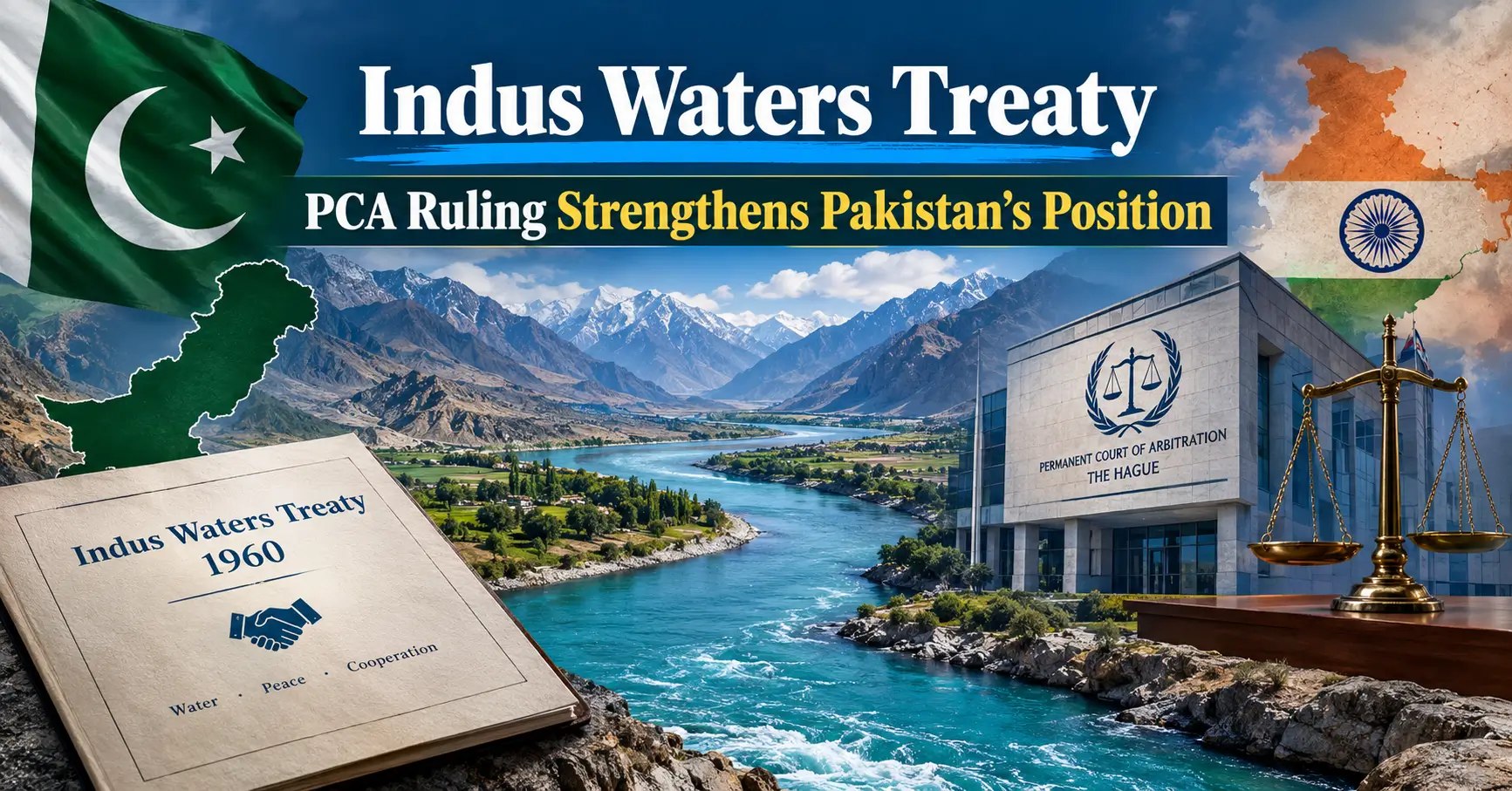
The Permanent Court of Arbitration (PCA) in The Hague has delivered an important development in the long-running dispute between Pakistan and India over the Indus Waters Treaty (IWT). In its award of August 31, 2026, the PCA strengthened Pakistan’s legal position concerning the interpretation and continued validity of the treaty.
Background of the Dispute
Pakistan approached the arbitration process over India’s proposed hydropower projects on rivers covered by the treaty. Pakistan argued that the projects could violate the engineering requirements contained in Annexures D and E of the IWT and potentially affect downstream water flows.
India challenged the PCA’s jurisdiction and argued that the dispute involved technical questions that should go before a neutral expert under the treaty’s dispute-resolution mechanism. However, the arbitration continued despite India’s decision not to participate fully in the proceedings.
PCA’s Key Findings
The tribunal examined whether India could justify suspending the IWT after the April 23, 2025, decision that followed the Pahalgam attack. The PCA considered several factors, including demographic changes, India’s energy requirements, technological developments, and climate change.
The tribunal concluded that these developments did not meet the high legal threshold required to suspend or terminate an international treaty. It also rejected India’s argument that Pakistan’s use of the treaty’s dispute-resolution mechanisms amounted to a material breach. Indus Waters Treaty
Most importantly, the PCA emphasized that armed conflict does not automatically suspend treaty obligations. It therefore affirmed that the Indus Waters Treaty remains legally binding on both countries.
Important Features of the Ruling
Affirms the continuing validity of the IWT
Rejects unilateral suspension during armed conflict
Examines India’s legal arguments against the treaty
Rejects the claim of Pakistan’s material breach
Separates terrorism-related allegations from treaty obligations
Maintains the treaty’s dispute-resolution framework
Protects the role of neutral international arbitration
Restricts actions that could undermine ongoing proceedings
Implications for Pakistan and India
The ruling gives Pakistan an important diplomatic and legal advantage. It reinforces Pakistan’s argument that India cannot unilaterally suspend treaty obligations based on political or security-related disputes.
For India, the decision highlights the limits of using political arguments to challenge a technical international agreement. The ruling also demonstrates the importance of international dispute-resolution mechanisms in managing complex water disputes. Indus Waters Treaty
Ultimately, the PCA decision strengthens the principle that international treaties require legal processes rather than unilateral political action. It may also influence future negotiations over water security, regional stability, and compliance with the Indus Waters Treaty. Indus Waters Treaty
Topic starter
Posted : September 7, 2026 10:33 am