
Notifications
Clear all

Kashmir: What Does International Law Say? by Asif Mahmood
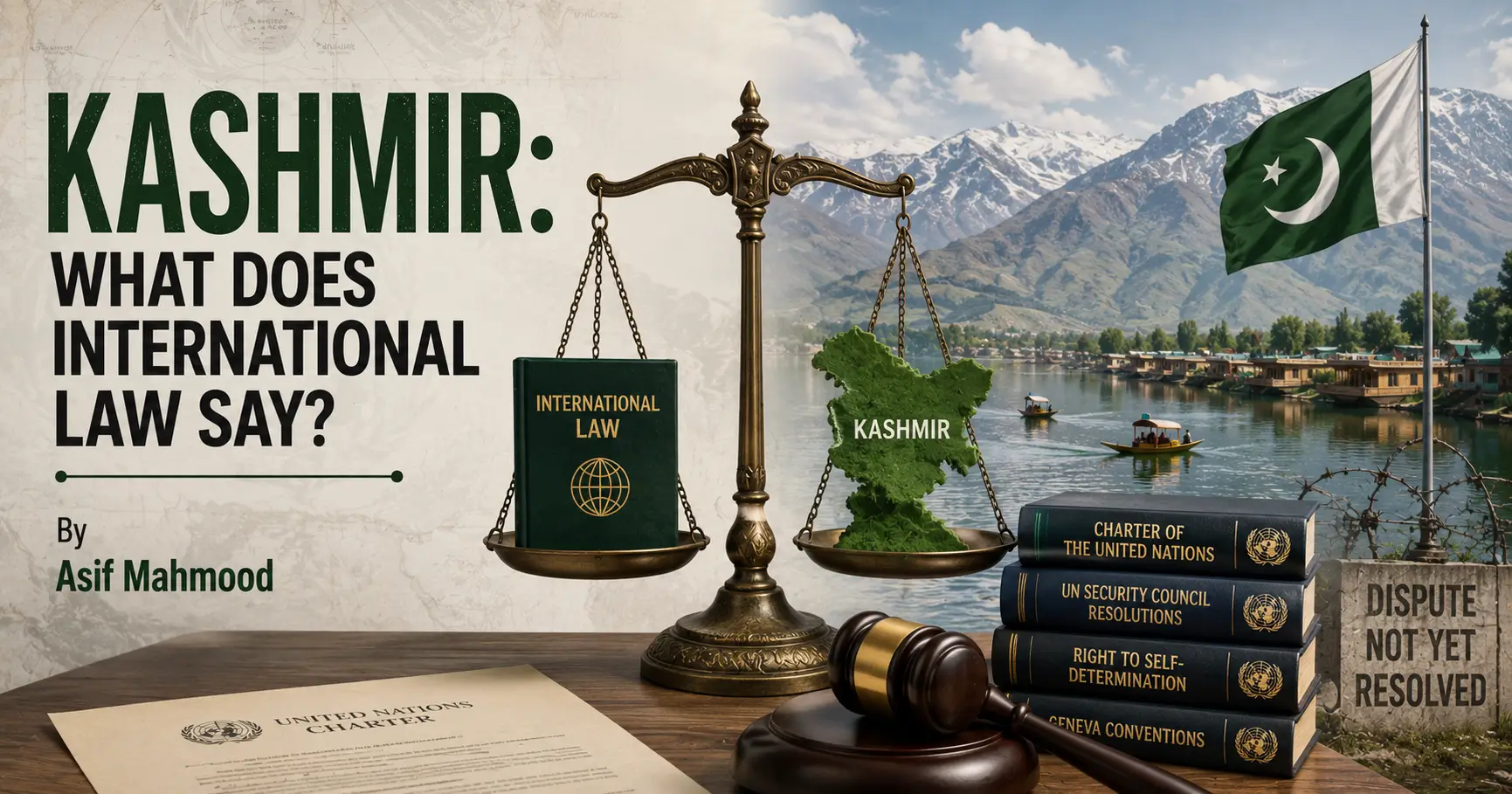
On 5 August 2019, India revoked Article 370 of its Constitution, abolished Kashmir’s special status, and unilaterally declared Kashmir to be an integral part of India. The question, however, is whether this made Kashmir a part of India. Do the resolutions of the United Nations Security Council and the principles enshrined in the UN Charter cease to exist because of sham legislation passed by India?
A few fundamental points must be clearly understood.
Kashmir is a disputed territory. Under international law, its final status remains to be determined. The United Nations has made it unequivocally clear that this determination can only be made through a plebiscite conducted under UN supervision. Neither the local puppet assembly in Kashmir has the authority to decide the matter outside the framework of the UN-mandated plebiscite, nor does India possess such authority. No decision by either, whether constitutional or administrative, can substitute the right of self-determination. Nor do they have any legal authority to determine the future of Kashmir.
India cannot deprive the people of Kashmir of their right to self-determination on the basis of any amendment to its Constitution.
Likewise, India cannot deprive the people of Kashmir of their right to self-determination on the basis of any amendment to its Constitution. India is an occupying power, and the United Nations has never recognised this occupation. India’s Constitution may apply within India, but it does not apply to Kashmir because Kashmir is not a part of India. International law is explicit that an occupying power does not acquire sovereignty over occupied territory. Regardless of how long the occupation continues, it remains nothing more than an occupying power.
This principle was established in the 1928 Pact of Paris. It is also reflected in Article 2 of the United Nations Charter. Article 45 of the Hague Convention reiterates the same principle, and it has been reaffirmed in numerous resolutions of both the UN General Assembly and the Security Council: an occupying power does not become the sovereign of occupied territory.
Another important point is that, in international disputes, India’s Constitution has no standing before international law. International disputes are not resolved under the Constitution of the occupying state; they are resolved in accordance with international law and the established principles of the United Nations. As a member of the international community, India is bound by UN resolutions. The United Nations is not bound by India’s Constitution.
It should also be remembered that Article 370 is not our point of reference. Whether it exists or is abolished is of no consequence to us. It was merely an arrangement between India and its protégé, Sheikh Abdullah. Our point of reference is the UN resolutions and the plebiscite.
The United Nations Security Council settled this principle sixty-eight years ago, on 30 March 1951, and again in November 1956. It declared that no law or decision passed by the Indian Parliament or the Assembly of occupied Kashmir regarding the future of Kashmir would have any legal effect, nor could it extinguish the Kashmiris’ right to self-determination.
If Kashmir was an unresolved international dispute under international law, it was not because of Article 370. The abrogation of that Article does not alter Kashmir’s legal status.
Kashmir’s status is determined by United Nations resolutions. Regarding these resolutions, the Security Council decided in 1996 that they would remain on its agenda unless both Pakistan and India agreed otherwise. An issue that remains governed by UN resolutions and continues to be on the Security Council’s agenda cannot be extinguished through an amendment to the Indian Constitution.
History
Source: https://dailytimes.com.pk/1533574/kashmir-what-does-international-law-say/
Topic starter
Posted : August 5, 2026 12:08 pm