
Notifications
Clear all

New Provinces, Old Fault Lines by Sajjad Ahmed Rustamani
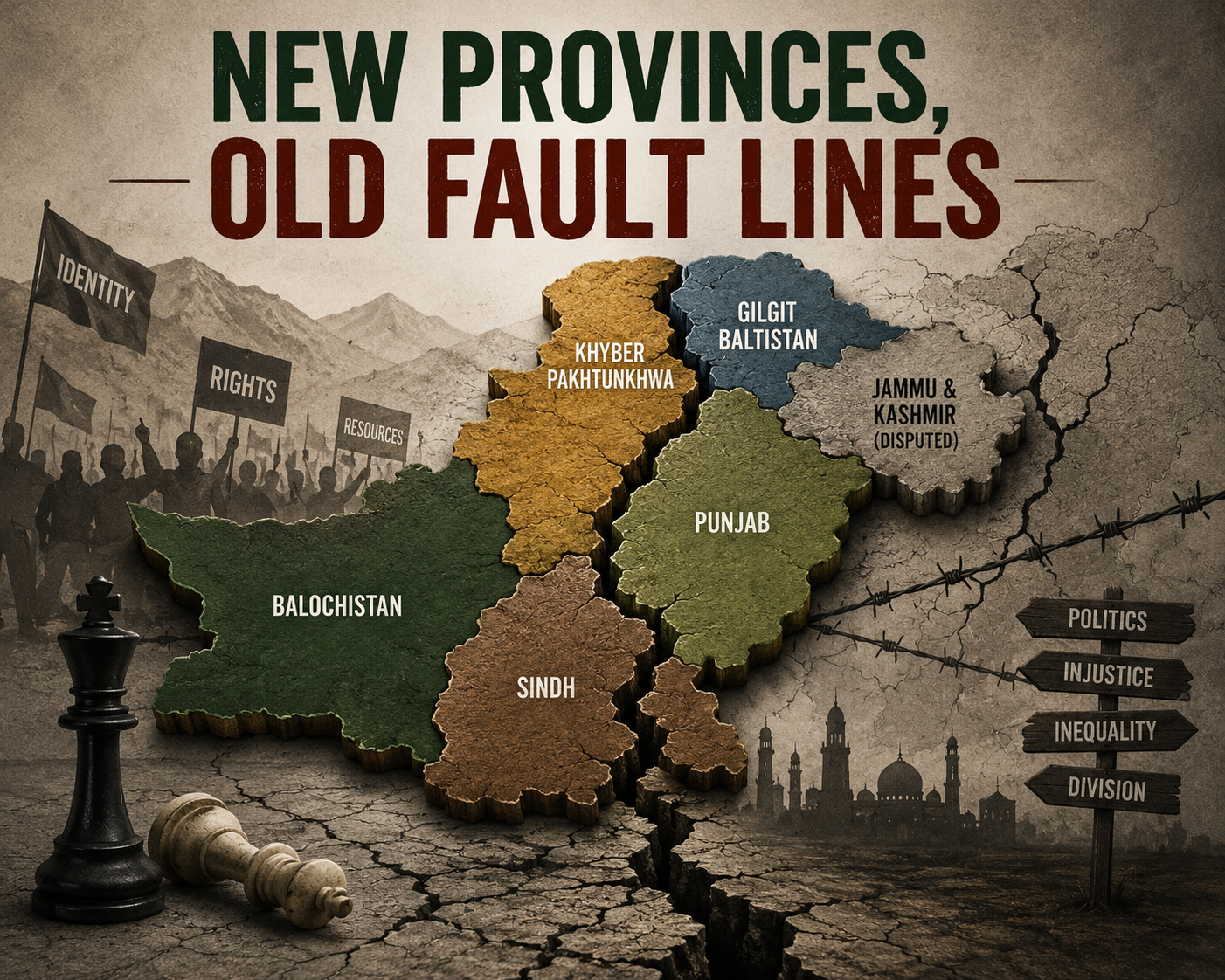
Pakistan’s debate over new provinces has suddenly moved from occasional political rhetoric to the corridors of power. It is reported that serious discussions are underway over creating new administrative units, with a senior government functionary viewing the exercise as a possible precursor to the proposed 28th Constitutional Amendment. More strikingly, proposals under discussion reportedly include bringing Karachi and Gwadar under federal control, dividing Punjab into three units and Khyber Pakhtunkhwa into two.Downloading Interactive Geographic Maps SouthAsians & Diaspora
This is no longer an abstract debate about administrative efficiency. It potentially touches the territorial composition of Pakistan’s federating units, the constitutional balance established after the 18th Amendment, and, in Sindh’s case, a historical question carrying enormous political and emotional significance.
Pakistan unquestionably has a governance problem. Citizens routinely struggle with weak municipal services, distant bureaucracies, uneven development and limited access to decision-making. But acknowledging these failures does not automatically prove that the country has too few provinces. Before Pakistan redraws its map, it must ask a more fundamental question: have we fully used the institutions of decentralisation already provided by the Constitution?
Article 140A requires each province to establish a local-government system and devolve political, administrative and financial responsibility and authority to elected local representatives.Pakistan regional tours
The latest debate can be traced prominently to Interior Minister Mohsin Naqvi’s address to the Pakistan Economic Summit in Islamabad on July 30. Naqvi argued that the existing governance system had “collapsed” and called upon political parties to reach consensus on structural reforms, including new provinces or administrative units. He argued that government and justice should become more accessible to ordinary citizens.
There is merit in the diagnosis that Pakistan needs deeper administrative reform. A citizen living hundreds of kilometres from a provincial capital should not have to navigate layers of bureaucracy for basic services. Nor should political and financial authority remain concentrated at the provincial headquarters while districts and municipalities remain dependent upon them.
Creating additional provinces could theoretically reduce administrative distances and produce new centres of political representation. Supporters argue that Pakistan’s population has grown enormously while its basic provincial structure has remained largely unchanged. MQM-P leaders and former prime minister Shahid Khaqan Abbasi have consequently supported additional administrative units, arguing that smaller units could improve governance and service delivery.Downloading Interactive Geographic Maps
That argument deserves consideration rather than dismissal. Yet it becomes far more complicated when administrative reform begins to involve historic provincial boundaries and proposals to place major cities directly under federal authority.
Karachi cannot be discussed merely as another administrative unit on a bureaucrat’s map. It is Pakistan’s largest city, its premier commercial centre and the capital of Sindh. Any proposal to detach it from Sindh or place it under permanent federal control would therefore go far beyond municipal reform. For Sindh, territory is intertwined with history, language, culture and political identity. Sindh was not artificially assembled as a modern administrative convenience. Its historical identity stretches across centuries. It was Sindh that became the first province of British India whose legislature passed a resolution supporting the creation of Pakistan in 1943. Treating its capital today primarily as an administrative problem risks ignoring this historical relationship.
Sindh Chief Minister Syed Murad Ali Shah has already rejected the idea of new provinces in Sindh. This resistance should not automatically be interpreted as hostility towards administrative reform. There is a crucial distinction between dividing Sindh and decentralising Sindh.
Indeed, Pakistan’s Constitution already provides an instrument capable of taking government closer to citizens without dismantling provinces. Article 140A requires each province to establish a local-government system and devolve political, administrative and financial responsibility and authority to elected local representatives.Pakistan regional tours SouthAsians & Diaspora
If Karachi needs more effective governance, empower its elected local institutions. If Hyderabad, Sukkur, Larkana, Mirpurkhas or other cities and districts require faster decisions, strengthen their municipal and district governments. Give elected local representatives predictable financial resources, administrative authority and genuine responsibility for local services.
The same principle should apply in Punjab, Balochistan and Khyber Pakhtunkhwa. Pakistan should first determine whether its governance crisis comes from the size of provinces or from the concentration of power within them.
Former Senate chairman Raza Rabbani has raised precisely this objection. In his response to the new-provinces debate, he argued that Pakistan’s governance problems are rooted less in the existence of its present federating units than in constitutional violations, excessive centralisation, weakened democratic institutions and inadequate implementation of provincial autonomy. Among his proposed remedies was meaningful devolution to elected local governments under Article 140A.Downloading Interactive Geographic Maps
Pakistan cannot repeatedly centralise authority and then blame the size of provinces when services fail. Nor can provinces retain authority at their capitals, neglect meaningful district-level devolution and then conclude that another layer of provincial governments is necessarily the solution.
The experience of the 18th Constitutional Amendment is also relevant. The amendment represented one of Pakistan’s most consequential attempts to strengthen parliamentary federalism and provincial autonomy. If shortcomings have emerged in the post-devolution system, they deserve serious evaluation. But difficulties in implementing decentralisation should lead to better decentralisation, not automatically to recentralisation.
Pakistan’s history should make policymakers particularly sensitive to questions of federal balance. A federation survives not merely because Islamabad possesses constitutional authority but because its constituent units believe their identities, resources and political rights are secure within the federation. Karachi certainly has serious problems. Transport, water, waste management, infrastructure, policing, housing and uncontrolled urban expansion require institutional reform on a scale matching the city’s importance. But none of these problems proves that Karachi must cease to be constitutionally connected to Sindh.
A powerful metropolitan government, backed by financial autonomy and clearly defined responsibilities, could address many of these problems while keeping Sindh territorially intact. Such an approach would represent decentralisation without fragmentation.
Similarly, rural Sindh requires stronger district institutions. Devolution should not become a Karachi-only argument. A citizen in Tharparkar, Umerkot, Kashmore or Dadu has as much right to accessible government as a resident of Karachi. Genuine decentralisation means taking authority from provincial capitals and distributing it democratically throughout the province.
The same standard should apply nationally. If smaller units are genuinely being proposed solely for better administration, the criteria should be transparent and uniform: population, geography, accessibility, fiscal sustainability, public consent and administrative capacity. Reform cannot appear designed around particular cities, ethnicities or political constituencies.
Nor should Pakistan assume that creating new capitals, assemblies, secretariats, bureaucracies, high-level offices and administrative structures automatically creates good governance. A smaller province governed badly remains badly governed.Pakistan regional tours SouthAsians & Diaspora
The better debate, therefore, is not simply whether Pakistan needs four provinces, eight provinces or many more. It is about where political, fiscal and administrative power should reside.
Naqvi is right to demand a national conversation about a governance system that too often fails ordinary citizens. Pakistan cannot defend institutional arrangements merely because they are familiar. But equally, structural reform must not become a euphemism for weakening federalism or reopening historical territorial questions without overwhelming democratic consent.
SOURCE: https://dailytimes.com.pk/1538952/new-provinces-old-fault-lines/
Topic starter
Posted : August 17, 2026 8:39 am