
Notifications
Clear all

New Provinces: Redrawing the Map or Changing People’s lives? BY Dr Lubna Zaheer
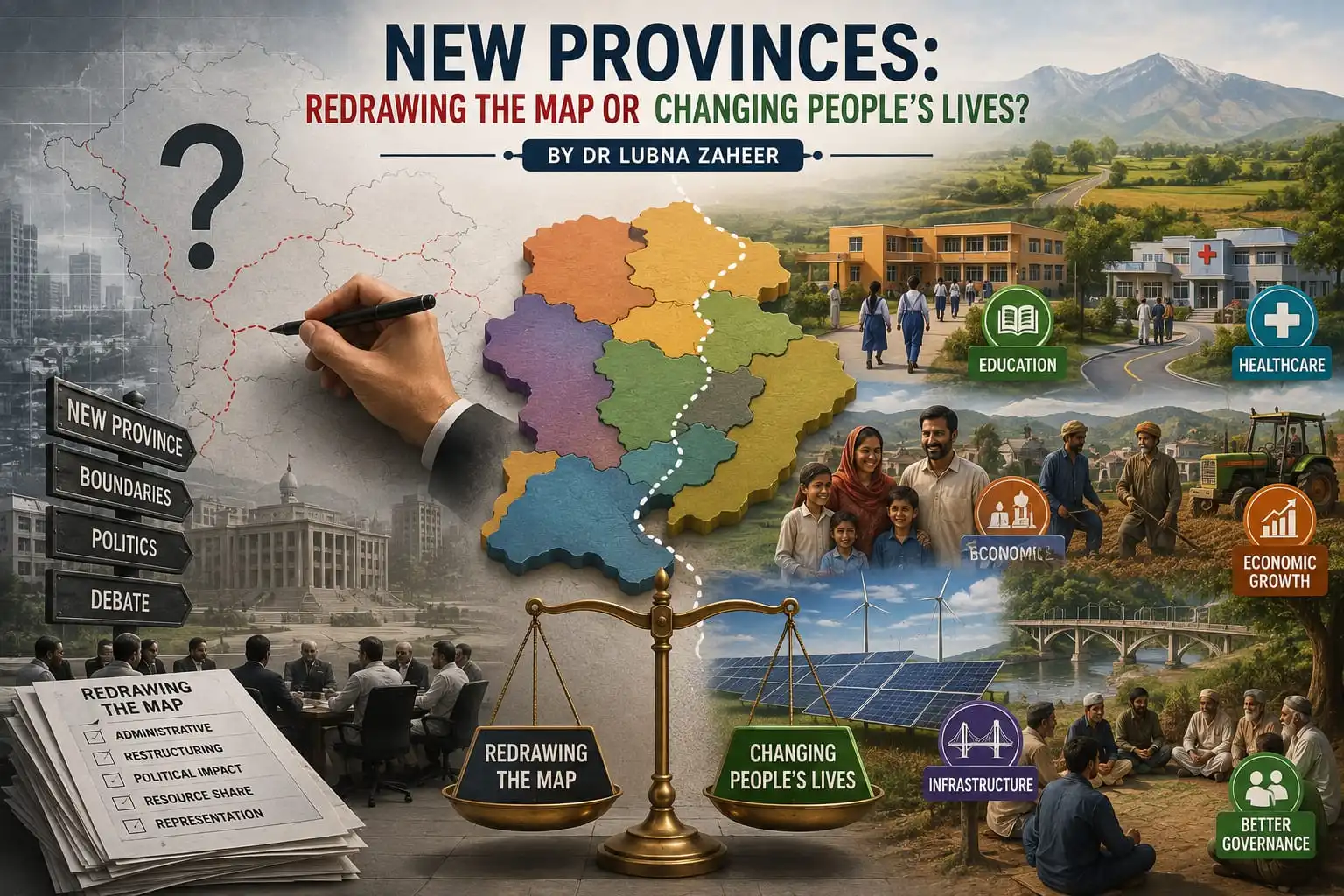
The debate over creating new provinces in Pakistan is not new. Every few years, it resurfaces in national politics. It has once again gained momentum following remarks by Federal Interior Minister Mohsin Naqvi, whose argument, in essence, was that the existing system has collapsed and new provinces have become inevitable.Downloading Interactive Geographic Maps
Under Article 239, changing provincial boundaries requires a constitutional amendment, a two-thirds majority in both houses of Parliament, and approval by at least two-thirds of the relevant provincial assembly. Political and national consensus is therefore essential.
The issue should be considered beyond the personal preferences of individuals, political parties or groups. If the purpose is to weaken political opponents or satisfy political ambitions, there is little justification for creating new provinces. But if the objective is better governance, effective administration and an improved quality of life, new provinces or administrative units deserve serious consideration.
Creating provinces is not simply about drawing lines on a map. Its real purpose should be the fair distribution of power and authority, better political representation and identity, and easier access to government.
Creating provinces is not simply about drawing lines on a map. Its real purpose should be the fair distribution of power and authority, better political representation and identity, and easier access to government. The key question is whether new provinces would actually achieve these objectives.
Pakistan has a population of roughly 240 million. Punjab has around 130 million people and Sindh approximately 60 million. We often hear that Punjab alone has a population larger than many countries. This raises a legitimate question: can one provincial capital effectively monitor and resolve the problems of such a vast population spread across numerous cities and regions?
Experts argue that smaller administrative units make monitoring and decision-making easier. Governments can remain closer to citizens and respond more effectively to local needs. However, population size alone cannot be the solution.
Consider Balochistan, with a population of approximately 15 million. Have all its citizens’ problems been resolved simply because it has a relatively small population? Khyber Pakhtunkhwa has around 40 million people. If population were the main determinant of governance, its people should face fewer problems than those in Punjab or Sindh. Yet this is clearly not the case.
The real solution lies in good governance. Those in power must use public resources efficiently and ensure that government funds are spent on public welfare rather than unnecessary expenditure. What guarantee is there that new provinces would automatically produce better governance? Who would ensure that political families or a particular segment of the bureaucracy would not simply become the new beneficiaries of power?
The experience of devolution also deserves consideration. Following the 18th Constitutional Amendment in 2010, substantial powers were transferred from the federal government to the provinces. The 7th NFC Award also increased the provinces’ share in the divisible pool of revenues. Yet the desired improvement in people’s lives has not materialised.
A World Bank report issued a few months ago noted that, even after the 18th Amendment, a significant portion of the resources transferred to provinces had not been effectively translated into improved public services. A major share of provincial expenditure went towards recurrent expenses, while local government budgets gradually declined.
This raises a fundamental question: if transferring authority and resources to existing provinces has not sufficiently improved public welfare, what guarantee is there that creating additional provinces will solve people’s problems?
Our real problem is the distribution of power and resources, particularly at the grassroots level. Article 140-A requires every province to establish a local government system and devolve political, administrative and financial authority to elected local representatives so that public problems can be addressed locally.
Unfortunately, everyone wants power, but few are willing to devolve it. This is why almost all political parties and governments have remained reluctant to hold effective local government elections and empower elected representatives.
There is also a major financial dimension. Every new province would require a chief minister, governor, ministers, chief secretary, departmental secretaries, an assembly, Chief Minister’s Secretariat, courts, police and numerous other departments. Who will bear these additional costs?
Pakistan is currently facing a fragile economic situation and is heavily burdened by debt. Who will shoulder the enormous cost of maintaining additional political and bureaucratic structures? We may end up creating new centres of power while continuing to complain about extravagant spending by politicians and bureaucrats.Downloading Interactive Geographic Maps
Just take the example of our public universities. Several colleges and campuses upgraded to university status, along with existing public universities, face serious financial crises. Yet reports periodically emerge of substantial spending on the personal facilities and luxuries of university heads and senior officials while institutions struggle to pay teachers and employees. What guarantee is there that newly created provinces would not follow the same pattern?
Perhaps the better option is to create smaller administrative units where necessary, while improving governance and institutional performance. Governments should control expenditure, strengthen local governments, devolve authority to the grassroots and ensure that public resources are used for public welfare.
The creation of new provinces should neither be rejected because it is politically difficult nor embraced merely because it sounds administratively attractive. It should be judged by one criterion: will it genuinely improve the lives of ordinary citizens?
If the answer is yes, it should be pursued through constitutional and political consensus. But if new provinces merely create more offices, political positions, bureaucratic structures and expenditure without improving governance, we would simply be redrawing the map without solving the problems.
Pakistan needs better governance, stronger local governments, responsible use of resources and effective public services. Once the basic problems of the people are addressed, other institutional debates can follow.
For now, the country can ill afford another expensive experiment. Before drawing new lines on the map, we must ensure that the existing lines of authority, responsibility and accountability actually work.
The writer is a Professor of Media and Communication Studies and a broadcast media expert. She currently serves as Chairperson of the Department of Film and Broadcasting at Punjab University.
SOURCE: https://dailytimes.com.pk/1541356/new-provinces-redrawing-the-map-or-changing-peoples-lives/
Topic starter
Posted : August 21, 2026 1:07 pm