
Notifications
Clear all

Pakistan at 79: From Political Cycles to National Direction BY Leila Khan
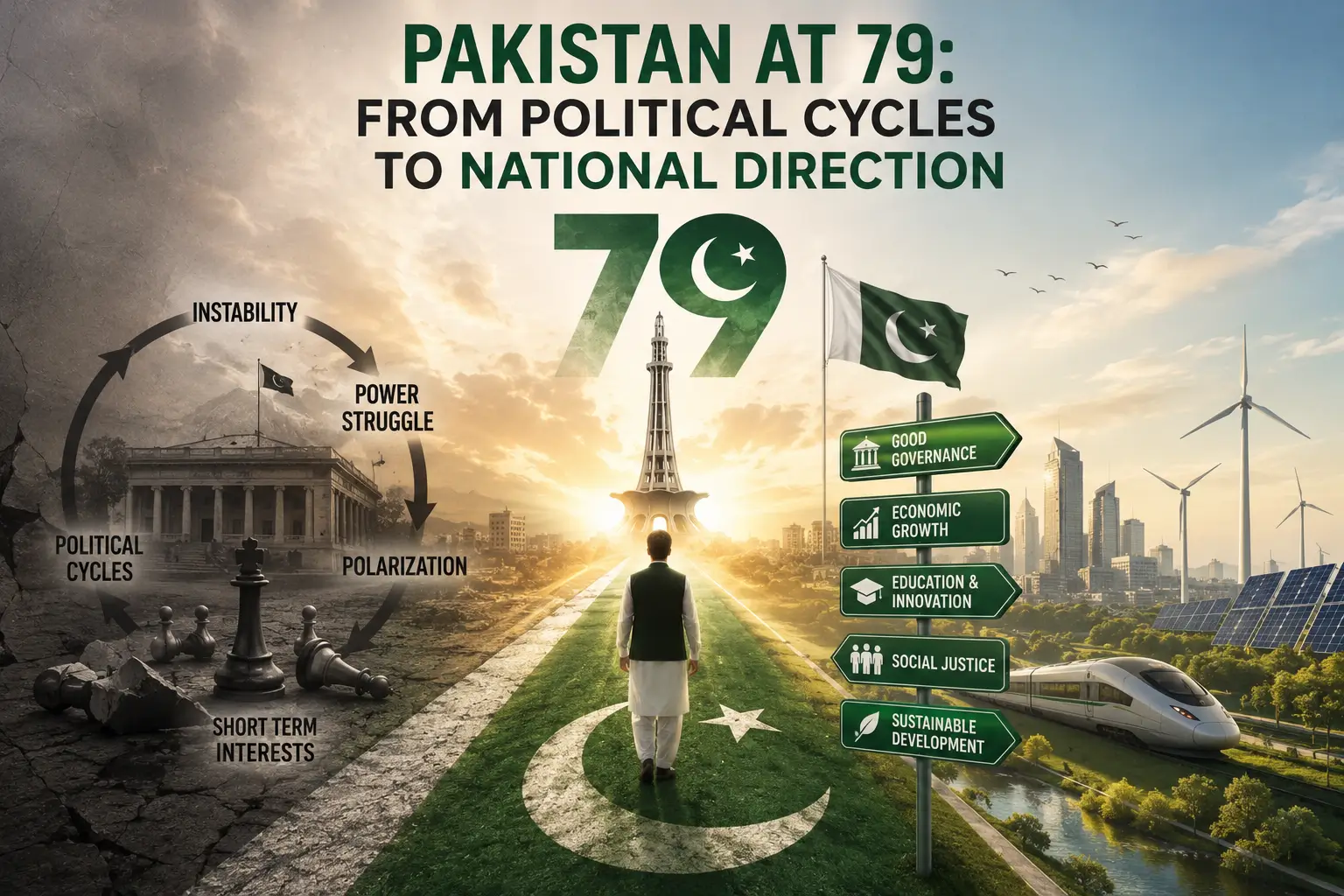
Every year on August 14, Pakistan turns into a sea of green and white. Flags wave from rooftops, children carry miniature flags, patriotic songs fill the air, and social media overflows with messages of pride. It is a day of celebration.
But it should also be a day for reflection.
Seventy-nine years after independence, one of the most important questions we should ask ourselves is not how far Pakistan has travelled, but why, after travelling for so long, we so often find ourselves back at the starting point.
Governments should have every right to improve policies that are failing, but political change should not automatically mean institutional reset.
Pakistan has never suffered from a shortage of plans. We have had economic strategies, education policies, health reforms, infrastructure programmes, investment initiatives, and ambitious development targets. Governments have announced reforms, established committees and presented visions for transformation.
Our failure has been in sustaining them.
Too much of our policymaking has been tied to political tenures rather than national timelines. Priorities shift, programmes lose momentum, and institutions are repeatedly redirected. Instead of improving what already exists, there is often a temptation to replace it. The result is a state that frequently loses institutional memory precisely when it should be building upon it.
Yet the greatest challenges facing Pakistan cannot be solved within the tenure of any single government.
Education reform requires a generation. Population management demands decades of consistency. Tax reform, industrialisation, water security, agricultural productivity, judicial reform, and administrative restructuring all require sustained implementation. These are national projects, not political projects, and their success depends upon continuity.
Successful countries understand the distinction between a change of government and a change in national direction. Political leadership will naturally bring different ideas and priorities, but the fundamental objectives of the state must remain larger than whichever party happens to be in power.Pakistan’s current experience also proves what focused and result-oriented leadership can achieve.
Our armed forces continue to make extraordinary sacrifices in defending the country against terrorism and external threats. The present leadership offers an important contrast. Its focus on national security, strengthening Pakistan’s strategic relationships and supporting the country’s diplomatic and economic engagement abroad has produced visible results during a period of considerable regional and global uncertainty.
This is not an argument for the military to assume the responsibilities of civilian government. In fact, it is precisely the opposite.
The lesson is that when leadership remains focused on its responsibilities, sets clear objectives and pursues measurable outcomes, institutions can deliver. Security and strategic stability can create the space for national progress, but they cannot substitute for effective civilian governance.
Economic growth, education, healthcare, policing, justice, municipal services and public administration remain the responsibility of governments. The question is why the same urgency, clarity of purpose and focus on results have been so difficult to establish across civilian governance.
Pakistan does not need one institution to carry the responsibilities of the entire state. It needs every institution to perform its own role effectively.Pakistan travel guides
Imagine if education policy were designed for twenty years rather than one political tenure. Imagine if population control, exports, taxation, water security and local government were treated as permanent national priorities with measurable targets that successive governments were expected to pursue.
A new government could change the method without abandoning the destination.
That single principle could fundamentally alter how Pakistan is governed.
Policy uncertainty carries an enormous economic cost. Businesses cannot plan confidently when regulations, taxation and economic priorities remain unpredictable. Investors hesitate when long-term commitments can be reconsidered after a political transition. Bureaucracies become cautious when officials know that today’s priority may become tomorrow’s abandoned file.
Ultimately, citizens pay the highest price.
They experience the consequences through inconsistent public services, weak local governments, an inefficient bureaucracy and reforms in education, healthcare, policing and justice that rarely survive long enough to transform everyday life.
Pakistan’s governance problem, therefore, cannot be reduced to the failure of one government, one political party or one period in our history. It is the failure to construct a system capable of preserving progress regardless of who governs.
Pakistan needs long-term national frameworks for its most important challenges, supported by measurable targets and institutions capable of carrying them forward. Governments should have every right to improve policies that are failing, but political change should not automatically mean institutional reset.
Accountability must also change.
Instead of judging governments by how many programmes they announce, we should judge them by national outcomes. Did literacy improve? Did the tax base expand? Did exports increase? Did population growth slow? Did public institutions become more efficient? Did local governments become stronger? Did ordinary Pakistanis receive better services?
Governments should compete over who can deliver these outcomes better, not over who can announce the newest initiative.
Pakistan has demonstrated extraordinary resilience over the past 79 years. We have survived wars, terrorism, political upheaval and repeated economic crises. Our people have succeeded across the world, and our institutions have repeatedly demonstrated what Pakistan is capable of when there is clarity of purpose, professionalism and continuity.
As we raise our flags this Independence Day, perhaps patriotism should mean more than celebrating how Pakistan was created. It should also mean reflecting on what kind of state we have built since.
The generation of 1947 gave us a country.
Our responsibility is to build institutions strong enough that Pakistan does not have to begin every few years again.Pakistan travel guides
Independence gave us the freedom to govern ourselves.
Seventy-nine years later, the real measure of that independence is how well we have learned to do it.
The writer is a former State Minister for Education and Professional Training, former Member of the National Assembly of Pakistan, Chairperson of the Prime Minister’s Youth Programme and Director at Media Times.
SOURCE: https://dailytimes.com.pk/1537774/pakistan-at-79-from-political-cycles-to-national-direction/
Topic starter
Posted : August 13, 2026 11:25 am