
Notifications
Clear all

Pakistan’s Credibility Crisis: From CPEC Delays to Rule of Law
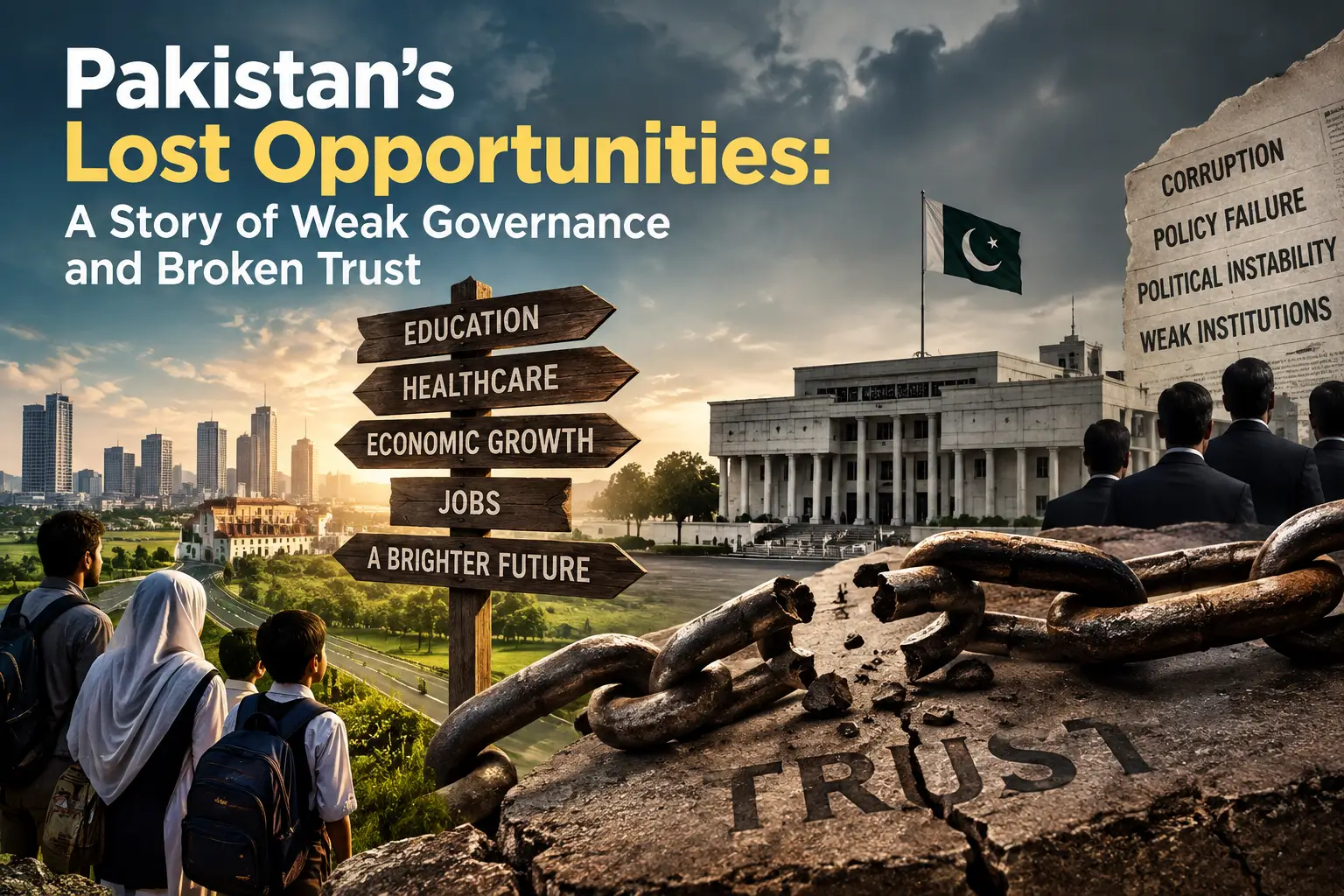
Pakistan’s Credibility Crisis: From CPEC Delays to Rule of Law Four events recently point out clearly that if not for the rulers who are mainly concerned with their own benefits and have no set rules they follow, then a government department that is rent-seeking and outdated can be a problem to the country. Each carries out decisions based upon a very similar way of thinking that keeps on ruining very precious opportunities without making much progress towards anything that really changes the situation. At the same time, these events clearly point out the problems there have been, in fact, there is a great inconsistency between what is said and done, between what is claimed and actually done, as well as what is preached and practiced. There is really no other possibility that the country is going through a serious crisis of credibility and authenticity. Every postponing of a crucial step, every violation of moral or constitutional standards, and every failure to abide by the Supreme Court's order increases and intensifies that crises.
First is that choosing the leader of Azad Kashmir through a technocrat seat clearly does not care for the wishes of the people. Even though the voters did not like Iftikhar Gillani in the last election, Nawaz Sharif still chose to go against the wishes of a close associate of his, Shah Ghulam Qadir. In doing so, the Prime Minister undermined the principle to ‘honor the vote,’ a slogan of his that has been repeated many times. Do you really see a reason why those same voters, who got nothing from the February 2024 election, would put any trust in the politician or in the political system itself?
Secondly, the Central Development Working Party (CDWP), through its report dated August 30, suggested a downward revision of the Balochistan government's requested Rs29 billion to Rs23.82 billion, which would be around 20 percent less, for the "Construction of Water Supply Scheme to Gwadar Town from Mirani Dam under Balochistan Socio-Economic Development Projects Phase-III". Ahsan Iqbal, the Planning Minister, requested the provincial administration to do a study on waste water treatment in Gadar, saying that it is important for the city not to turn out like Karachi where untreated sewage water contaminates the sea.
The Forum asked the ECNEC to take up the matter only after a satisfactory solution or resolution was provided for the issues. Among the major outstanding issues raised were demand forecasting, verification of water sources, land acquisition status, procurement planning, a financially-viable operation and maintenance (O&M) plan, a credible project execution schedule, a clear picture of the hydrologic characteristics, and verification of hydrologic studies.
This is just amazing, isn’t it? More than eleven years have already gone by from when the first CPEC agreements were signed with Gwadar playing the centerpiece of the venture.
In another meeting, Ahsan Iqbal too chaired on August 28, the minister turned down the development plan proposal of Frontier Works Organisation (FWO) for the 460km Rohri-Multan ML-1 stretch and asked them to submit alternative options for the section as he saw there were no other feasible options. They also pointed out that the estimates did not properly account the locomotives, coaches and operating expenses.
Is it not very ironic to find out that a minister who has always talked about CPEC, especially its Gwadar and ML-1 parts, being the change-making project par excellence, is now seeking alternative funding? Besides, that he deserves recognition as well because on two grounds: 1) rejecting FWO for the Rohri-Multan section as its proposal contained lots of weaknesses; and ii) ordering an independent audit of own cost estimates of the organization.
The planners have just revealed an alarming situation: they haven't yet completed the ML-1 proposal, let alone have they figured out alternative funding. Besides, their dedication to the ML-1 project isn't clear-cut either; according to accounts, the relevant federal ministries were only attended by junior officers. Surely, that is not how you present a team to carry out a very big project?
A very disheartening scenario is at hand. Up until the day the world began to realize, through the news channels, about the spread of a strange disease in Wuhan, the Chinese leaders were more than willing to invest in China Pakistan Economic Corridor projects and were ready to finance everything including ML-1 at the expense of their own economy which is the Chinese economy after all.
An elderly Chinese official from the party was kind enough to give me his opinions on whether or not China might finance ML-1.
"Little brother, 7-8 billion dollars is just a small number to the Chinese government but you need to make sure your people come to China with real plans on ML-1 because we, too, have been putting all our efforts into this and we expect other partners to do the same", he said. Pakistan’s Credibility Crisis: From CPEC Delays to Rule of Law
We are now facing the reality that not only is the funding for ML-1 from Beijing no longer forthcoming, it is a fact that Beijing is pulling back and may not finance any other CPEC project for that matter. The government is now searching for other ways to finance the development shortfall.
In spite of China's goodwill, Pakistan's bureaucratic machine—probably including the officials who have a conflict of interest with their western counterparts—and the ones who are strongly against an increased flow of Chinese capital and influence into Pakistan—has failed to exploit this opportunity. Because of all this, the idea of ML-1 is, quite literally if not at least in terms of Chinese financing, a dead horse to the authorities of Pakistan.
In a way, China pulling out could even turn out to be a good thing for ML-1. Why so?
As a matter of fact, the officials of various levels from different sectors of the Pakistani government have already done their bit through a number of activities to discourage the Chinese from their investments at the power sector level that is, for instance, an increase in circular debt, and delayed repayments of loans by the authorities as well as creating obstacles, among other things, in repatriation of profits. This clearly indicates a very strong anti-foreign investment stance of Pakistani government and the officials involved.
A major source of worry, nevertheless, is the rule of law. Both locals and foreign observers find themselves at a loss to explain how the country's leadership constantly turns a blind eye to superior courts' rulings. On the one hand and after a lengthy period of time of inactivity, the decision of the Islamabad High Court (IHC) of 2022 on the navy farms and sailing club issues was again taken back at a much later date, that is September 2, 2023, giving another sign to the fact that the higher judiciary's special favors go mainly to those deeply rooted elites. On the other hand, and with greater frequency in the most recent cases, the directives of the Supreme Court and IHC relating to former Prime Minister Imran Khan have also been ignored again several times.
When the highest authorities themselves show complete contempt for the law, public confidence inevitably suffers and foreign investors become hesitant. For the latter group at least, an understanding or knowledge that even companies of a "long-standing good friend" like China encounter major administrative and legal obstacles in this country naturally raises a very sensitive question: How come it is so easily possible not only to ignore judicial decisions but also to get away with it when one is involved in a case with foreign investors and a judicial system that is expected to operate independently but is not being allowed so in reality? Pakistan’s Credibility Crisis: From CPEC Delays to Rule of Law
Topic starter
Posted : September 6, 2026 1:57 pm