
Notifications
Clear all

Resetting the system BY Ishrat Husain
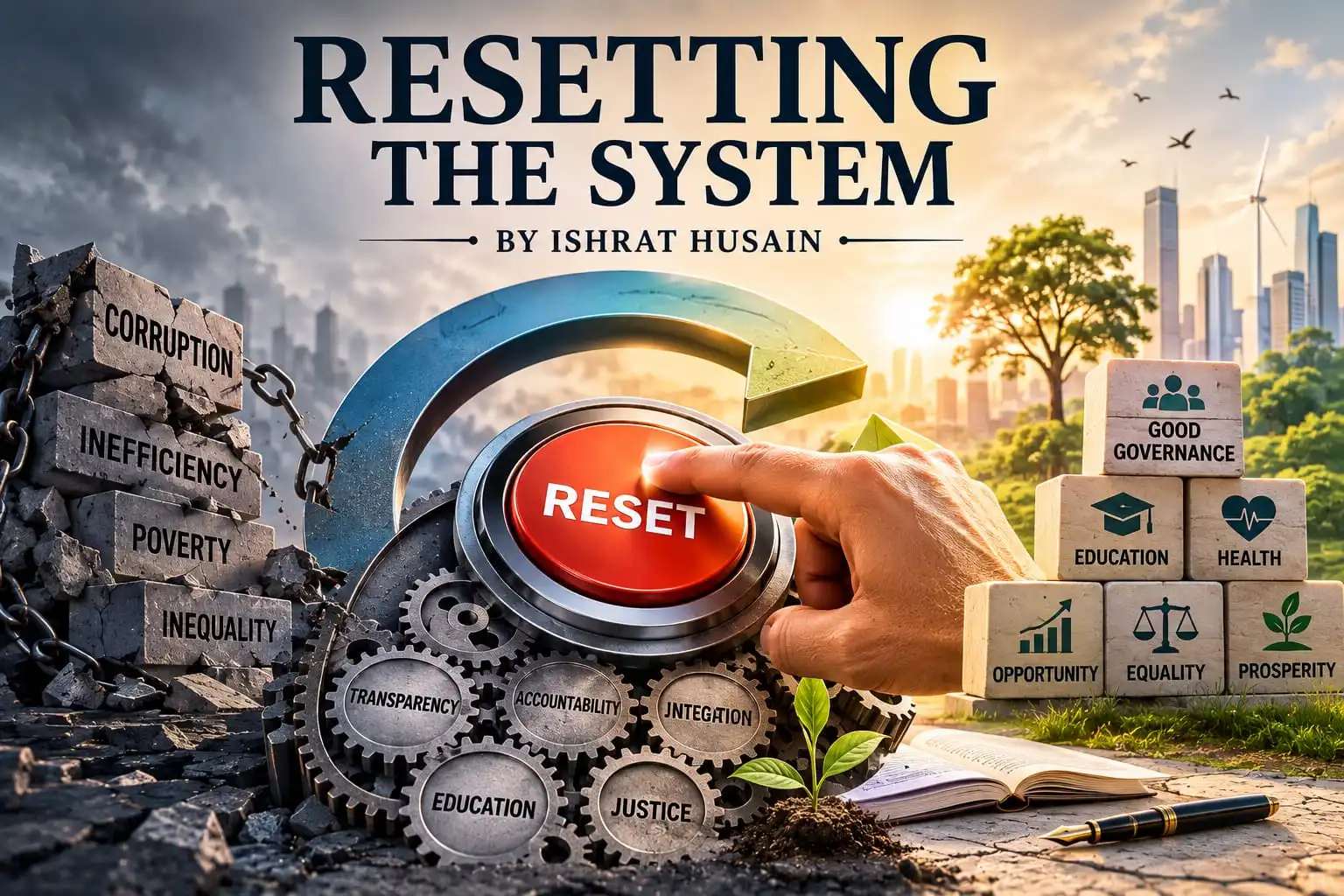
INTERIOR Minister Mohsin Naqvi has rightly diagnosed Pakistan’s poor performance. But will his prescription — the creation of 12 or 32 provinces and administrative units — take us towards inclusive and sustained economic growth? If the present system is to be reset, this should be the end goal against which any proposed restructuring must be judged.
Two pillars need strengthening. The first is the delivery of basic services — education, healthcare, drinking water, garbage disposal, public transport, etc. — at the grassroots level. Citizens must have easy access to their elected representatives. The second is to unleash the private sector’s entrepreneurial energies by replacing intrusive, remotely located and unaccountable bureaucratic agencies with local, facilitative institutions. Businesses must be enabled to produce exportable goods and services, create economic opportunities for the youth and raise living standards. It is against these two criteria that the proposal for new provinces should be evaluated.
First, the proposal could disrupt the process of fiscal consolidation. Pakistan is making progress on this front, with a remarkably low fiscal deficit and a surplus on the primary balance. Medium-term tax reforms are also being contemplated: rationalising tariffs, abolishing the super tax, easing the burden on salaried taxpayers, providing relief to exporters and expediting refunds, reducing GST on selected items used by the poor, improving collection of agricultural income tax, urban property tax and GST on professional services, and harmonising federal and provincial tax filing. These reforms could lose momentum if political and administrative energies are diverted to territorial reorganisation. Our history shows that just when things begin moving in the right direction, we take one step forward and two steps backwards, returning to square one.
Second, new provinces would impose additional fiscal costs. It was commendable that the provinces agreed to support the federal government for three years through grants under Article 164 of the Constitution and exceeded their surplus targets. It is difficult to see how this arrangement will continue if numerous new provinces are created. Each would require headquarters, legislatures, administrative departments, buildings, etc. Even if incremental, the provinces would have less room to transfer resources to the centre, which would resort to heavy borrowing from banks, precisely when banks are beginning to expand lending to SMEs, agriculture and low-cost housing. This would be a setback to advancing inclusive growth.
At this critical juncture, Pakistan should avoid experiments in political and economic fragmentation.
Third, the National Finance Commission process would be further complicated. The NFC Award has already proved so contentious that a new award has not been agreed on since 2010, despite Article 160(1). Increasing the number and diversity of provinces would make consensus more difficult. Less-developed provinces would demand criteria to increase their share, while better-off ones would want to preserve existing allocations. Prolonged negotiations could further delay resource allocation.
Fourth, administrative restructuring would absorb enormous political and bureaucratic attention. New provinces would initially be busy setting up headquarters, bureaucratic structures and legislatures, dividing assets and liabilities and making their administrations functional. Attention would be diverted from development, service delivery and reforms. Having been associated with the reorganisation of One Unit into four provinces, I can attest that the pre- and post-dissolution processes took several years before routine administration could function normally. Imagine repeating the exercise for 12 or 32 provinces. Disputes over assets could reach the higher courts, while the CCI could spend months resolving inter-provincial disputes. The aim of improving public services could therefore be compromised.
Fifth, coordination problems would multiply. We’ve already faced serious difficulties in coordinating policies in food and agriculture, education, health, climate change and population planning since the 18th Amendment. Previous decisions made by the federation in these areas are no longer binding on the provinces. Hence, implementation has been uneven, even ignored. The wheat support price controversy is an example of coordination failure. More provinces would mean more governments, more divergent interests and more difficult coordination.
Finally, the constitutional and political process shouldn’t be underestimated. The Constitution has a clear procedure for creating new provinces. Indications are that this process would be difficult, particularly when some provincial assemblies have already expressed opposition. Much political capital would have to be spent building consensus among provinces and political parties. The political leadership could become absorbed in this exercise at the expense of monitoring economic revival.
Against this backdrop, the balance of risks weighs heavily against creating a large number of new provinces. Is there a better alternative to achieve the same goals without disrupting the momentum towards economic stability? There is:
A fully empowered, adequately resourced and directly elected local government system offers a tested alternative. Pakistan had such a system in the early and mid-2000s; citizen satisfaction reached 58 per cent, a level not achieved before or since. The system had weaknesses, but these can be corrected. Alongside this, the Police Order provided greater accountability of the police. Devolving political, administrative and financial authority to LGs would bring decision-making closer to the people without creating a new layer of provincial governments. LGs could provide land, utilities, infrastructure and other facilities required by businesses, reducing the cost of doing business. Regulatory reform could be targeted more effectively at the local level to help create jobs and stimulate private investment and exports.
Encouragingly, recent discussions among political parties show support for greater devolution from provinces to LGs. This pathway offers many advantages: continuity in economic policies, preservation of fiscal consolidation, savings in unproductive administrative expenditure, progress towards a new NFC Award, better service delivery and a stronger stimulus to private enterprise.
We’ve already paid a price for interruptions in economic and political continuity, including the dismissal of a government in 2017 and a no-confidence vote in 2022. Had reforms been allowed to continue uninterrupted, the economic situation might have been different. At this critical juncture, Pakistan should avoid experiments in political and economic fragmentation. The priority should be to complete ongoing reforms and strengthen LGs, making them accountable to citizens.
As an editorial in Dawn observed, “Changing boundaries without reforming the underlying political and institutional culture will only lead to governance failures.” The real reset needed is not a redrawing of boundaries but a transformation of governance — bringing government closer to citizens, enabling the private sector and ensuring continuity in economic reforms.
The writer was deputy secretary of the One Unit Reorganisation Committee.
SOURCE: https://www.dawn.com/news/2024064/resetting-the-system
Topic starter
Posted : August 20, 2026 11:00 am