
Notifications
Clear all

Smart Learning, Lower Costs: Can Ai Replace Expensive Tuitions in Pakistan? BY Dr Muhammad Nouman Atif
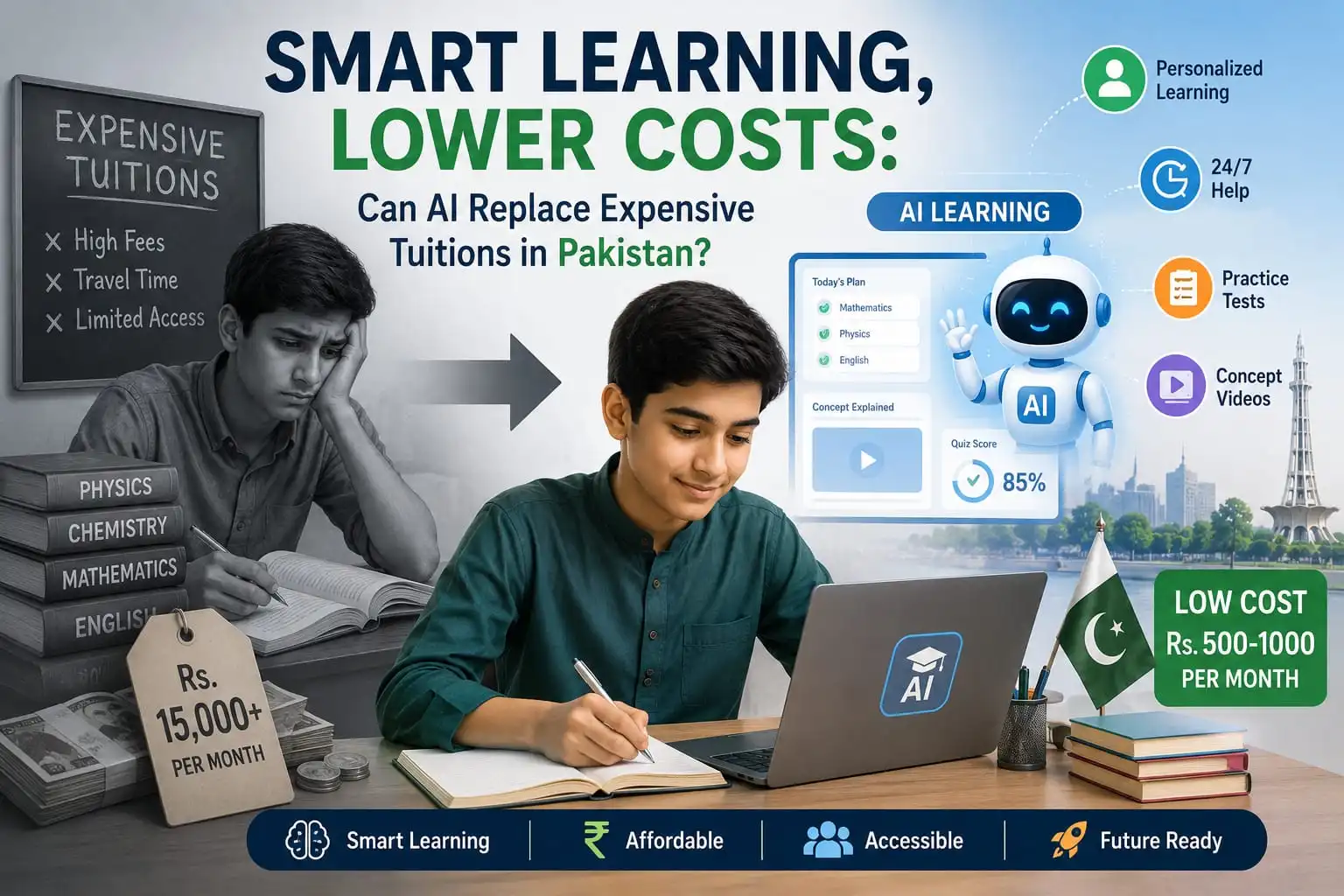
Do the maths on an average Pakistani household with three school-going children, and the numbers stop being abstract fast. Home tuition and coaching classes in Pakistan typically run between Rs 5,000 and Rs 15,000 a month per child, depending on the subject, grade level and city, according to tutor rate data compiled by tuition platforms. For three children, that is commonly Rs 15,000 to Rs 45,000 a month, on top of school fees, books, and transport. Against an average household income of roughly Rs 82,000 a month, reported by the Pakistan Bureau of Statistics for 2025, coaching alone can eat up a fifth to more than half of what a family brings home. That single calculation is why a quiet, largely unplanned shift deserves attention: parents and students turning to free AI chatbots such as ChatGPT, Gemini, Claude and DeepSeek to do at home, for free, what coaching centres charge thousands of rupees a month to do.
What Holds Pakistani Students Back?
Pakistan’s average household income has doubled in nominal terms since 2019, from about Rs 41,545 to Rs 82,000 a month, but inflation has eaten most of that gain; economists estimate that today’s average salary buys roughly what Rs 55,000 could a few years ago. The minimum wage, meanwhile, was set at just Rs 37,000 a month in July 2024, less than half the national average. For families near that line, a coaching bill of even Rs 15,000 a month is not a small household expense. As families struggle to meet essential expense such as food, housing, transport and utilities, spending on private tuition often becomes a difficult financial decision rather than an educational choice. This affordability challenge is consistent with PIDE’s 2026 article on minimum wages and household welfare, which argues that rising living costs have significantly eroded the purchasing power of low and middle income households. This is not a niche problem. Pakistan’s 2023 digital census put the population at 241.49 million, making it the fifth most populous country in the world, behind only China, India, the United States and Indonesia. More than 40 percent of that population is under 15. That is tens of millions of school-going children whose families are, right now, weighing the same coaching-fee arithmetic every month.
Climate Warning
Here is the part of the story that rarely gets told: Pakistani parents may already be sitting on the solution, in their pockets. A 2023 State of Apps report, compiled by Data Darbar in partnership with the streaming platform Begin, ranked Pakistan 10th in the world for hours spent on mobile devices, with users logging a combined 99 billion hours on smartphones that year. Spread across the country’s roughly 124 million broadband subscribers at the time, that works out to a little over two hours a day, per person, on average. Two hours is not spare time that has to be found from nowhere. It is time that is already being spent, mostly on scrolling and social media. Redirecting even fifteen or twenty minutes of it, an evening spent going through a maths problem or an English paragraph with a child using an AI app instead of a group chat, costs a family nothing it was not already spending. That reframes the choice: this is not asking parents to buy a new tool or clear a new block of time. It is asking them to point time they already spend on their phones in a different direction.
Political Optics
Parents elsewhere have already started doing exactly this. A Pew Research Center survey found that 26 percent of American teenagers aged 13 to 17 used ChatGPT for schoolwork in 2024, roughly double the 13 percent recorded just a year earlier. In India, the Bharat Survey for EdTech 2025 found that among students already using education apps, about 35 percent had turned to generative AI tools for learning, and nearly 70 percent of those students were using them daily. Pakistan is not being asked to pioneer something untested. It is late to a habit that has already taken hold in comparable, education-cost-conscious households elsewhere.
The Sea Is on Fire
Most households in Pakistan now have a smartphone in reach, and the tools themselves are free or nearly free. What holds many parents back is not cost but confidence: uncertainty about how to phrase a question, or the assumption that these tools are built for professionals and researchers rather than a Class 6 student stuck on fractions. That barrier is smaller than it looks. These tools are built to understand plain, everyday language, in Urdu or English, typed or spoken, and reward curiosity more than technical skill.
This also opens a door for mothers who manage the household’s academic load without themselves having advanced English or technical training. With a small amount of exposure, a parent can sit with a child, ask an AI tool to explain a concept a second or third way, and follow along without needing to coordinate a tutor’s schedule or pay a fee voucher every month.
Past in Perspective
AI is not a perfect substitute for teachers or parents. Like any digital tool, it can occasionally generate inaccurate or misleading information, making parental supervision essential, particularly for younger students. Parents are encouraged to verify important importation with textbooks rather than accepting every AI generated response at face value, as per UNESCO (Global Education Monitoring (GEM) report published in 2023. In International Telecommunication Union report, 2024, it is observed that smartphone ownership and internet access have expanded rapidly in Pakistan, unequal digital access remains a challenge for many low-income and rural households. Improving affordable internet connectivity and digital literacy will therefore be important if AI assisted learning is to benefit all students rather than widening existing educational inequalities.
None of this argues for shutting down coaching centres or replacing teachers, and it should not be read that way. Structured classroom instruction, and a good tutor’s judgement about where a specific child is struggling, still matters. What AI tools offer is a free, always-available layer underneath that structure, one that can absorb the routine, repetitive parts of after-school learning that currently come with a monthly bill attached. At a time when inflation has outpaced wage growth for years running, and a coaching bill for three children can rival a month’s rent, treating this as only a technology story misses the point. It is a household budgeting story. The tools are already free. The time is already being spent on the phone. The only thing missing is the habit of pointing both at a child’s homework instead of a feed.
Topic starter
Posted : August 20, 2026 10:44 am