
Notifications
Clear all

The Age of Invisible Warfare BY Zaid Bin Inam
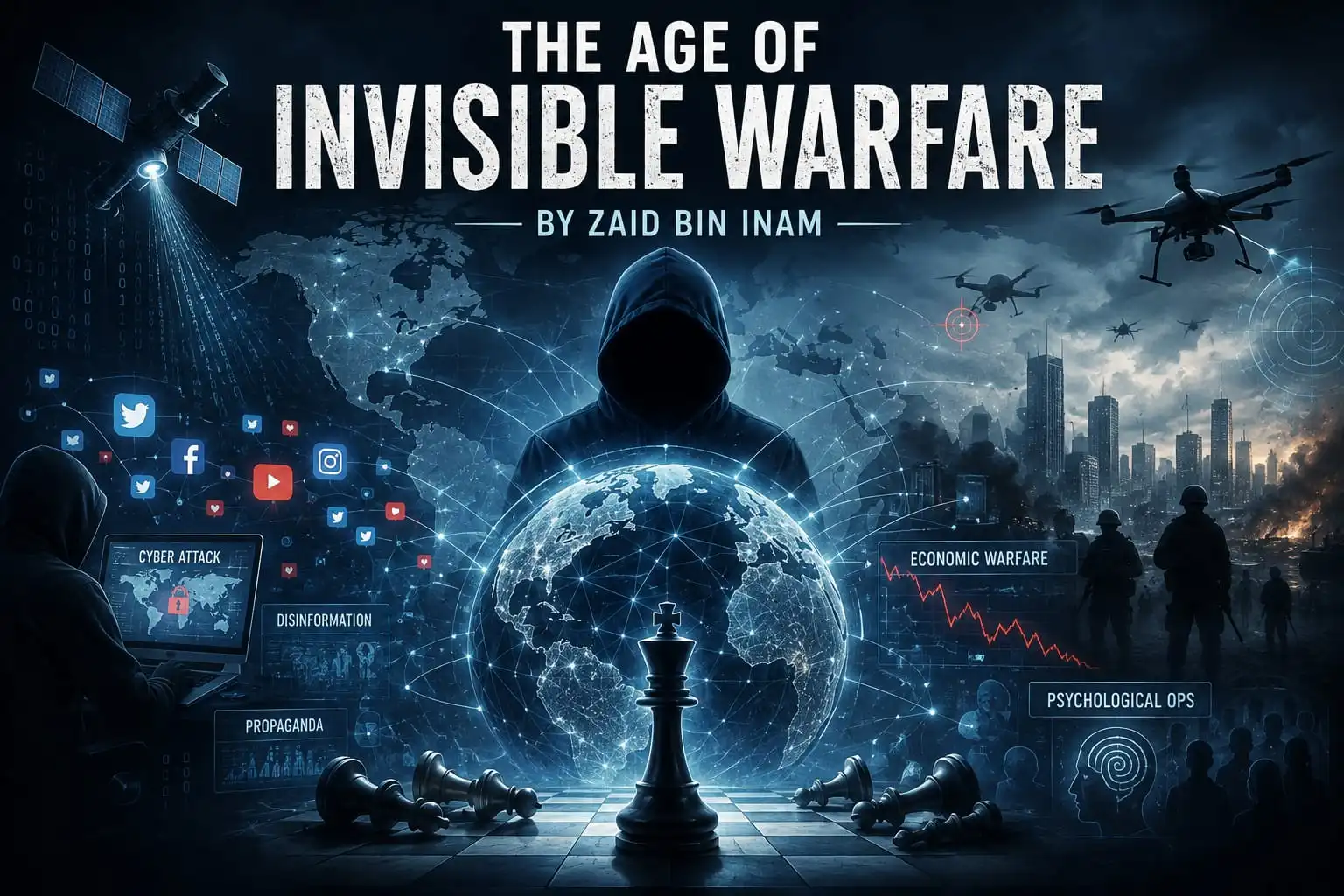
“Is it possible to induce mankind to live without war?” This question, aptly posed by Bertrand Russell, remains relevant in contemporary times. The modern-day landscape of military equipment encompasses technologies such as counter-drone systems, quantum computing, robotics, 3D printing, cyber-hacking, electronic warfare, big data and the Internet of Military Things. Developments in defence-related sectors have necessitated a reconsideration of threat assessments and counter-strategies. These tectonic shifts and their manifestations reflect the changing dynamics of interoperational frameworks.
In this context, this column delves into the operationalisation of blackout warfare, on which relatively few studies have been conducted. The employment of multiple vectors by one state against another demands significant conceptual and strategic understanding, since modern warfare is no longer limited to sea, land and air. The increasing level of automation and, consequently, reduced reliance on the human factor will affect operational efficiency and raise ethical concerns. Keeping in view the latest technological advancements, the definition of a state’s national power needs to be reconsidered through the inclusion of AI and quantum computing as crucial components of national power.
Ackout warfare is also known as “non-contact warfare,” in which non-kinetic measures are undertaken by adversarial states to achieve their objectives.
The book Blackout Warfare was published by Dr Peter Vincent Pry in 2021. However, it received relatively little attention in scholarly circles. Blackout warfare is also known as “non-contact warfare”, in which non-kinetic measures are undertaken by adversarial states to achieve their objectives. The book is a significant addition to military discourse and contributes to the study of the revolution in military affairs.
The strategic thinking behind blackout warfare is to compromise a state’s electrical grid through an electromagnetic pulse (EMP), thereby paralysing the interconnected network of critical infrastructure on which modern urban centres are almost entirely dependent, in order to achieve decisive victory. Infrastructure that may be vulnerable to attacks by hostile states includes transportation, finance, communications, water systems and petroleum infrastructure. The humanitarian crisis resulting from the direct or indirect effects of blackout warfare is equally worrying.
The fallout from blackout warfare for civilian populations and military installations would also affect the efficacy of deterrence. Civilian populations, as non-combatants, would bear a substantial proportion of the consequences of blackout warfare, since patterns of urban and, to some extent, rural life are increasingly dependent on online platforms and interconnected systems. The potential impact of blackout warfare is far more extensive than that of conventional attacks. As we can see on contemporary battlefields, the use of sophisticated and advanced technology is altering the balance between defence and offence.
However, a question arises regarding the impact of artificial intelligence on blackout warfare. As we know, the rise of AI has changed the overall dynamics of human-technology interaction. Technological advancements in the field of AI provide a significant interface through which actors can manoeuvre within contemporary networked societies. The downside of AI is the growing prevalence of automation in our lives, which can affect the human capacity to think critically and make decisions in real-life scenarios.
The complex terrain of AI in military technology could also have implications for the general principles of warfare. Compromising AI systems, coupled with the use of a nuclear EMP, could jeopardise the strategically calculated options available to political and military leaders. While technology is making life easier for individuals, its proliferation is simultaneously creating “technical vulnerabilities” that put both combatants and non-combatants at risk. Changes in the technological landscape and the integration of critical technologies into warfare therefore require a reassessment of war-fighting tactics.
Another aspect that needs to be highlighted is the symmetric-asymmetric equation among states regarding the employment of blackout warfare. The technological divide between states provides leverage to those possessing more advanced equipment and smart weapons. However, the contemporary framework of symmetry and asymmetry does not primarily depend on the size of an army or conventional military capabilities. Rather, it depends on a state’s ability to achieve political and military objectives by exploiting vulnerabilities in technological networks with a minimal level of kinetic involvement.
The ever-evolving world of technology in the defence and security domains demands pragmatic solutions to emerging threats and challenges. To assess this aspect, the latest war-gaming exercises conducted by think tanks should incorporate blackout warfare by presenting different scenarios to evaluate the strategic challenges posed by adversaries through the use of EMPs. As a result of these exercises, analysing the nature of “stealth” attacks, such as cyberattacks on electrical grids, would enable policymakers to develop strategies and alternative mechanisms in case of any eventuality.
The role of AI also needs to be taken into account in futuristic assessments of threats. The importance of private technology companies should likewise be recognised because of their capacity for out-of-the-box thinking and research and development.
As Dr Peter Vincent Pry notes, “Blackout warfare can indirectly kill millions in the long run, by collapsing electric grids and other life-sustaining critical infrastructures for weeks, months, or forever, causing starvation and societal collapse.” Hence, the changing nature of warfare demands policies and strategies capable of addressing invisible threats through an “infrastructure of knowledge” developed from the synergistic alignment of the public and private sectors.
Universities and think tanks should be provided with incentives to engage in research on emerging technologies and their implications, since the global political arena increasingly revolves around the utilisation of technology to control vital chains of connectivity that affect humanity both directly and indirectly.
SOURCE: https://dailytimes.com.pk/1539931/the-age-of-invisible-warfare/
Topic starter
Posted : August 18, 2026 12:26 pm