Notifications
Clear all

When Petrol Prices Rise, Who Pays the Price?
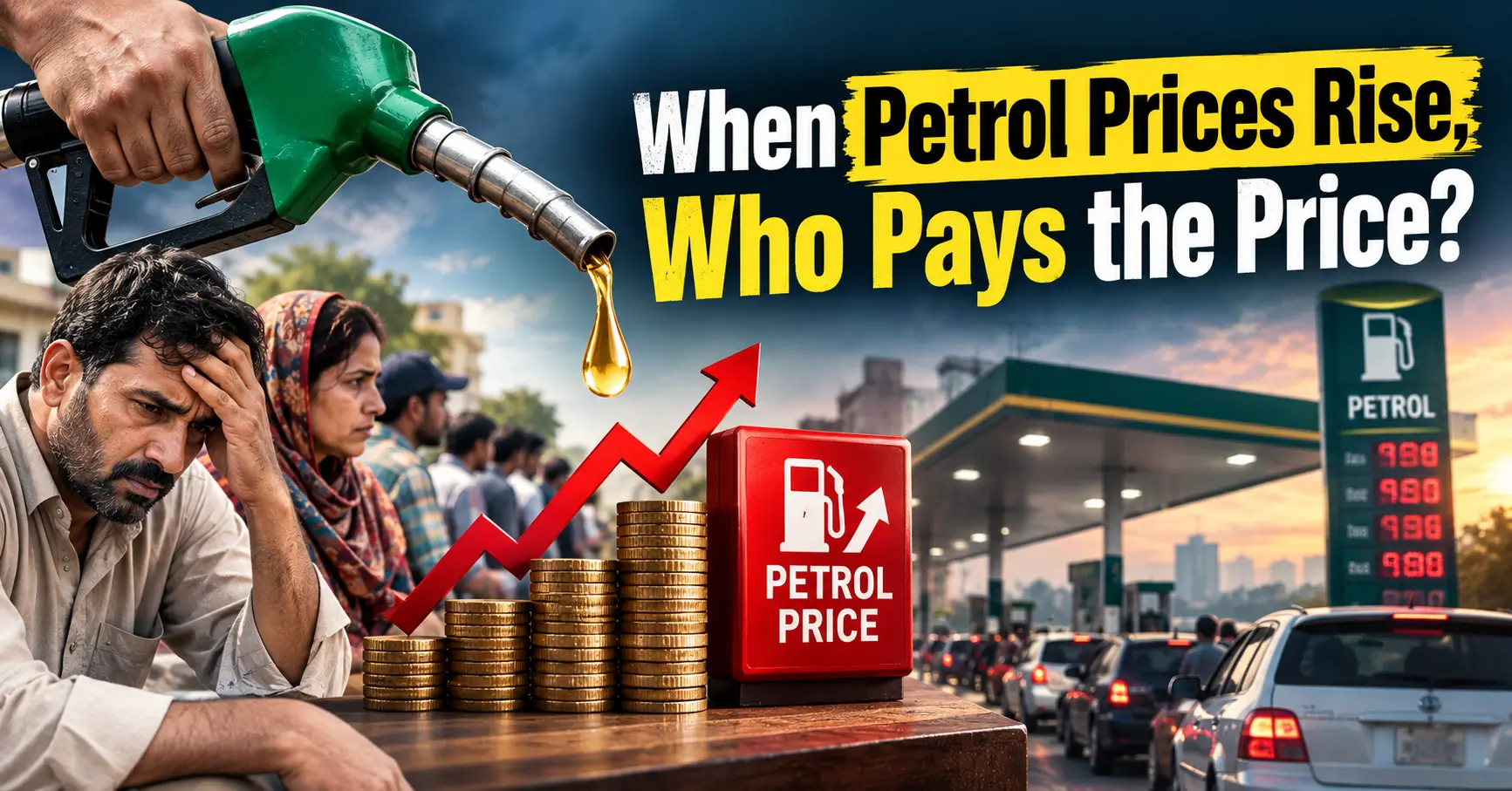
When Petrol Prices Rise, Who Pays the Price?
When Petrol Prices Rise, Who Pays the Price? THE rising of petrol prices is having a very significant effect on people's lives as can be seen from the statement of Dr Inam-ul-Haq Javed that the first thing he does every morning is checking how much the petrol prices went up today. Dr Sahib’s deep connection to literature makes it very clear that he has dedicated most of his career to writing in both Urdu and Punjabi which are two of his main languages. It is said that he has written quite a few poems, novels, etc. Over the past fifty-five years of Pakistan's existence it is very likely that Pakistan went through a few very disturbing events for which he would have been upset, but he could never get a newspaper and so he never stayed in touch with whatever current affairs were around him. Now the situation has changed. He has now taken a newspaper only to know on a daily basis how much the price of petrol is going to increase. Everyone in Pakistan is worried about this matter hence is why people in the organisation of Jamaat-e-Islami also protest and sit-ins.
This is probably one of the most remarkable stages that Pakistan is currently undergoing. Many new changes come to light while quite a number result only in worries and hardships. There is one very interesting fact to be found in what the Makkah Covenant reveals to us. In fact, it was described by journalist Mujib-ur-Rehman Shami as the manifestation of united feelings of the whole Islamic Muslim Ummah. In my opinion, he is totally justified as well. What has finally happened is the completion of one dream that remained only in the realm of imagination for 107 years, 8 months and 27 days. The weakness of Muslim was initiated by the First World War and later was reinforced by challenges that lasted over a hundred years. Today Makkah has become the most important political symbol for all Muslims where Muslim nations have begun pooling resources to defend the Sanctuary. In this regard, the contribution by Pakistan is the most noticeable. Prime Minister Shehbaz Sharif, Deputy Prime Minister and the Foreign Minister Ishaq Dar, along with Field Marshal Syed Asim Munir have been very dedicated in this matter and made a significant effort to reach the goal. Meanwhile, another point of concern is what has been said by Mohsin Naqvi about whether Pakistanis will get new provinces at all after Pakistan's surprise statement. The Pakistan Peoples Party has again announced that it will definitely not support the initiative. But Mohsin Naqvi says that the wheel has already started turning and stopping it is impossible. When Petrol Prices Rise, Who Pays the Price?
A totally different kind of worry, of course, exists here in Adiala where the entire focus has shifted from all other political issues to that of Imran Khan. It really seems that nothing else is going through their minds except for Imran Khan’s case so that even the issues like new provinces and defending Makkah together seem to have lost the interest of most people. Their only demand is very clear and they want nothing more than seeing Imran Khan, giving him the best medical treatment, and getting him released. Compared to their problems other concerns would not seem to matter that much even if the fuel prices had become very high for people to afford them. That their indifference of the problem is probably not a big surprise considering PTI’s record in which it has always been an enemy of any kind of fuel price hikes. The story goes that a year after I got the opportunity to talk Imran Khan after his visit to Karachi in which he was introducing his party's manifesto. My questions for Khan were diverse and one of them concerned the Constitution. I said something along the line that if he got elected as prime minister which he was, he will have been a constitutional violator at least twice. He simply asked, “Which Constitution?". When Petrol Prices Rise, Who Pays the Price?
It was obvious that he didn’t even know to what I was referring, so, being very much surprised, I told him that General Musharraf had changed the Constitution two times and that this is what I meant. Right away, Khan made a very clear distinction between the cases and said, “This is definitely your matter (Sharif’s) and not mine.”
If a political party was able to rise from the chaos with hardly any care about what was happening to the ever-increasing petrol prices, maybe such disinterest is not all that surprising a phenomenon to begin with. This aspect of the matter, though, aligns particularly well with what Hafiz Naeem and Jamaat-e-Islami are best suited to deal with as a matter for it is ordinary citizens who are most directly impacted by the issue. On this point, at least, Jamaat-e-Islami really has been the conscience of the people in a way. It does however, depend on whether or not the campaign can be converted into votes. That said, losses the party have sustained for the period of about twenty to thirty years might still be a thing of the past and the party could very well be coming back to the scene from the political mainstream as a result.
The central question revolves around whether Jamaat-e-Islami’s efforts will actually lead to a cut in the price of petroleum. Just about a year before, through demonstrations on the streets, this political force managed to take down some of the burdens imposed by the IPP’s, the Independent Power Producing companies.
This round, they are focused on a petrol price levy (a part of the petrol price). Their plea is not just that petrol should be cheaper than it is now but also that they should be allowed to sell it without levying any charges altogether. The decision of Hafiz Naeem-ur-Rehman and his associates to settle on this exact kind of demand appears like a conscious move and is a result of their ability to accurately foresee that petrol prices will never go down under the current world situation unless it is done via the removal of this levy. But then, what exactly does the levy refer to here? Does it represent the cost of buying petrol only or delivering it? Definitely not at all. In reality, it is basically Pakistan’s economy which has become so frail. When Petrol Prices Rise, Who Pays the Price?
The government takes in this levy as revenue to support the running of its services and therefore indirectly imposes a second tax on the very people the taxes help the government to support! It should be pointed out that there have been instances in history when the petroleum tax has been reduced in response to a significant rise in international petrol prices so the government can give the consumers some kind of breather. The levy, as a matter of fact, is something of a double edged sword since petroleum prices are already going up so there are no gains from either side, just losses.
A total elimination of the levy might not be the right step. In fact, the government’s financial commitment goes far beyond the several publicly visible costs alone. The state has complicated institutional setups so that their costs are very hard to trace and are not always easy to find.
Can a cash-strapped government just shut a door on a very lucrative income source? Obviously not. The truth is that nobody can really come up with a simple answer to this question at the moment. So, this is actually the reason that Ahsan Iqbal informed Hafiz Sahib that, if Jamaat-e-Islami were able to produce any practical formulae, the cabinet would certainly look into the whole issue. One of their senior members is a technical man, Syed Firasat Shah who spent his working life in the oil industry. If the party decides for him to be part of the government negotiation team, it is a sure possibility that he would introduce viable proposals for consideration in the negotiations. Nonetheless, even the oil and gas sector is going to pose some difficulties to the political leader. When Petrol Prices Rise, Who Pays the Price?
In fact, this is about the economy overall and the way government spending is being conducted. Finding a solution to it needs first that the people in charge have a broad, in-depth understanding of the way the state functions and that there is a national agreement on reducing government expenditure. The only thing to bring about such a radical change is the NFC Award which, right now, is a very delicate subject for discussion. Signs suggest at the moment that Pakistan might be on the verge of moving in that direction.
Topic starter
Posted : September 17, 2026 1:55 pm