
Notifications
Clear all

285 Days at Sea: Why USS Abraham Lincoln Is Covered in Rust
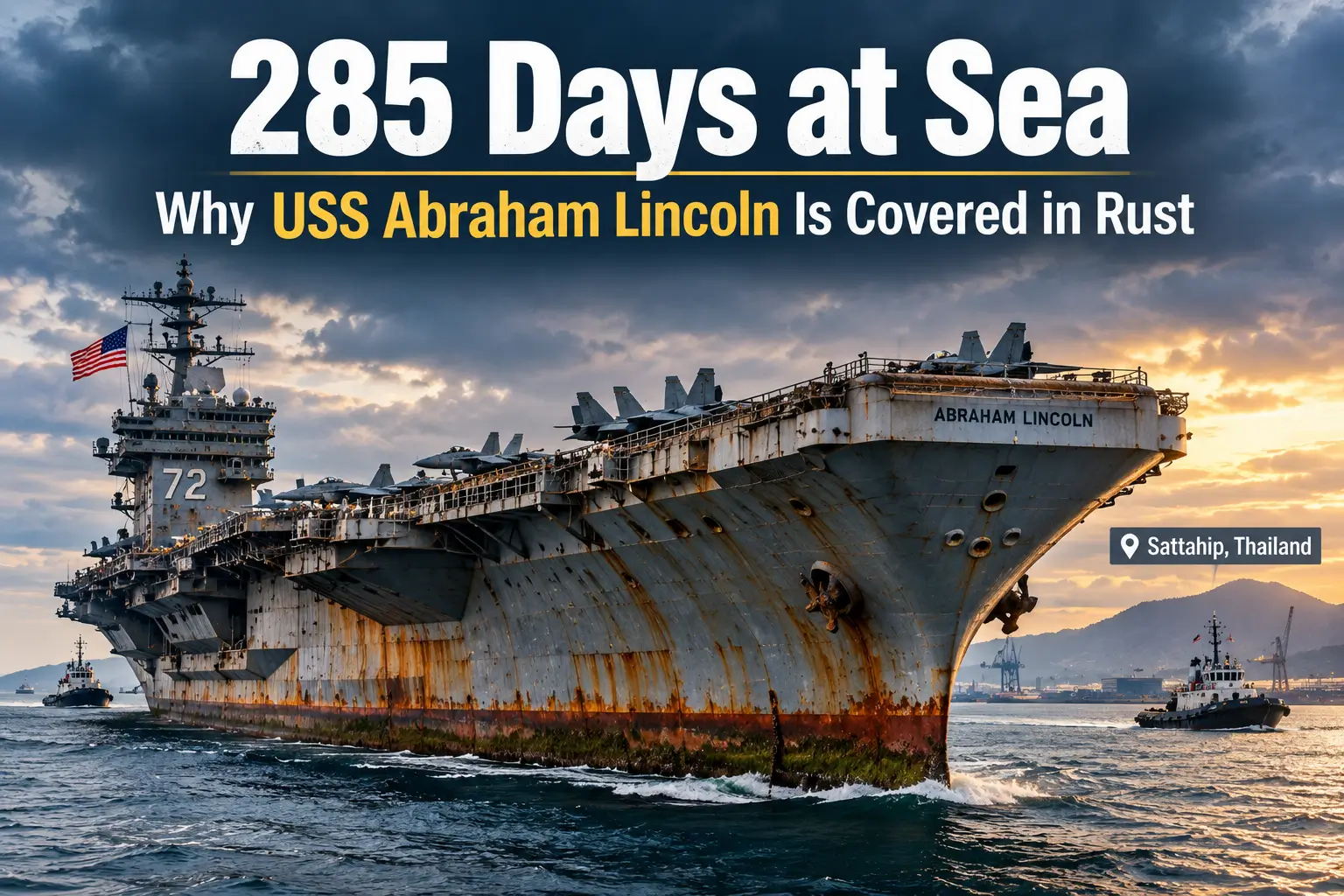
USS Abraham Lincoln’s Rusty Return
285 Days at Sea: Why USS Abraham Lincoln Is Covered in Rust The US Navy has dealt with corrosion for generations, and the USS Abraham Lincoln (CVN-72) offers a clear example of how difficult it is to keep a carrier free from rust. The aircraft carrier arrived in Pattaya, Thailand, after spending 285 days deployed, attracting attention because of visible rust and algae across parts of its hull.
Social media users quickly shared photographs of the ship and questioned why it looked so worn after its Middle Eastern deployment. The explanation lies in the demanding conditions at sea. The carrier spent almost its entire deployment operating at sea and made only two port visits. Long periods in saltwater naturally accelerate corrosion.
Carl Schuster, a former US Navy captain who served aboard Nimitz-class aircraft carriers, explained that rust around the waterline commonly appears after ships spend 60 days or more continuously at sea.
How the Navy Deals With Rust
Planned Maintenance
The Navy normally tackles corrosion when a ship returns to port for a Planned Incremental Availability (PIA). During this maintenance period, shipyard workers and contractors repair, maintain, and modernize the carrier.
Rust removal forms part of that work. Crews can treat affected areas such as hangar decks, structural bulkheads, and flight deck catwalks by removing surface corrosion and applying new marine coatings.
Dry-Dock Repairs
Workers cannot fully treat the underwater hull while the carrier remains afloat. For extensive repairs, the Navy can place the ship in dry dock during a Docking Planned Incremental Availability (DPIA).
Dry docking gives crews access to the entire hull. They can scrape and blast away corrosion and marine growth before repainting the surface with protective coatings. 285 Days at Sea:
Schuster estimated that removing the Lincoln’s visible rust could require around 30 days of preservation work, including rust removal, primer, and naval gray paint.
Why the Rust Attracted Attention
Rust affects warships around the world, so the Lincoln does not face an unusual problem. However, photographs of the carrier spread rapidly across social media, bringing unusual public attention to its condition. 285 Days at Sea:
The Navy has also faced similar corrosion challenges when ships spend extended periods away from port. A recent “MegaRust” conference in San Diego highlighted how corrosion affects naval readiness and increases the lifetime cost of maintaining warships.
Important Features of This Article
- Explains why USS Abraham Lincoln developed visible rust.
- Covers the carrier’s 285-day deployment.
- Describes how saltwater contributes to corrosion.
- Explains PIA and DPIA maintenance.
- Details the role of dry docks in hull repairs.
- Examines why the carrier attracted social media attention.
- Highlights corrosion as a long-term challenge for the US Navy.
Topic starter
Posted : September 8, 2026 11:26 am