
Notifications
Clear all

New Provinces or Better Governance? Pakistan’s Bigger Question
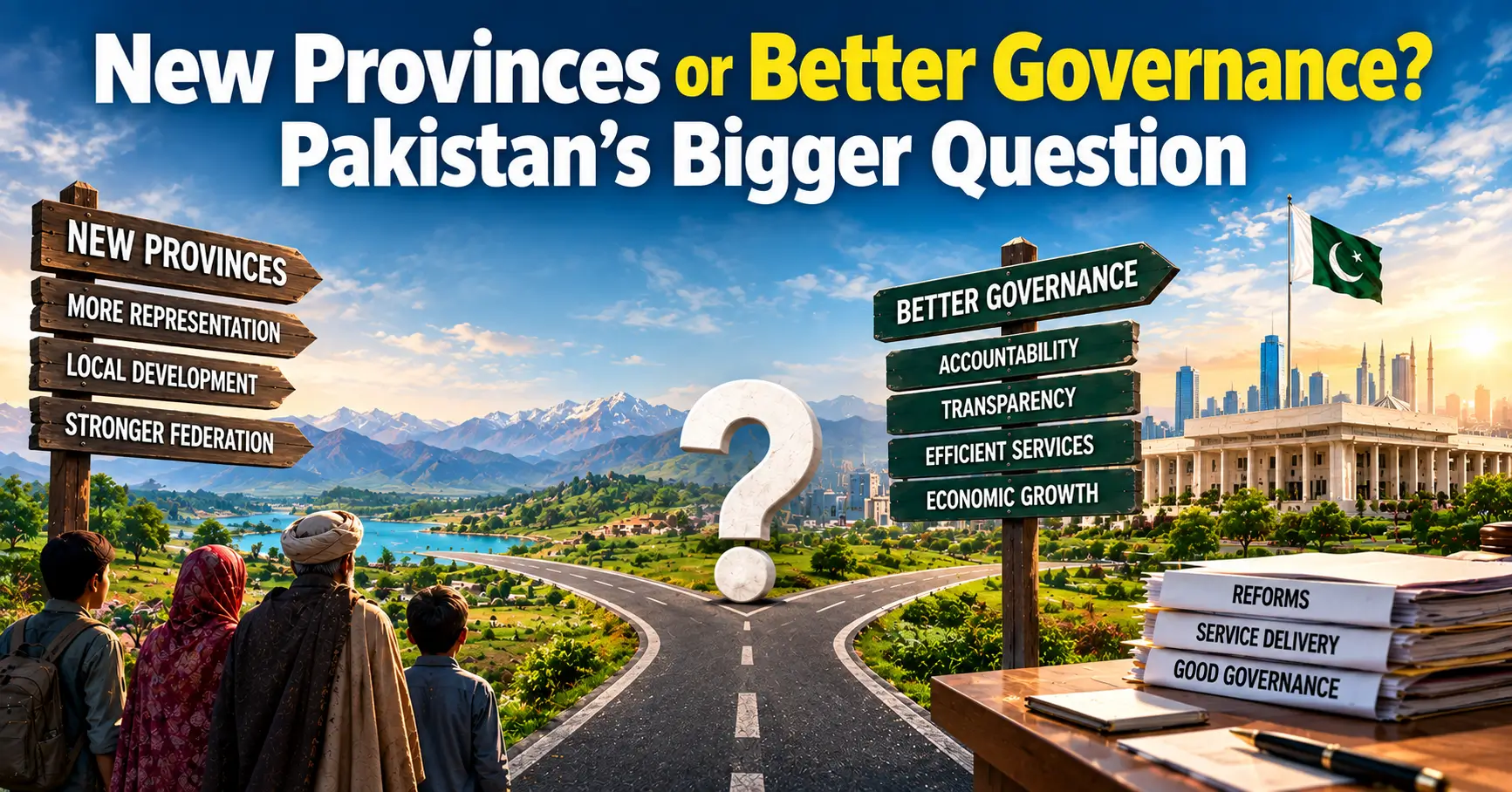
New Provinces or Better Governance? Pakistan’s Bigger Question
New Provinces or Better Governance? Pakistan’s Bigger Question Minister of Interior MOHSIN NAQVI triggered much debate when, at the end of July, he brought in the topic of making new provinces. At first, the Pakistan People's Party (PPP) had remained on the sidelines of the debate, but now it is very clear how the party stands. The topic became so heated that Murad Ali Shah, the provincial Chief Minister of Sindh, who vehemently rejects the very idea of parting the province, was only one of many lawmakers to comment. Among others, Farial Tayyab was also present and commented.PPP's stand was very clear that they will not accept the division of Sindh.During the interchange, Mohsin Naqvi made a second explanation of his previous reference to a "reset." He made clear that he was not talking about tearing down the existing system but wanted only to mend its weaknesses. Moreover, he stated that, even if this would cost him his current position, he would still go on with the proposal of creating new provinces and administrative units. Leader of Saeed Ghani of PPP then remarked that, under such circumstances, Naqvi might indeed be left with no option but to go out of office.
President Asif Ali Zardari later went to London and met with Mohsin Naqvi. According to insider reports Zardari expressed his disapproval of splitting Sindh once again at face value, while it appears, that the President was willing to talk about it in the case of Punjab.
If the aim to make provinces is just to weaken the others, to concentrate the power of the dominant families, to please political loyalists or satisfy personal desires, it is necessary to scrutinize the motive behind such a decision.
Meanwhile, the Pakistan Muslim League-Nawaz (PML-N) kept silent at the beginning of the crisis, and the party did not publicly commit to a certain position instantly. Some political and media observers even considered that it might be to the PML-N's benefit to steer entirely clear of the situation and leave it to the PPP to fight with the people supporting the new provinces. There is also a notion that Punjab Chief Minister Maryam Nawaz Sharif would not like that decision at all, and Prime Minister Shehbaz Sharif, on the contrary, would probably not oppose it too much. These understandings of the matter could also be the reason behind the political party's reserved stance in the initial days of the discussion.
The nature of the conversation changed entirely when Mr Hammaz Shehbaz Sharif, former Punjab CM, in a relaxed chat with journalists, suggested that an efficient local government system would, by reducing the reasons for the citizens wanting new provinces, make the demand for creating additional provinces disappear. At the same time, however, he recognized that it is the subject of a legitimate debate.
Hamza Shehbaz has given his views publicly on a matter that might divide a political party. These views will be of importance and interest to the members of parliament not only in the PML-N but also elsewhere. Because in Pakistan the political parties are still quite family-oriented in many ways.
He further points out how he has stayed close with the PML-N leaders and lawmakers through the past periods. So naturally the party's workers would look upon him to lead them in the future after he becomes their leader.
That is exactly what he is saying by his words that even though they are talking about provinces, there might just be a few new units added to the administrative ones and it would definitely be a PML-N decision. New Provinces or Better Governance? Pakistan’s Bigger Question
Minister of Planning Ahsan Iqbal in his own part has thrown more light on the entire matter by proposing the option of having a country like ours, with up to 15 provinces, including the current 9 provinces and the 15th could be a new province. The idea seems pretty out-of-the-box but one can't rule it out either.
He suggested the formation of a committee to take a look at the problem. Khawaja Asif agreed to the idea of more administrative units. Yet he stated that all changes were supposed to be made with a view to administrative needs and the national interest rather than on the basis of ethnic divisions or language considerations. The next day, parliamentary affairs minister Tariq Fazal Chaudhry said the matter is expected to be discussed in October by parliament.
Till date, the Pakistan Tehreek-e-Insaf (PTI) has not made the full case for its stance with regards to the ongoing discussion. The party, and especially its chairman Imran Khan, did, in fact, back an independent province in South Punjab. On this current proposal of the formation of extra provinces, though, party has not yet shown the same level of decision and determination. New Provinces or Better Governance? Pakistan’s Bigger Question
Chief Minister Sarfraz Bugti of Balochistan also supports the setting up of new provinces, and he maintains that administrative needs should be the determining factor as opposed to language or ethnic considerations.
With the political parties being on such opposite sides of the issue, it is really hard to get a handle on the whole thing.
PPP can be persuaded into a talk if the topic deals with changes that concern Punjab, but it completely negates any talk regarding the partition of Sindh.
The only demand of the Muttahida Qaumi Movement- Pakistan (MQM-P) has always been that Karachi be turned into a province.
The Awami National Party (ANP) has always been against the idea of a separate Hazara province as their demand to create such a province had been raised for the first time in 1950s.
On the issue Pakistan Tehreek-e-Insaf (PTI) had at one time supported the creation of South Punjab,
With different interests being represented by the political parties and the regional demands, a consensus is going to be hardly reached at any cost.
This discussion doesn't restrict itself to the political statements made in the Parliament and there has been a rise in the number of televised debate programmes which are talking about this matter. In addition, different universities and other educational institutions are holding seminars and forums for discussion on the issue. New Provinces or Better Governance? Pakistan’s Bigger Question
If Parliament accepts the suggestion made by Tariq Fazal Chaudhry, then the matter might end up getting official attention at the House level.
Towards the end of last month, I had another chance to talk about this issue in the form of a commentary column from an academic view, and I had a set of issues in my mind which could not be solved through that conversation. Since these issues haven't vanished yet, they definitely merit a second look.
The consideration of creating new provinces should not be entangled to the private interests of politicians, political parties, and strong-backed groups. There would be hardly any justification to support the idea if the proposed administrative reorganisation is actually done with the motive of weakening political opponents, gaining advantage by certain families, giving favours to particular ones or even pursuing a political ambition. New Provinces or Better Governance? Pakistan’s Bigger Question
But when the aim is merely to reform and govern more efficiently, to give more power to the citizens through their administration and at the same time to enhance public services and ultimately the quality of life of the citizens, the whole proposal should be carefully examined and seriously considered.
Making a province out of an administrative unit includes much more than redrawing the borders on a piece of paper. In fact, it would aim at the decentralization of the power, a wider political base, and a better government-citizen relationship by making it possible for people at the governmental level to respond quickly to local problems and requirements. It is an important question to ask whether setting up a new province really brings about those purposes of which it is an integral element. New Provinces or Better Governance? Pakistan’s Bigger Question
Those favoring smaller administrative units assert that smaller jurisdictions enable the governments to oversee their areas more efficiently.
Local issues can be more thoroughly addressed, decisions can be more rapidly made and officials can stay closer to the citizens. The issue is that population size alone cannot dictate the quality of governance.
Balochistan is a case in point.
A rough estimate of its population is 15. million making the province much sparser compared with Punjab. However, it&rsquos quite obvious that its smaller population is It hasn't automatically eradicated its governance and development problems either.
In a similar vein, Khyber Pakhtunkhwa is home to the population of around 40 million. Nevertheless, changing administrative divisions would be an inadequate solution to its people's problems.
This example highlights that the real problem is not even the population number within one province.
Factors like governance, institutional capacity, accountability, resource use, and political administration all play essential roles.
We should continue to focus our conversations and debates on good governance as a result. Those in charge of running the state should do their utmost to make sure public resources are handled responsibly and government expenditure is primarily meeting the demands of the people, not being used for unnecessary administrative or political reasons.
Establishing new provinces won't automatically lead to better administrations. Therefore, we should get back to the main issue: by which means can we prevent political leaders or influential family clusters or factions within bureaucracies from just taking over the newly added layers of provinces?
Besides political ramifications, the financial consequences should be scrutinized as well. The formation of a new province would have to be backed up by its administrative structure and a political framework to support them.
The new province would have a governor or chief minister who will be the head. It would have ministers or the head of different departments, chief secretary, departmental secretaries, provincial assembly, the office of the Chief Minister, courts, police bodies and various other government departments.
Of course, the whole affair would mean that more public money will be spent. And since that would be the case, the question will be raised whether it will be possible to raise and allocate the necessary funds to such an extent from a budget-wise perspective and the other way around if these new provinces will be of significant use to the people in question. New Provinces or Better Governance? Pakistan’s Bigger Question
In order to decide on boundary reorganization, the policymakers need to first review the current set-ups as well and determine whether they are working correctly. New provincial lines won't necessarily result in improved public services. If only, the decentralization of power, delegation of duties, and accountability were being implemented effectively, otherwise more provinces would mean nothing but an increase in the number of administrative structures, not the solutions to the problems themselves.
The real debate, as a result, should not focus on how many provinces Pakistan will have.
It is better that discussions are held about what type of administrative structure will offer citizens better governance, enhanced representation, increased accountability and improved delivery of public services.
Topic starter
Posted : September 19, 2026 1:44 pm