
Notifications
Clear all

Pakistan’s Silent Water Crisis: When Drinking Water Becomes a Health Threat
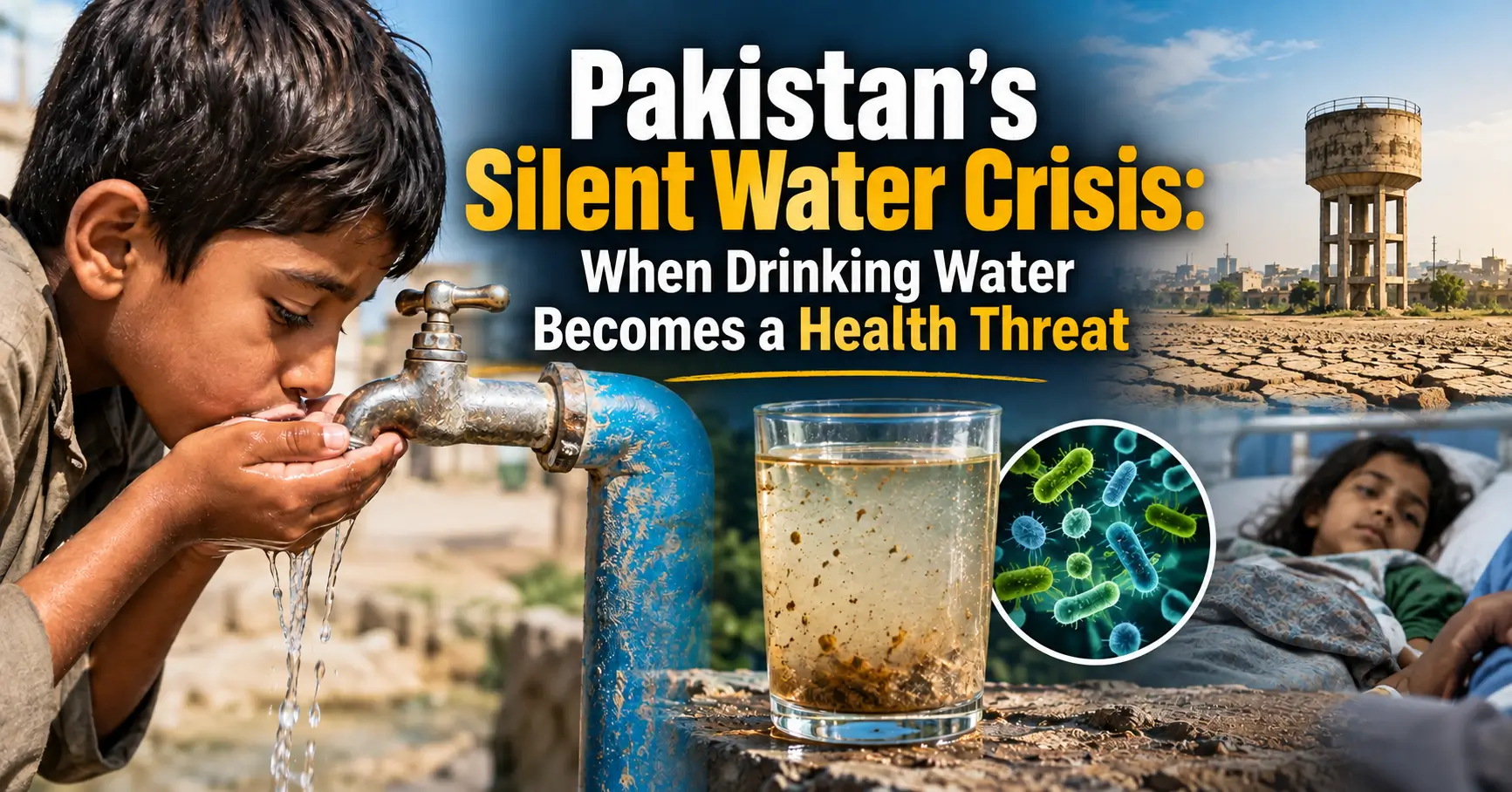
Pakistan’s Silent Water Crisis: When Drinking Water Becomes a Health Threat
Pakistan’s Silent Water Crisis: When Drinking Water Becomes a Health Threat Water scarcity in Pakistan is becoming a real crisis for the common people; water shortage has become a critical issue in daily life. A report states that Pakistan is one of the countries suffering from an extremely high water shortage. More than 80 percent of Pakistan’s population is currently experiencing severe water scarcity. In fact, the problem is not simply a lack of water. What is increasingly alarming is that large amounts of water that reach to rural and urban communities is not safe to drink because of high levels of chemicals and bacteria which are toxic to humans.
Pakistan’s water problem has therefore gone much farther than just a shortage, a need to implement rationing, and the degradation of the physical infrastructure involved in water supply. At present, water scarcity is posing a threat to the environment and the health of people. Contamination of water with harmful microorganisms is leading to diseases. Kidney disease has recently become another issue in Pakistan’s rising health crisis caused by pollution of water, mainly from heavy metals, such as the lead in drinking water, which have been found mainly in small industrial and mining towns.
Safe water and proper sanitation are fundamental human rights that promote dignity and good health, according to the United Nations.
The World Health Organisation (WHO) has on many occasions issued warnings about the harmful effects of dirty drinking water. It points out that contaminated water is the major carrier of diseases; microbial and chemical water toxins can both endanger the health of people.
From city piped supply to hand-pumps, to canals through which irrigation water is carried even from one region to another, all these sources of water in Pakistan are possible ways that household can get contaminated drinking water. Pakistan’s Silent Water Crisis: When Drinking Water Becomes a Health Threat
The availability of such contaminated water is paradoxically problematic, i.e., the very accessibility of potable water means people may unknowingly consume unsafe water which might cause health problems in the future. Therefore, the enjoyment of water right by people when the same is supplied to their homes laden with health-hazard chemicals is a mockery at the concept of water right.
PCRWR data reveals that only 32% of tap water sources in all corners of Pakistan are free from contamination whereas the remaining 59% have got contaminated by microbiological factors.
Karachi residents, however are in a worse condition. The reports indicate that in Karachi city, there are very few water testing samples that do not reveal the presence of carcinogens. Therefore, the people have no option but to rely on the availability of drinking water at shops.
It is quite clear that even drinking water contaminated with pollutants will lead to chronic rather than acute diseases and therefore will require long-term medical care.
Sources in industrial areas such as Gujranwala have confirmed the presence of various heavy metals like cadmium, lead, arsenic and mercury to levels considered as public health risks.
Shortage of water alone is not the issue here.
The reasons why these water bodies and groundwater sources in the form of wells have turned into a polluted mess with various types of wastes are - untreated sewage, industrial waste, agricultural runoff, and lack of regulation to protect the waterways.
In fact, one can not be sure about a well's water quality even after seeing only the surface. Only lab testing will be able to reveal the presence of chemicals.
Poor households can be the hardest hit because they are not able to afford clean water bottles, domestic water filters or even the continuous healthcare. Hence, drinking unsafe water becomes more or less a matter of habit for them rather than being an occasional danger. Pakistan’s Silent Water Crisis: When Drinking Water Becomes a Health Threat
Recent publications have once more stressed the connection between polluted water and kidney diseases. At March 9 2026, the Pakistan Medical Association raised an alarm that, Pakistan might face at least a quarter of 25000 or nearly 50000 new cases of kidney patients getting to end-stage renal disease. The prediction adds to a big load on the country's dialysis and kidney transplant services. These warnings are particularly impactful in a region that is marked by a wide disparity in healthcare access. A major issue lies here: kidney diseases could develop unnoticed by the patient at all until the condition worsens with visible symptoms appearing as a result of kidney failure. For example, people who consume contaminated water may not even feel sick until after many years of consumption resulting in them suffering kidney diseases.
In communities that have long-term issues of unclean water, the consequence could manifest through a progressive increase in medical expenses, a drop in family income, and the lengthening of treatment periods.
Pakistan is facing similar issues at the same time all over the world, but it is getting affected more because of the combination of these problems that the country is suffering. In this context, if the country is suffering, it can only happen to the people living together in the region, who do not only lack safe water and have poor sanitation, are polluted from the water, are poverty-stricken, but are also unable to enforce their laws effectively. Therefore, the kidney crisis in Pakistan has to be looked into from more than one angle. It should be seen not only as a medical problem but as an environmental and governance issue. The solution can be a frequent checking of water quality at different locations, a much more stringent control of pollution from both municipal and industrial sources, improved wastewater treatment, groundwater conservation and publicly available water quality information. In fact, safe drinking water should be considered a public good infrastructure rather than a service that people mainly pay for. Pakistan’s Silent Water Crisis: When Drinking Water Becomes a Health Threat
Possibly, the most alarming thing in Pakistan’s water crisis is its slow emergence. Compared to such events as floods or earthquake that cause massive destruction in a defined moment, polluted water usually does not leave such a trace. Its effect is that the water becomes an almost invisible enemy for people who get affected again and again, day by day. It is very often the case for the water which is polluted but it is only when people get ill and the disease is diagnosed then it is realized as the problem. Even though it has been many years since Pakistan has been warned about these dangers, it still experiences the very same symptoms through polluted water in groundwater, unsafe town water supplies, the poor quality of bottled waters as well as the ever-growing strain on health services because of this. At this stage, our focus should be to shift from providing temporary solutions to finding long-term solutions to the underlying issues.
We cannot protect public health when the country’s natural resource is so contaminated. It really is time to understand that safe and clean water is not only necessary but also a basic right for a human to live in good health.
This topic was modified 54 minutes ago by manzoor1
Topic starter
Posted : September 19, 2026 12:16 pm