
Notifications
Clear all

Russia’s Hybrid Warfare and the Growing Threat to Europe
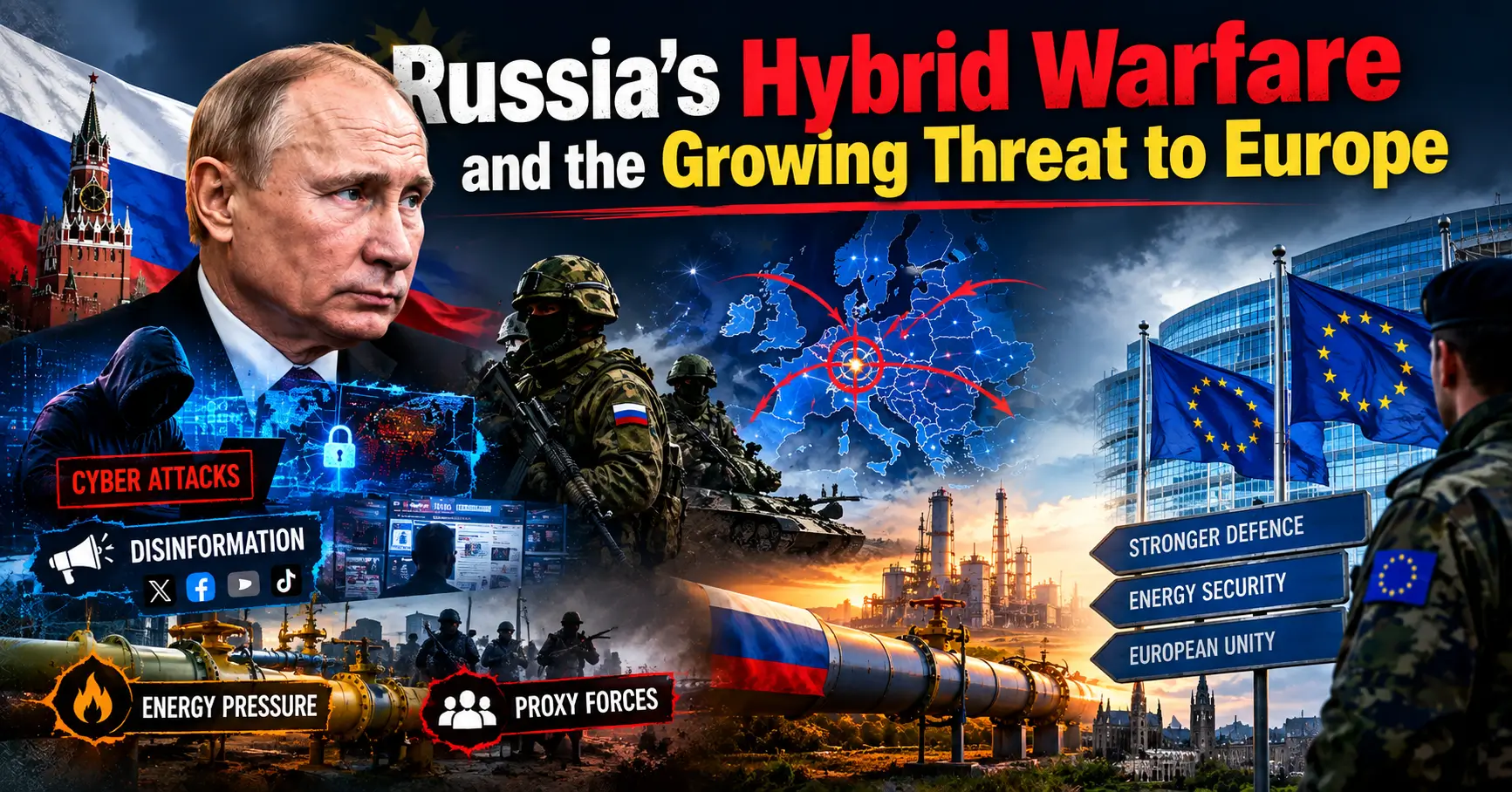
Russia’s Hybrid Warfare and the Growing Threat to Europe
Russia’s Hybrid Warfare and the Growing In this era of rapidly advancing technology, businesses have to keep pace by adopting the latest tools and methods if they are to stay competitive. Companies that are equipped with sound content strategies can get closer to their customers and meet their needs effectively more often. Good interaction also helps create a relationship of trust between companies and their customers, and it is quite a challenge for teams to get it right. Those companies that are stuck to the old methods will be left behind as their competitors move forward.
Russia's hybrid tactics in confronting Europe seem to have been orchestrated closely with attempts to weaken US diplomatic activities. Russia’s Hybrid Warfare and the Growing
“Mr. Putin, I really appreciate the fact that you have chosen to welcome us,” Steve Witkoff - US Special Envoy - said when he met Putin in Moscow during his recent visit. At that meeting, he and his fellow US Special Envoy Jared Kushner were attempting to get an agreement signed by Putin to have peace talks with Ukraine on the table with more than just their peace proposals but also economic incentives and promise of removing some of the sanctions.
The United States and Europe may be seriously misjudging Russian President Vladimir Putin by trying to appeal to his ego, pressuring Ukraine, and hesitating to respond decisively to his increasingly provoking, risky actions—all with the idea of somehow coming to an agreement with him or avoiding actions that might lead to further escalation.
Putin is testing the Europeans to find out if they would be brave and resist through what is termed by many as "hybrid warfare"—including cyber attacks, spreading fake information, sabotage, and diverse forms of military provocations. However, the European governments worried about escalation have mostly refrained from reacting with similar measures, while Washington has not pressured them to be harder. Russia’s Hybrid Warfare and the Growing
Should Putin perceive this cautious attitude as a sign of lack on the Western side, then his hybrid war campaign might be seriously ramped-up, or worse, his army may cross into another EU country. At that point, the European countries would be scared enough about Russia’s territorial hunger to actually deploy an army to block further expansions; this could eventually lead to a direct clash.
To prevent such a chain of incidents from happening,Washington and the governments of the European countries have to act with stronger measures right now, define unequivocally the consequences for crossing the set red lines, and show the readiness to put those consequences into the real action.
Soon president Donald Trump was pressing Kyiv to abandon the strikes on the saying that the strikes were causing the diesel fuel shortage. But he didn't demand Moscow do similar, including the call to stop the attacks on the Ukrainian civilians and the infrastructure or to end the abuses characterized as “mass detainments...industrial-scale torture...[and] the largest forced deportation of children since World War II.”
It is unlikely that American expressions of approval and economic incentives, together with Washington's clear shift towards Moscow and turning away from Kyiv, will convince Putin about the benefits to Moscow of making peace.
Putin has publicly claimed that "all of Ukraine is ours" and has referred to Ukraine as "even a country," thus he seems to have no problem at all to regard US diplomatic efforts in this matter with total contempt. Russia’s Hybrid Warfare and the Growing
This has no bearing on Russia which, while Putin's public comments, has continued a series of attacks on Europe whose frequency is increasing and the boldness is getting bigger.
A particularly notable event occurred on September 13, when a Russian drone damaged a train engine close to Ukraine's borders with Poland, a move that could have been interpreted as a warning for the supporting countries. However, the drone landed on another train carrying the former CIA Director David Petraeus.
Meanwhile, the strike happened "very shortly" after the separate train carrying Boris Johnson and other European Officials had already left and the train carrying former British Prime Minister Boris Johnson and other European Officials.
Previously, a Russian drone caused moldova "temporarily ground several flights" among them a flight that was meant to transport Volodymyr Zelensky from Chisinau to Oslo for the funeral of Norway's King Harald V.
Meanwhile, the Russian military has continued launching flights carrying aircraft and drones through the air space of several NATO countries. Furthermore, Russia has also participated in face-offs with other armed forces over high seas, jamming GPS and navigational systems all through Europe and the continent. Russia was suspected of election interference, as well as being responsible for various other forms of sabotage.
Copenhagen revealed that a Russian frigate had shot at a Danish air force helicopter over the north part of the sea separating Europe from Asia.
German government officials attributed the drone attack at the freight terminal of Leipzig/Halle Airport to Russian forces, while Bulgaria has started the investigation into explosions at a few weapons storage centers.
European authorities are angry about the whole situation; yet, they are vowing not to back down. According to Danish Foreign Minister Lars Lokke Rasmusson, who commented after Russian forces and Danish helicopters had been engaged in an altercation incident, “It is totally unacceptable.” The European Parliament was about to pass a resolution in which Russia is defined as the “gravest hybrid threat” to the [European] Union and its Member States.”
However, mere statements are unlikely to be sufficient. European authorities are, according to press reports, discussing a series of options that might include "starting a debate on whether a so-called hybrid attack would constitute a use of force under which NATO's article 5 mutual defense clause is invoked, responding with more unified communication to attacks and a more aggressive strategy regarding protection of critical infrastructure".
Western capitals in general, Washington and European capitals specifically, are well advised to really think about taking things seriously much much more. Besides strengthening and securing their respective energy and communications grids as well as improving their cyber defenses, the western governments should also consider bolstering their military strength and making necessary equipment and resources available not only to Ukraine but also to other countries that might be especially vulnerable to a possible Russian attack. Given what Russia has done recently as an illustration, the failure of western countries not to carry out those actions may lead to much greater costs, in the long run, if they are not prepared.
Topic starter
Posted : September 19, 2026 12:16 pm