
Notifications
Clear all

The borrowing dependency and debt sentence By Dr Shujjat Ahmed
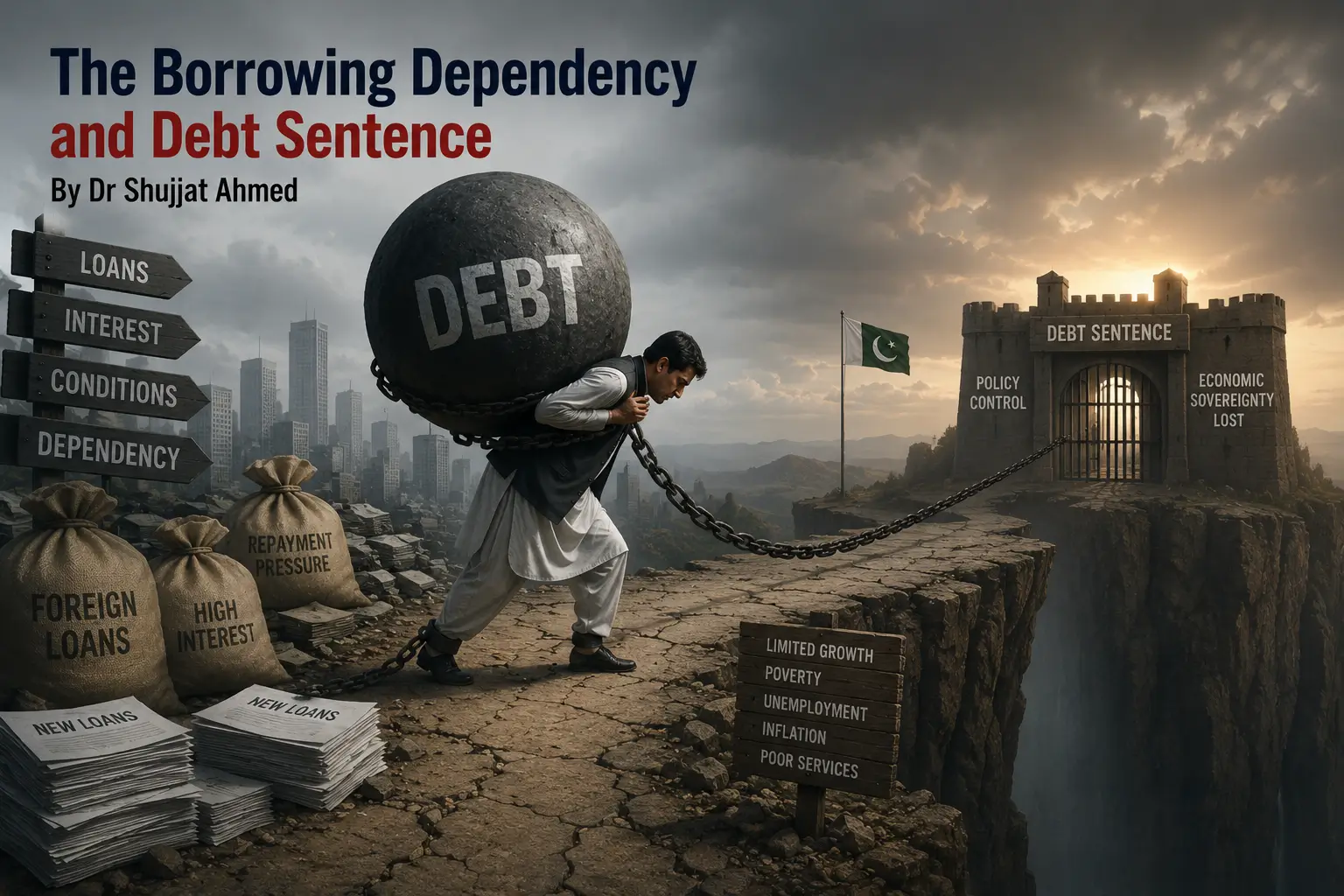
The borrowing dependency and debt sentence by Dr Shujjat Ahmed. We are all borrowers in one sense or the other, and our survival cannot be sustained without this reliance. What matters most is the form of borrowing and its purpose: to pacify feelings, satisfy needs and ambitions, build productivity, hide personal or enterprise failures, or conceal national failings.
The zenith of human feeling is love. Unrealised, it becomes a lifelong regret, as Ghalib puts it: love is not in your control; it is a fire that neither ignites on command, nor extinguishes when you wish. Ironically, lover's debt is at least one's own to carry. What differs is survival debt, political debt, and national debt, which are paid by those who never incurred them.
Survival borrowing traps masses in a cycle of abusive structure that refuses to break. Bonded labour is not a new phenomenon; it has existed since ancient times. The modern form is cheap remote tech-labour from the Global South. Distasteful as it is, nothing is less dignified than rural masses living in generational poverty, indebted to feudals who lend them the means of survival and lock them into a cycle across generations. The matter of the urban poor is not much different: borrowing for health crises, weddings, and burials from their private employer, repaid through salary deductions sometimes spanning over years. The borrowing dependency and debt sentence by Dr Shujjat Ahmed
For some, a way of life is to further ambitions at any borrowing cost: Political office, institutional control, career progress, foreign postings, tenure extension, and enterprise greed through a window of financial gains. For this, they readily seek undue favours, becoming indebted and prepared to pay any price in returning them. Naively, we ask why corruption exists. Because most of us are casually part of it without realisation. Extraordinary favours paid at an extraordinary price; ongoing legal aristocrats' engineering sustains the country's capture, ironically not paid by captors but through the country's dignity and people's well-being.
Now comes the habit of infinite national borrowing, while policymakers defy brutal universal logic: do not live beyond means. Borrowed existence eventually catches up with unpleasant consequences, without exception. Bailouts, fresh borrowing, and friendly-country rollovers give only a temporary reprieve from financial coma, signaling a final warning, and no one knows when it becomes permanent.
When is enough, enough? Public borrowing: the Debt-to-GDP ratio is capped at 60%, with a targeted limit of three months' forex cover for imports. My engineering background compels me to look at structural tolerances, not just ceiling limits, which become meaningless without analysing input energy (revenue) and stress factors (repayment capacity). Without these, debt ceilings become divorced from structural reality. The 60% debt-to-GDP limit was a politically compromised figure for 12 original EU countries in 1992, with fiscal deficit set at 3% of GDP. Repayment capacity was left out entirely; apparently, their average revenue was 41.5% of GDP, yielding a debt-to-revenue burden of 1.45 times. The borrowing dependency and debt sentence by Dr Shujjat Ahmed
Debt limits are therefore superficial, neither derived from economic theory nor based on rigorous models. Jan Priewe (2020) concluded they were mere coincidences; some argue that rigid numerical targets are flawed, while others suggest a debt tipping point at 64% of GDP for developing economies and 77% for advanced ones. Despite being incompatible with the world's diverse economies, the IMF and World Bank institutionalised a 60% debt limit within the Debt Sustainability Framework for low-to-middle-income countries.
Pakistan legislated this limit without accounting for structural capacity to repay. It breached the Fiscal Responsibility and Debt Limitation Act 2005 in 2016 and has continued to breach it ever since. Debt reduction limit and fiscal deficit targets were also breached, while sovereign guarantees have exceeded the prescribed limit every single year from 2005 to 2025, now standing at 3.8% of GDP. The subsequent target of 50% of GDP by 2028 is another target the country is already destined to breach.
An early escape was available: debt relief from the West reduced the debt-to-GDP ratio from 65.1% to 48.9% during 20012005. We squandered this opportunity, as debt crept up from 2015 and crossed the tipping point in 2016, driven by a debt-fueled spending spree on CPEC and fresh borrowing to repay old debt. Ironically, the same lot governs the country a decade later.
Pakistan's debt limit is a foreign concept whose applicability to Pakistan's unique economic realities is questionable, more so because it is not aligned with our revenue generation capacity. Yet the IMF, World Bank, and ADB continue lending to an increasingly leveraged country because they are in the business of lending, securing principal and earning interest, while patronising the population with reform prescriptions, rather than inducing structural economic correction through land reforms, human development, and a knowledge-based economy.
Reality is quite different: revenue is raised through taxation and reduction of subsidies, as recipients refuse to incur the political cost of course correction, even at the cost of displacing Pakistan's ability to develop within its own resources. Their combined disbursements stand at $113 billion, of which $61.2 billion principal and $14.4 billion interest have been paid (19582026); $51.8 billion remains outstanding, maturing until 2056, with estimated future interest of up to $18 billion at a 4% weighted average interest rate. The borrowing dependency and debt sentence by Dr Shujjat Ahmed
What comes next has already manifested elsewhere: Greece collapsed at a debt/revenue stress, triggered by excess public borrowing and hidden deficits; Portugal at 3 times, after years of low growth and public borrowing; Cyprus at 3.5 times, due to overexposed bank debt; Italy remained stressed but avoided collapse. Most recently, Sri Lanka, where revenue collapse pushed the multiplier to 15.8 times, triggering financial meltdown. Pakistan stands at 4.5 times, a fiscal vulnerability to reckon with.
IMF's three-month forex cover, designed in the 1960s for trade alone, ignores capital outflows entirely. Greenspan-Guidotti rule (1992) argued that reserves should exceed external debt maturing within 12 months. Pakistan's forex fault line into FY26-30 is stark: yearly outlay $41 billion (imports $17 billion, principal $20.68 billion, interest $3.40 billion) against inflow $63 billion (exports $34.8 billion, remittances $28.2 billion). Manageable until one considers usable reserves net of rolled-over principal of $15.88 billion. Situation appears untenable.
By every metric, Pakistan is already living in a financial coma, just not yet awakened, due to the lifeline provided by short-term borrowings and rollovers. Policymakers must not confine themselves to the same thinking. Political leadership must demonstrate real commitment to course correction. Otherwise, the debt sentence will be served not by those who borrowed, but by those who never had a choice, generation after generation. The borrowing dependency and debt sentence by Dr Shujjat Ahmed
SOURCE: https://tribune.com.pk/story/2626776/the-borrowing-dependency-and-debt-sentence
Topic starter
Posted : September 1, 2026 12:25 pm