
Notifications
Clear all

The Future of Mediation: Pakistan’s Diplomatic Role in a Multipolar World
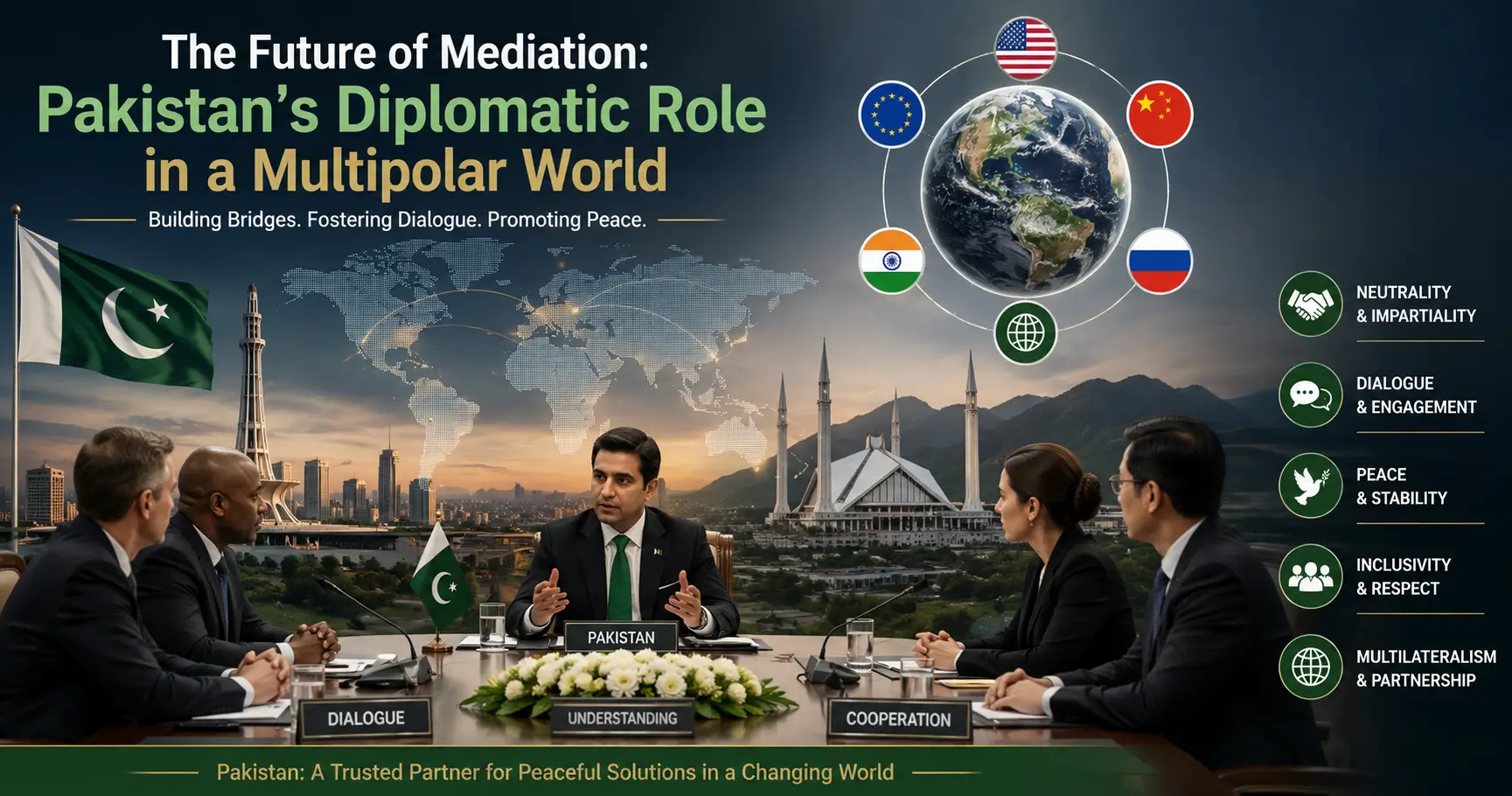
The Future of Mediation: Pakistan’s Diplomatic Role in a Multipolar World Pakistan's diplomatic efforts at crafting a good reputation were most successful when a 300-strong US delegation and a 71-member Iranian one came to the country on 11 April 2026 with the intention of finding a means for the resolution of the US-Iran hostilities. Pakistan had made its rapid transition from a country that is often portrayed in an negative light - dangerous or a difficult one - to a country that is considered as a key global peace mediator, which was, without doubt, a major diplomatic success.
Facilitated by Pakistan and with the cooperation of Turkey, Saudi Arabia, Qatar and Egypt, the 21-hour 'Islamabad Peace Talks' that led to the 'Islamabad MoU' were brokered by Pakistan which resulted in a ceasefire agreement as well as a 60-day period for the two protagonists to continue peace talks. This is undoubtedly considered a significant political breakthrough of the two countries.
Nevertheless, on 8 July when Iran launched attacks on commercial ships sailing in the Strait of Hormuz and the US immediately retaliated with airstrikes against Iranian territory, the ceasefire came to a sudden end. At this point, we are already many days beyond the 17 August deadline for the two parties to reach an agreement and as the frequency of the strikes is rising rapidly, the war seems to be picking up steam on its own so that the idea of mediation is no longer a viable option for the disputing parties. The Future of Mediation: Pakistan’s Diplomatic Role in a Multipolar World
Past experiences demonstrate that perfect mediators do not exist and that sustained involvement, the same or the same type of mediator, are not absolutely a requirement in a dispute for the dispute to end up being settled. Pakistan, a United States ally, and Iran, an entity that is strongly recognized for its hostility to the US, nonetheless, Iran believed in and respected the neutrality of Pakistan on the matter and had the firm conviction that Pakistan could play its role at the negotiation table well enough. A similar trust made Egypt a party to the acceptance of US mediation of Israeli issues, which later on led to the signing of the Camp David Accords in 1978. The Future of Mediation: Pakistan’s Diplomatic Role in a Multipolar World
Mediators pursue a range of objectives. From historical records it is evident that when undertaken by large and smaller powers respectively, mediation is a source of different kinds of inspirations and results. Small and middle powers tend to use their influence to achieve mediation goals as part of a combination of trading, strategic and reputational advantages that their mediation efforts are going to bring in. In a similar way, great powers normally are able to combine prestige from diplomatic channels with the capacity to offer rewards or inflict punishments. Pakistan's involvement in the US China opening-up process in 1971 helped Washington see Pakistan as a strategic asset as well as the context, the US position on the India-Pakistan confrontation, to be shaped by the wider circumstances.
Another key takeaway, if not the first one, about mediators from history is that when the parties are not brought by a mediator to a common point where both decide to give up something for the other party's benefit, it can well happen that the problem is in the timing of the mediation, i.e., that the right or 'ripe' time for a mediated solution was chosen wrong. Either mediation may commence while the protagonists are still thinking about their positions and searching earnestly for a solution and, in this case, their willingness to make concessions is high, or it will probably arrive much later than the time of a resolution of the dispute, when such an agreement could even lead to the loss of political status of the involved leaders domestically. Thus, in both cases, history shows a tendency to describe the mediator more as an assistant with minimal role than as the one whose actions brought about the settlement of the conflict. As an example, Oman's secret diplomatic meetings between the US and Iran in 2012 led to direct talks that eventually culminated into the larger multilateral negotiations that included the P5+1 - the US, the UK, France, Russia, China plus Germany, - and the EU, which eventually produced the Following the 2015 comprehensive agreement on Iran's nuclear program (JCPOA), Pakistan did not give up but had a series of failed attempts in persuading the Taliban for a peace deal, even amidst the American invasion of the country. On the contrary and under different conditions, Doha Peace Process was supported by Qatar and US forces withdrawal from Afghanistan in 2020 became a fact partly due to this. The Future of Mediation: Pakistan’s Diplomatic Role in a Multipolar World
Major powers mediating in international politics can boost the chances of success, for instance, by offering economic incentives, or conversely, by threatening penalties. Suez Canal crisis in 1956 was a case where the US through financial pressure and economic sanctions threat got Britain, France, and Israel to pull out their troops from Egypt. In return at its initiative, Israel was granted $3 billion in concessional finance for constructing new aerodromes in the Negev to compensate for the loss of the Sinai to the Arabs. Egypt received in 1980-81, the largest volume of USAID, a testament to their peace through a treaty agreement with the United States.
Major powers were the only ones who could conduct diplomacy successfully until, at least, they monopolised mediation through the twentieth century, when a multipolar world came to the fore, and the availability of mediators has been growing. A shift towards multiparty mediation is based on an assumption that competition over ideology has ceased since the world became de facto unipolar, and inter-state disputes have become more numerous and less predictable, thereby generating levels of violence, conflicts, or cycles of wars that vary with time. Thus, even a well-known mediator, in addition to a change in circumstances or a shift in the character of the conflict during a particular phase, may lose the mediation function and not appear important or even be remembered. A classic case is Israel and Syria. The mediation began in 2000 by the US, later Switzerland from 2004 to 2007, and afterwards, Turkey took charge in 2008. At the start of the 1969 Sino-American relations, France under General de Gaulle was a significant factor because the leader had high international standing, and trust in the mediator by the two nations allowed de Gaulle to lead the two sides into a situation whereby each one of them was ready to compromise. However, in 1971, before Pakistan took the lead of the negotiations. The Future of Mediation: Pakistan’s Diplomatic Role in a Multipolar World
Furthermore, history has shown that an impartial mediator can quickly lose the parties support if they perceive the mediation efforts as serving primarily financial interests or political gains. For many Middle East negotiations, especially from the early 1970s and until the beginning of the 21st century, no one really knew who else could mediate apart from the US. However, President Trump, in 2017 by himself, declared Jerusalem to be the capital of Israel as part of domestic politics and political considerations. This decision came with the cutting of aid to the Palestinians through refugee agencies such as UNRWA. The world viewed this move as being an attempt to win votes within the US by promoting one-sided solutions. After the US announced its recognition of Jerusalem as Israel’s capital on a one-sided basis, the Palestinian Authority (PA) said the US had declared itself not to be a viable mediator, that the PA would never take part in talks led by the US, and, in fact, that the PA wanted to have peace talks only on a multiparty or a multilateral basis to bypass the US altogether.
In view of the above, the world has gradually witnessed the emergence of and a resort to multiparty and multilateral mediation in an increasingly multipolar world.
Topic starter
Posted : September 6, 2026 8:13 am