
Notifications
Clear all

The Room of Power: How Elite Capture Shaped Pakistan
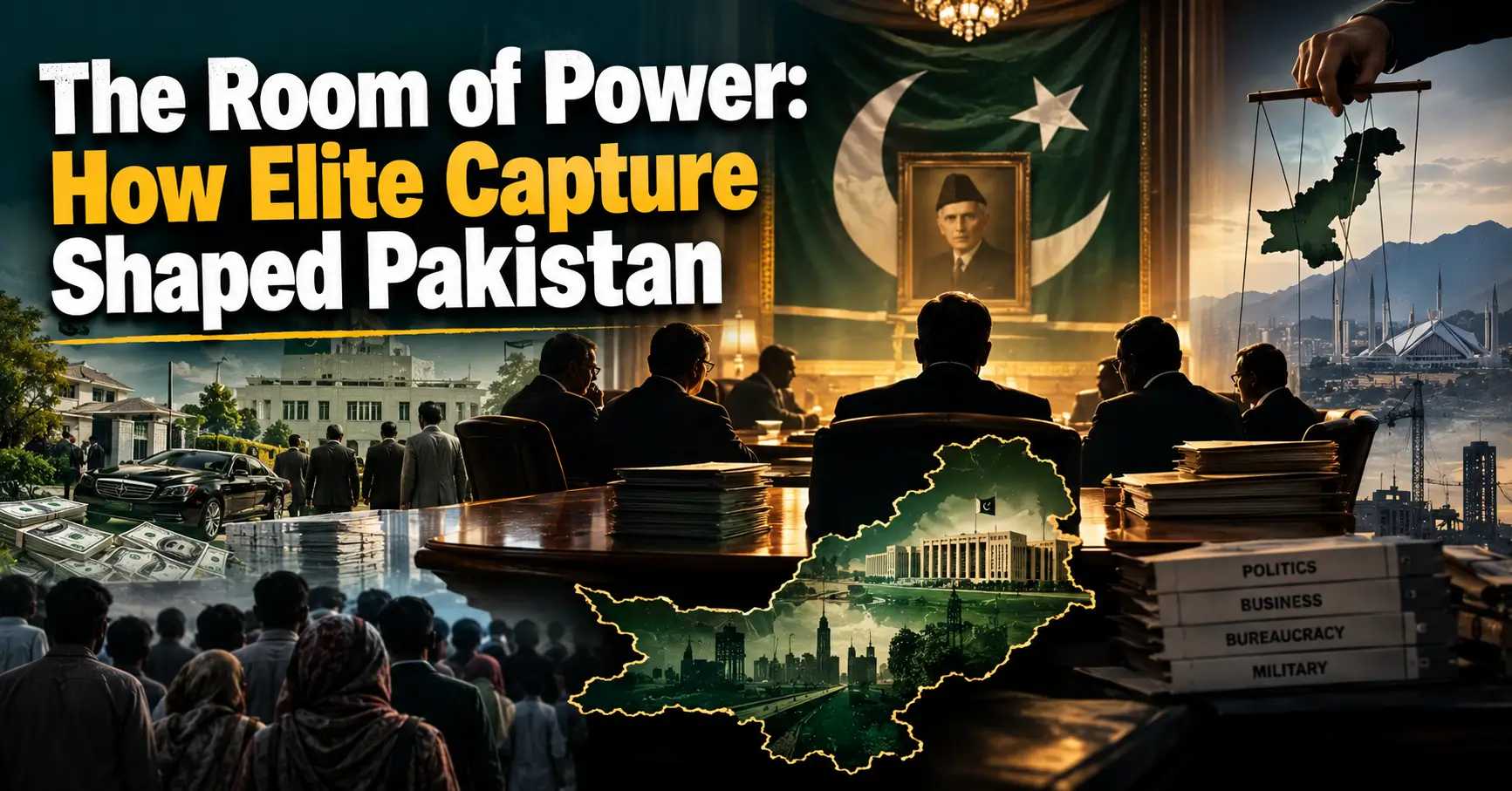
The Room of Power: How Elite Capture Shaped Pakistan
The Room of Power: How Elite Capture Shaped Pakistan Before, at the district headquarters, power arrived on horseback only.
After getting down in front of the whitewashed bungalow, the collector entered an airy chamber where clerks hunched over enormous ledgers under the slow motion circle of a ventilator.
In the meanwhile, peasants waited outside carrying tax certificates, land disputes and grievances against landlords. Inside, a young British officer governed a region larger than an English county. He was responsible for the payment of taxes, the control of the police in collaboration, the administration of law, etc. and was accountable to a government thousands of miles away.
He reported to the superiors, and all the other people reporting to him.
That chamber was Pakistan's inheritance.
Pakistan's leadership team changed post-1947 but the same power structure remained in place. Corrupt means dishonesty when a person takes advantage of the system, whether the person is politician/bureaucrat. The term is right but not sufficient as it reveals the person who is stealing from public funds but does not reveal the system which allows this kind of behavior to take place. " Elite capture " describes in a broader way, the capacity of the few, rich, powerful people to make use of laws, regulations, etc. that would be against public interest and then they would call the result, a product of public interest. The Room of Power: How Elite Capture Shaped Pakistan
The origin lies in the colonial era as well. British rulers were more concerned with their revenue and the peace and the protection of the people. Thus, their state apparatus was not about equal rights. A tiny apparatus was in control over the mass population via mediators such as landlords who would collect revenues, and tribal chiefmen who would be in charge of the area. These landlords and chieftans were given rewards of land titles, titles, and patronage for the purpose of getting them to be loyal. The result is that they were very much powerful and influential, and power was in their hands as property which could be passed on.
The whole structure turned out to be a complete one only in the North West Frontier where the irrigation system of the colonies brought prosperity and development to those whose ancestors were given access to the new land, while others did not. Favors and retired army persons were given landed estates sufficient for several generations with great influence. In Sindh, the big owner became the employer, the creditor and the person through whom the police station could be reached and thus all sorts of things. The Room of Power: How Elite Capture Shaped Pakistan
Colonial government did not do away with existing powers and systems locally. It only got into these power systems and used them. This new system started when Partition happened where refugee trains carried not only people but remnants of lives that were left behind as well. A new nation had to be created, yet everything was in chaos around it Muhammad Ali Jinnah passed away within thirteen months.
Liaquat Ali Khan got killed three years later
It was after a period the Muslim League that the unelected institutions made their presence increasingly felt through the principle that the court at the time of the case referred to as doctrine of necessity.
This came out clearly when the Government of the Country's representative i.e. the Governors General Ghulam Muhammad threw up the issue of the constituent assembly of 1954. He claimed that the state was being protected from politics through the power of the officials. It was very clear that through every such exercise of power, the representative institutions were further weakened, and the next exercise was more than a piece of cake. The Room of Power: How Elite Capture Shaped Pakistan
Security reasons also helped fortifying the existing arrangement. Conflict with the Indian neighboring state coupled with dependence on aid from other countries boosted the military's role. The civil service provided the administrative arm.
Business owners and big landlords brought the necessary votes and economic collaboration with the elite.
All these elements formed an alliance, which, although they had different motives and were even involved in competing with each other for power, ultimately united under the principle of keeping ordinary citizens away from power while they themselves controlled everything.
Industrialisation, indeed, brought along many advancements but the advantages it offered were not fully shared with the masses and remained confined within a few hands.
By 1968, Mahbub ul Haq's statement about twenty-two families controlling the vast majority of industrial wealth in country turned out to be a national issue. The incident showed yet another aspect Pakistanian political economical system has remained the same since long a time, business, yes, but connections were equally, if not more, important.
Zulfikar Ali Bhutto, the then president, announced to break from the past and to reshape society. He initiated the policy of nationalization and implemented changes in government employment policy, which caused losses among the previously dominant groups of society on top of which a number of other elements have become more dependent on political power.
On General Zia-ul-Haq's regime, the combination of dictatorship, Islamic ideology, and foreign assistance resulting from Afghanistan conflict led to a change in dynamics. Looting, issuing permits, or even getting promoted to a particular office became a tool of rewarding one’s loyalty with loyalty as an expected outcome. Thus, not only did patronage become an element of governance but it also got deeply rooted in the functioning of the government. The Room of Power: How Elite Capture Shaped Pakistan
After the resurgence of the elections in 1988, the political players have altered while the underlying structure of operation has remained the same. A government in weak position was bound to search for and obtain the votes of the people through a wide network of party members and activists. On the side of the representatives it was not an end in itself if the country developed, as long as they would not be left behind; they too want resources at home and in offices, the latter being more important. Officials in higher positions have also been dependent on political patrons.
One of the consequences of the government’s approach towards the opposition was becoming tough, while at the same time becoming lenient in its treatment of its allies was that the government got very good at figuring out who were the right people to punish, i.e., the wrong doers, who could be more efficiently dealt with through disloyalty.
This is why elite capturing of politics continues to prevail regardless of elections, revolutions and measures of enforcing responsibility. It does not depend on an individual ruler only. Any sort of a political benefit, such as a sugar subsidy, a cheap plot, a sheltered cartel, or a developmental project under the patronship of a famous politician, follows the same political route. Public resources become private gains through official declarations, administrative decisions, and bureaucratic actions, etc. The signatures are authentic. The file does not stop anywhere. The final decision of the government, however, is crooked and wrong.
The most serious damage of elite capture is not merely the misappropriation of funds. Decisions at different levels of society are greatly affected through elite capture like in which area water would be supplied, whether a school of a little child would be operating or not, whether the business owner would be given loan or the family of an accident victim would be made a cause of concern on national level through media, etc. One such aspect of a State is that it is not only against the weak, but also reluctant to go against the powerful. So if one is selling goods in the open one is expected very strict compliance with regulation. At the same time a cartel has got a chance to even dictate how regulations would be drawn up.
Pakistan keeps confusing the removal of beneficiaries of capture with restructuring. The removal of one group of elites is followed by the takeover by another group while the capture apparatus continues to operate unchanged and in its own way the former system remains in operation. The arresting of high-profile individuals is nothing but stagecraft. So is the announcement of sweeping changes. Real structural modifications on the other hand imply the limitation and curbing the use of capture mechanisms in the following manner: introducing public disclosure of political finance, using procurement that gives equal chances, the setting up of watchdog officials who are fully independent of the government, taxing agricultural income and property, and last but not least a merit-based system of appointments that is not dependent on political connections but on the competence of civil servants.
Elite capture initially was one of the instruments utilized by the British during their reign on Pakistan, and then became a mode of a sort of a new kind of governance of the insecure state that had emerged after independence, and at this juncture of the history has taken such a strong form of an interlocking web of protection between different elites that the privilege appears to be the result of administration and inequality to be that of the nature of human beings.
There was nothing about a collector riding on his horse that made the Revo Daala different. Its horn shrieked while its red and blue lights blinked. The bungalow had the banner of Pakistan raised on it. Still, the ceiling was very high, the people in front of the office waiting were the same as always, and the source of the power was the same as before. Inside, paper chasing, file movement all went on unabated while privilege got its legitimacy from the language of law and necessity by which only the privileged were able to reproduce themselves.
Outside, millions of people were in a queue hoping the gates would be opened in their favor after the officials have gone home.
Until the citizens of Pakistan stop acting like petitioners who have to beg for the door to open for them and instead change their role in relation with the establishment becoming room owners, it would not be possible for them to achieve the goal of becoming a Republican society.
Topic starter
Posted : September 15, 2026 11:27 am