
Notifications
Clear all

What the US Navy Can Learn from Iran By Christopher A. Preble, and Marie-Louise Westermann
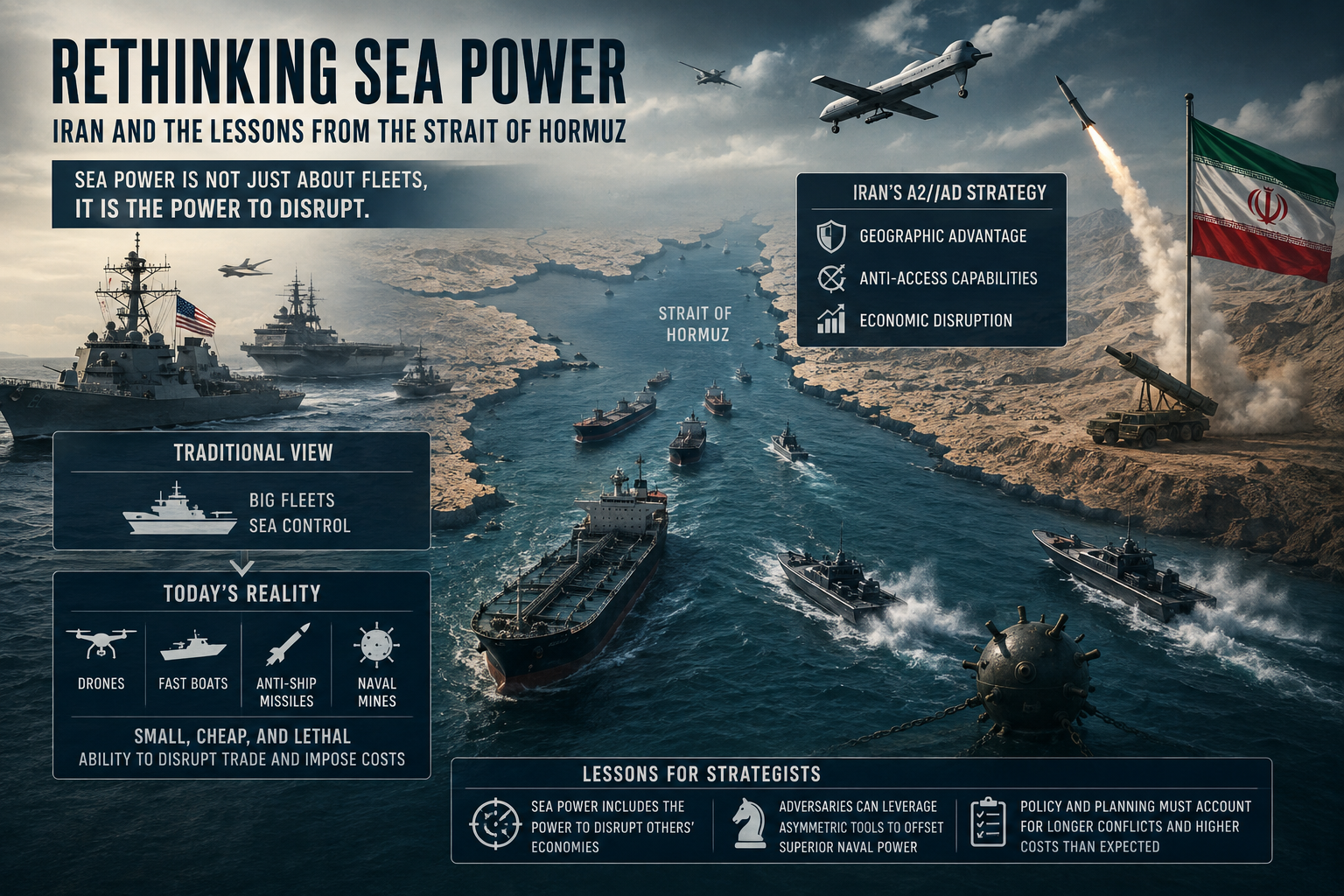
The closure of the Strait of Hormuz underscores the need for US strategists to reframe what it means to exercise sea power.
“The Iranian Navy rests at the bottom of the Persian Gulf. Combat ineffective. Decimated. Destroyed. Defeated…It is no more.”
Defense Secretary Pete Hegseth made this observation less than a week after the initial US-Israeli military strikes against Iran. And yet, despite a devastating bombing campaign that substantially degraded—or even entirely destroyed—Iran’s traditional navy, Tehran continues to obstruct the safe passage of tankers, container ships, and even the US Navy through the Strait of Hormuz.
freestar
Iran’s ability to block the strait speaks to a growing global trend. This past decade has witnessed a host of actors with few traditional instruments of maritime power confounding conventionally superior navies. Ukraine has heavily restricted the movement of Russia’s Black Sea Fleet across the western and central Black Sea. And the Houthis, a non-state actor, periodically disrupt trade through the Bab el-Mandeb Strait.
These cases demonstrate how relatively weaker actors can exert leverage over more powerful adversaries by exploiting inexpensive, unsophisticated anti-access/area denial (A2/AD) capabilities to support near-shore operations.
This pattern defies decades of US Navy doctrine and planning.
Since the Cold War, Washington has operated on the core assumption that if the Pentagon optimizes its military capabilities to deter peer competitors, then it can readily handle lower-intensity conflicts against less capable states.
freestar
Iran’s leverage over the strait tells a different story. Through A2/AD capabilities and geographic advantage, Iran has transformed an expected two- or three-week campaign into a five-month war. Instead, the unanticipated length of this conflict suggests that the Pentagon’s emphasis on peer or near-peer competitors has come at the expense of lower-level conflicts.
The expectation that military operations would cease relatively quickly can be partially explained by how American policymakers and military leaders have traditionally viewed sea power, a story that goes back to the late 19th century and the writings of Alfred Thayer Mahan.
Mahan brought the concept of sea power into the mainstream through his most influential work, The Influence of Sea Power Upon History, 1660–1783. In it, he described sea power as not only the demonstrated military strength of a fleet, but also the wealth generated through global trade and merchant shipping to sustain and further expand a country’s navy.
Mahan rightly understood that neither military capabilities nor economic strength alone could generate sea power. Rather, both elements were required. Importantly, however, he tied the usefulness of economic power to a state’s capacity to build and maintain a naval fleet.
freestar
This understanding of economic strength has led contemporary strategists, academics, and military leaders to view large and expensive fleets as adequate manifestations of sea power.
For political geographer Colin Flint, “sea power is the possession and use of large and effective military and merchant fleets to achieve interests and goals.” For the US Department of Defense, “sea power describes a nation’s ability to protect its political, economic, and military interests through control of the sea [emphasis added].”
These visions of sea power are incomplete in today’s world.
Specifically, the economic component of sea power should be understood not only as a state’s financial capacity to generate military might but also as the ability to disrupt or damage other states’ economic capacity. Iran has effectively demonstrated this ability through its use of speed boats, drones, anti-ship missiles, and naval mines to interdict nearby shipping.
Naval Warfare
How Trumpism Rejects Sea Power
President Donald Trump is more prone to viewing the United States as a continental rather than a maritime power.
ExecutiveBranch
Three Questions PodcastTrade
Corporate America’s China Neutrality Trap
A crisis in US-China relations will put American companies in a dilemma, forcing them to take sides.
Isaac Stone FishPaul J. Saunders August 10, 2026
Thus, the act of disrupting a country’s maritime trade is not an outcome of sea power, but rather a core component that defines it. This broader definition of sea power explains how smaller states—like Iran—can exercise sea power even without a large fleet or traditional sea control.
This would pose a substantial change in the traditional understanding of what platforms and systems encompass an adequate navy. A reinterpretation of sea power—to include the capacity to disrupt an adversary’s economy—would move navies away from being measured simply by fleet tonnage or the distance over which a fleet can project force to impose sea control.
While these characteristics are important in some circumstances, other capabilities, such as the capacity to disrupt trade, weaponize chokepoints, and impose economic costs, should be considered by civilian and military leaders when assessing a country’s maritime power — including one’s own.
Washington’s emphasis on high-end conflict and the relative neglect of asymmetric capabilities leaves gaps that adversaries can and have exploited. This is how Iran, a country whose navy is now “at the bottom of the Persian Gulf,” effectively countered a country with one of the world’s most technologically advanced fleets.
freestar
As Tehran attempts to maintain de facto control of the strait and Washington looks to regain a bargaining advantage, American policymakers and military leaders should capitalize on the lessons learned in this conflict.
Broadening our understanding of sea power would be a helpful first step in preventing Washington from underestimating competitors’ military capabilities and in providing policymakers with a more realistic assessment of expected timelines and the likely costs of going to war against a seemingly weaker adversary.
About the Authors: Christopher Preble and Marie-Louise Westermann
Christopher Preble is the senior fellow and director of the Reimagining US Grand Strategy program at the Stimson Center, and co-host of the Net Assessment podcast. Prior to joining the Stimson Center, Preble served as co-director of the Atlantic Council’s New American Engagement Initiative. He was vice president for defense and foreign policy studies at the Cato Institute from 2011 to 2020, and director of foreign policy studies from 2003 to 2011. He is a life member of the Council on Foreign Relations.
Marie-Louise Westermann is a research associate for the Reimagining US Grand Strategy Program at the Stimson Center. Her research examines US defense policy in the Indo-Pacific, with an emphasis on military logistics, naval strategy, and defense acquisition. Prior to joining Stimson, Westermann was a 2024 National Security Innovation Network X-Force fellow at US European Command, where she analyzed defense procurement processes within US security assistance initiatives. Westermann earned a Master of International Affairs from the Bush School of Government and Public Service at Texas A&M University, where she focused her studies on military and strategic affairs.
SOURCE: https://nationalinterest.org/feature/what-the-us-navy-can-learn-from-iran
Topic starter
Posted : August 12, 2026 7:50 am