
Notifications
Clear all

Culture: Comprehensive Notes for CSS Sociology
Concepts, Sociological Perspectives, Pakistani Examples, and Past-Paper Analysis
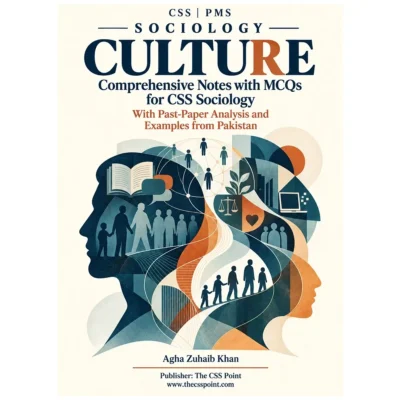
Culture provides the meanings through which people understand their world and the expectations through which they organize collective life. It influences what individuals consider desirable, respectable, sacred, normal, or unacceptable. Language, family customs, moral beliefs, educational practices, technology, dress, and everyday manners all form part of culture.
However, culture is more than a collection of traditions. It is also a changing and contested system of meanings. Individuals acquire culture through socialization, reinterpret it through interaction, and sometimes challenge it through collective action. Institutions preserve cultural patterns, while migration, education, technological innovation, and globalization introduce new possibilities.
For CSS Sociology, therefore, a strong understanding of culture must connect meaning, socialization, social order, diversity, power, and social change. The attached papers repeatedly require these connections.
1. Past-Paper Analysis: How FPSC Has Examined Culture
1.1 Scope and limitations of the uploaded compilation
Although the filename covers 2016–2026, the uploaded PDF contains papers for ten examination years: 2016–2020 and 2022–2026. The 2021 paper is absent. Consequently, its questions cannot be verified from this attachment.
The compilation includes the objective sections for 2024, 2025, and 2026, but not for all earlier years. Any analysis of MCQs must therefore remain limited to the objective sections actually available.
Using a clear criterion—a descriptive question or sub-question explicitly addressing culture or one of the listed cultural concepts—the chapter appears in nine of the ten available annual papers. There are thirteen relevant numbered question slots, although some combine culture with other topics and the 2022 appearance is a ten-mark note. These are not thirteen questions devoted exclusively to the whole chapter.
1.2 Year-wise descriptive questions
The following table paraphrases the questions while retaining their actual focus.
| Year | Question | What the examiner asked | Preparation required |
|---|---|---|---|
| 2016 | Q4 | Comment on culture becoming a tool through which a ruling regime transforms citizens’ outlook. | Culture and power, ideology, political socialization, consent, and cultural domination. |
| 2017 | Q4 | Discuss sociocultural factors that promote or retard social and cultural change. | Cultural adaptability, resistance, education, traditions, values, and institutional change. |
| 2017 | Q7 | Explain culture’s role in socializing individuals into useful members of society and the cultural patterns involved. | Functions of culture, socialization, internalization, norms, values, and role learning. |
| 2018 | Q2 | Differentiate ethnocentrism and xenocentrism and assess their implications for peace and development in Karachi. | Conceptual comparison followed by contextual analysis of identity, prejudice, exclusion, and conflict. |
| 2019 | Q2 | Explain the gap between material and non-material culture and suggest how cultural lag can be reduced. | Ogburn, unequal rates of change, consequences, and practical remedies. |
| 2019 | Q4 | Comment on how ethnocentrism promotes social change and maintains social order. | A balanced assessment of solidarity, mobilization, conformity, exclusion, and resistance. |
| 2019 | Q6 | Explain how cultural ethos can obstruct social change and discuss planned social change. | Entrenched values, vested interests, resistance, participation, and reform. |
| 2020 | — | No direct descriptive question on the specified culture concepts. | Religion, social action, and social change offer related applications, but should not be counted as direct chapter questions. |
| 2021 | — | Paper missing from the compilation. | No verified conclusion possible. |
| 2022 | Q8(ii) | Write a note on cultural relativism. | Definition, contextual understanding, significance, examples, and limitations. |
| 2023 | Q7 | Alongside society and its types, define culture and distinguish material from non-material culture. | Conceptual foundations, examples, and the relationship between the two forms. |
| 2024 | Q2 | Discuss culture and socialization, emphasizing mechanisms through which individuals internalize cultural elements. | Explain how learning occurs, rather than merely listing agencies. |
| 2025 | Q3 | Differentiate social and cultural change and discuss resistance in Pakistani society and culture. | Distinction, interdependence, cultural barriers, structural constraints, and Pakistani examples. |
| 2026 | Q3 | Evaluate culture as meanings embedded in power structures; discuss cultural elements, cultural lag, and relativism in relation to adaptation and moral conflict. | An integrated, theoretical, and critical answer. |
| 2026 | Q8 | Discuss drivers of social and cultural change and globalization’s effects on Pakistani practices, norms, and identities. | Technology, demography, education, economy, globalization, and cultural transformation. |
Source: The uploaded Sociology paper compilation.
1.3 What the pattern reveals
The questions follow several recurring approaches.
First, the examiner tests conceptual understanding, as in the distinction between material and non-material culture in 2023. Second, culture appears as a mechanism of socialization and social reproduction, particularly in 2017 and 2024. Third, the papers examine cultural differences and judgments, including ethnocentrism, xenocentrism, and relativism. Fourth, they repeatedly connect culture with change, resistance, and adaptation.
The 2016 and 2026 questions add an essential dimension: culture operates within relations of power. An answer that presents culture only as a harmonious body of shared traditions will therefore remain incomplete.
These patterns establish the chapter’s importance in the available papers; they do not guarantee a particular future question.
1.4 Objective questions relevant to this chapter
The available objective sections also test concepts that have not appeared as standalone descriptive questions.
| Year | Selected concepts tested |
|---|---|
| 2024 | Cultural relativism as a critique of ethnocentrism; multiculturalism; cultural lag. |
| 2025 | Socialization; mores; Ogburn and cultural lag; Bourdieu’s habitus; the culture industry; ideological state apparatuses. |
| 2026 | Culture as superorganic; internalized norms; education as cultural transmission; formal control; assimilation. |
Subcultures, high culture, popular culture, acculturation, and multiculturalism should therefore remain part of comprehensive preparation even where direct descriptive repetition is limited.
2. Meaning and Nature of Culture
2.1 Culture as a learned way of life
In sociology, culture is the socially learned and transmitted system of meanings, values, beliefs, norms, practices, symbols, and material objects associated with a group or society.
E. B. Tylor’s classic formulation in Primitive Culture (1871) treated culture as a broad whole encompassing knowledge, belief, art, morality, law, custom, and socially acquired capacities. Its central contribution is the recognition that culture extends far beyond literature or fine arts.
Clifford Geertz’s interpretive approach places greater emphasis on meaning. From this perspective, sociological analysis asks what actions, objects, and rituals signify to participants.
A wedding, for example, is not simply a gathering involving clothing, food, and music. It may communicate ideas about kinship, respectability, gender, religious obligation, family reputation, and social status. Culture enables participants to understand these meanings.
2.2 Culture and society
Culture and society are closely connected but analytically distinct. Society concerns organized social relationships; culture concerns the meanings and ways of life associated with those relationships.
A school illustrates this distinction. Its relationships among teachers, pupils, administrators, and parents constitute part of its social organization. Its expectations concerning discipline, achievement, punctuality, language, and respect constitute aspects of its culture.
Neither exists in isolation. Relationships require shared meanings, while meanings survive through social interaction. This distinction is also central to the introductory treatment in OpenStax’s discussion of culture and society.
2.3 Culture is not equivalent to refinement or education
Every human society possesses culture. Formal literacy, wealth, technological development, or familiarity with elite art does not determine whether a population is “cultured” in the sociological sense.
An agricultural community’s knowledge of seasons, oral narratives, kinship expectations, food preparation, and dispute settlement forms a cultural system. University qualifications represent particular cultural achievements; they do not establish the presence or absence of culture itself.
Calling an entire community “without culture” substitutes a judgment of superiority for sociological explanation.
2.4 Ideal culture and real culture
Ideal culture consists of the standards people profess. Real culture consists of their actual practices.
A society may publicly value merit while individuals seek appointments through personal connections. It may praise simplicity while families feel pressure to organize expensive weddings.
The discrepancy does not mean that ideals are irrelevant. Ideals can provide standards through which citizens criticize conduct and demand reform. However, the gap reveals why sociologists must examine behaviour alongside public declarations.
3. Characteristics of Culture
3.1 Culture is variable
Culture varies across societies, regions, classes, generations, and historical periods. People meet common human needs through different arrangements.
Marriage exists widely, but rules concerning partner selection, residence, ceremonies, and family involvement differ. Likewise, expectations about dress, hospitality, privacy, and appropriate speech vary.
Pakistan itself contains considerable cultural diversity. Regional languages, occupational communities, urban and rural settings, religious traditions, and socioeconomic circumstances contribute to different cultural experiences. No regional or ethnic population should be treated as internally uniform.
Cultural variation demonstrates that familiar practices are not necessarily universal or biologically inevitable.
3.2 Culture is learned
Individuals acquire culture through observation, instruction, imitation, participation, and interaction. They are not born knowing a particular language, greeting, religious ritual, or standard of politeness.
Biology makes learning possible, but it does not prescribe the specific cultural content learned. Hunger is biological; expectations about acceptable foods, meal timing, and table manners are cultural.
Because culture is learned, it can also be relearned and modified. A person entering a new occupation or society can acquire unfamiliar practices.
3.3 Culture is social
Culture develops through collective life. A private preference becomes culturally significant when others recognize, share, or respond to it.
Language provides the clearest example. A word communicates because speakers share an understanding of its meaning. Similarly, marriage rituals, professional ethics, and national symbols depend on collective recognition.
Individuals create innovations, but their wider cultural significance depends on social uptake.
3.4 Culture is shared
Shared cultural expectations make interaction intelligible. People can participate in a classroom, market, or religious gathering because they possess some common understanding of the situation.
However, shared culture does not imply complete agreement. People may recognize the same symbol while disagreeing about its meaning. Citizens may share national identification while disputing the relationship between language, religion, and citizenship.
Thus, culture involves both common reference points and contested interpretations.
3.5 Culture is transmissive and cumulative
Culture passes between generations and among contemporaries. Language, storytelling, education, observation, apprenticeship, and media enable this transmission.
It is also cumulative. Each generation inherits knowledge and practices that it can preserve, modify, or reject. Agricultural techniques, scientific knowledge, and literary traditions can therefore develop beyond the experience of any single individual.
Transmission does not produce exact copies. A family may preserve a wedding custom while changing its expense, duration, or meaning.
3.6 Culture is dynamic
Culture changes through invention, discovery, contact, migration, conflict, and reinterpretation.
Digital communication, for instance, introduces new expectations concerning availability, friendship, reputation, and privacy. Older customs also change when participants reinterpret them in new circumstances.
Different components change at different speeds. This unevenness is crucial to the concept of cultural lag.
3.7 Culture is adaptive
Culture helps populations respond to environmental and social conditions. Housing, clothing, food preservation, livelihood practices, and cooperative arrangements may develop in response to particular needs.
Adaptation does not mean every established custom remains beneficial. A practice suitable under earlier conditions may become ineffective or harmful after circumstances change.
Moreover, a practice may benefit one group while imposing costs on another. A critical answer must therefore ask: adaptive for whom, under what conditions, and with what consequences?
3.8 Culture is symbolic and superorganic
Culture depends heavily on symbols: objects, words, gestures, and actions that carry socially recognized meanings. A flag is physically a piece of fabric, but its cultural significance may involve citizenship, sacrifice, and belonging.
Culture is sometimes described as superorganic because it operates beyond biological inheritance and outlives particular individuals. Languages and institutions survive through social transmission rather than genetic reproduction.
The term does not mean that culture exists without people. It means that cultural patterns cannot be adequately explained by individual biology alone.
Past-paper relevance: These characteristics support the 2023 foundational question, the 2024 discussion of internalization, and the 2026 MCQ on culture’s superorganic nature.
4. Types of Culture: Material and Non-Material
4.1 Material culture
Material culture includes the physical objects and built environments that people create and use: houses, roads, tools, clothing, vehicles, books, machinery, and communication devices.
These objects reveal more than technical capability. They may express social hierarchy, identity, aesthetic preferences, and historical experience. A house can communicate ideas about privacy and family organization; clothing can indicate occupational membership or ceremonial significance.
Material culture therefore combines practical use with symbolic meaning.
4.2 Non-material culture
Non-material culture includes intangible meanings and standards, such as language, values, beliefs, norms, moral expectations, and knowledge.
A classroom building belongs to material culture. Expectations about the authority of teachers, the value of education, and appropriate student behaviour belong to non-material culture.
Likewise, a printed legal document is a physical object, while the rules and ideas of justice it expresses are non-material.
4.3 Their relationship
| Dimension | Material culture | Non-material culture |
|---|---|---|
| Basic form | Physical objects and built environments | Meanings, knowledge, beliefs, and expectations |
| Examples | Vehicles, buildings, clothing, machinery | Courtesy, religious beliefs, language, moral values |
| Main analytical question | What do people make and use? | What meanings and rules guide their use? |
| Interaction | Creates opportunities and constraints | Influences design, acceptance, and use |
The distinction is analytical rather than absolute. A smartphone is material, but the etiquette surrounding messages, expectations of immediate replies, and ideas about online privacy are non-material.
Influence runs in both directions. Technology may alter interaction, while values influence which technologies people adopt and how they use them.
Past-paper relevance: This distinction appeared directly in 2023 Q7 and forms the foundation of 2019 Q2 on cultural lag.
5. Functions of Culture
5.1 Transfer of knowledge
Culture preserves accumulated experience and makes it available to others. Through language, education, oral history, and practical training, people learn skills without having to discover everything independently.
Farmers may learn cultivation methods from experienced relatives, while medical students acquire knowledge through organized education. Both processes involve cultural transmission, although their methods of validating knowledge differ.
Culture can transmit errors and prejudices as well as useful knowledge. Its educational function must therefore include critical examination and correction.
5.2 Defining situations
Culture helps individuals interpret what is happening and what conduct is appropriate.
People behave differently at a funeral, job interview, wedding, and examination because they recognize different expectations. The same action may carry different meanings in different settings: loud laughter can express celebration in one situation and disrespect in another.
The idea of the definition of the situation, associated with W. I. Thomas, highlights how interpretations guide action. When people act on a definition, that interpretation can produce real consequences.
For example, interpreting a disagreement as a minor misunderstanding encourages negotiation; interpreting it as an attack on collective honour may intensify conflict.
5.3 Providing patterns of behaviour
Culture supplies established ways of acting in recurring situations. Greetings, professional etiquette, family obligations, and market conventions reduce uncertainty.
These patterns make cooperation possible because individuals can anticipate others’ responses. Customers expect an exchange after payment, and students expect some relationship between academic performance and evaluation.
However, behaviour patterns can also normalize unequal treatment. Their familiarity does not automatically make them just.
5.4 Moulding personality
Culture influences aspirations, emotional expression, self-understanding, and habits. Socialization teaches individuals what counts as success, respectability, responsibility, or failure.
A setting that strongly rewards obedience may encourage deference, whereas one that rewards questioning may encourage assertiveness. Such tendencies are influences, not fixed outcomes. Family differences, personal experiences, social position, and individual agency produce variation within every cultural setting.
Culture therefore shapes personality without mechanically determining it.
5.5 Creating identity and solidarity
Shared language, memories, rituals, and symbols generate belonging. Collective celebrations and mourning can connect individuals to a wider community.
Durkheim’s analysis helps explain how shared representations and rituals sustain solidarity. Yet solidarity within one group may coexist with exclusion of outsiders.
5.6 Regulating conduct and legitimizing authority
Culture supports social order by making certain expectations appear legitimate. Individuals often obey norms because they consider them appropriate, rather than because punishment is immediately threatened.
The same process can legitimize unequal authority. Ideas concerning class, gender, age, or status may make unequal arrangements appear natural. A comprehensive answer must therefore consider both culture’s integrative functions and its capacity to reproduce domination.
6. Elements of Culture
6.1 Norms
Norms are socially recognized expectations concerning appropriate behaviour. They translate general cultural standards into guidance for particular situations.
For instance, respect may be a value, while allowing another person to finish speaking is a norm that expresses it. Norms can prescribe desirable behaviour or prohibit unacceptable conduct.
Folkways
Folkways concern ordinary conventions of everyday life, such as greetings, dress etiquette, and table manners. Their violation usually produces relatively mild reactions, although severity depends on context.
Mores
Mores carry substantial moral significance. Expectations concerning honesty, care of dependants, and serious obligations often fall within this category.
Their violation is more likely to produce strong condemnation because members believe something morally important is at stake.
Taboos
Taboos are powerful prohibitions attached to conduct considered deeply unacceptable. Incest prohibitions are a common example, although societies differ in how they define prohibited relationships.
Laws
Laws are formally enacted or recognized rules enforced through authorized institutions. They may reflect moral expectations, but law and morality are not identical.
Some laws regulate technical matters, while some moral expectations remain outside formal law.
6.2 Values
Values are broad standards concerning what is good, desirable, or important. Justice, loyalty, achievement, hospitality, freedom, and equality are examples.
Values guide choices but do not necessarily produce consensus. Societies contain competing values, and individuals may face conflicts between them. Loyalty to relatives may conflict with merit-based recruitment; privacy may conflict with demands for collective oversight.
Such conflicts help explain why cultural life is not perfectly integrated.
6.3 Beliefs
Beliefs are propositions people accept as true. They may concern religion, society, nature, causation, or everyday experience.
The distinction from values is straightforward: beliefs concern what people think is true; values concern what they consider desirable.
A person may believe that education improves employment prospects and value educational achievement. Beliefs vary in evidential support and should not be treated as scientifically established merely because they are widely shared.
6.4 Sanctions
Sanctions are responses that encourage conformity or discourage violations. They may be positive or negative, formal or informal.
| Type | Example | Function |
|---|---|---|
| Formal positive | An institutional award for achievement | Officially rewards approved conduct |
| Formal negative | A disciplinary penalty or fine | Officially discourages violations |
| Informal positive | Praise, appreciation, or social approval | Reinforces conduct through everyday interaction |
| Informal negative | Criticism, ridicule, or withdrawal of approval | Discourages conduct through social pressure |
Sanctions work most effectively when people consider the underlying expectations legitimate. Excessive punishment can produce outward compliance without genuine acceptance.
6.5 Customs
Customs are established practices sustained through repetition and collective acceptance. Wedding arrangements, hospitality practices, and ways of observing festivals can become customary.
A custom is a repeated practice; a norm is an expectation. They overlap when people believe that a customary practice ought to be followed.
Customs can preserve identity and mutual assistance. They can also impose burdens when people feel compelled to maintain costly or exclusionary practices.
6.6 Symbols and language
Although the supplied list emphasizes norms, values, beliefs, sanctions, and customs, symbols and language are necessary to explain how these elements operate.
Symbols carry meanings beyond their physical form. Language permits people to communicate complex ideas, preserve knowledge, classify experiences, and imagine alternatives.
Language also connects culture with power. When institutions give greater prestige to one language, speakers with access to it may enjoy educational or occupational advantages. The issue is institutional recognition, not any inherent superiority of the language or its speakers.
6.7 How cultural elements operate together
Consider hospitality. A community may value generosity, believe that welcoming guests expresses good character, expect hosts to offer refreshments, and maintain customary forms of reception. Praise rewards generous hosts, while criticism discourages perceived neglect.
Culture thus operates as an interconnected system rather than a disconnected list of definitions.
Past-paper relevance: This integrated explanation is especially useful for 2024 Q2 and 2026 Q3.
7. Culture and Socialization
7.1 Meaning of socialization
Socialization is the lifelong process through which individuals learn, interpret, and internalize the expectations and competencies needed for social participation.
Culture supplies much of the content; socialization explains how people acquire and use it. Through socialization, individuals learn language, social roles, emotional expectations, moral standards, and ways of relating to others.
It is not confined to childhood. Entering a profession, becoming a parent, migrating, or joining a new organization can require further learning.
7.2 Primary and secondary socialization
Primary socialization occurs in early life through close relationships, especially within the family and immediate caregiving environment. It establishes basic language, identity, trust, and behavioural expectations.
Secondary socialization occurs through wider settings such as schools, peer groups, workplaces, religious organizations, and media. It introduces more specialized roles and expectations.
These categories overlap. Families continue to influence adults, while children encounter wider institutions at an early age.
7.3 Formal socialization
Formal socialization involves deliberate, organized instruction within recognized institutional arrangements.
Schools teach academic knowledge and explicit rules. Professional organizations train members in occupational responsibilities. Public-service training introduces official procedures and institutional expectations.
Formal institutions also communicate unintended lessons. A school’s hidden curriculum may teach punctuality, competition, obedience, gender expectations, or assumptions about authority through its everyday organization.
7.4 Non-formal and informal socialization
The syllabus uses “non-formal socialization.” In an examination answer, explain your usage because non-formal and informal learning can be distinguished.
Informal socialization occurs through ordinary interaction: observing parents, participating in peer groups, consuming entertainment, or experiencing approval and criticism.
Non-formal learning, in a narrower educational sense, is organized learning outside the formal education system, such as community workshops or youth programmes.
Thus, cultural learning may be formally institutionalized, organized outside formal institutions, or acquired informally through everyday life.
7.5 Mechanisms of internalization
Imitation and observation
Individuals learn by observing others, especially significant people. Children may imitate adults’ language, habits, and responses to conflict.
Instruction and explanation
Parents, teachers, and peers explicitly explain rules and their meanings. Understanding why a rule matters can encourage deeper acceptance than commands alone.
Rewards and sanctions
Praise, approval, correction, and penalties communicate which behaviours others expect. Repeated responses can strengthen habits and attachments.
Identification
Individuals adopt practices associated with admired people or groups. Family members, teachers, public figures, and online personalities can become models.
Role-taking
George Herbert Mead emphasized learning to view situations from others’ standpoints. Through interaction, individuals develop an understanding of expectations beyond their immediate impulses.
His concept of the generalized other describes an orientation toward the expectations of the wider community.
Reflected appraisal
Charles Horton Cooley’s looking-glass self explains how self-conceptions develop through imagined judgments of others. Individuals interpret how others see them and develop feelings about themselves accordingly.
Habit and participation
Repeated participation makes practices familiar and sometimes automatic. A person may come to follow a convention without consciously recalling how it was learned.
7.6 Internalization versus outward compliance
A person who follows a rule only under supervision displays compliance. A person who accepts it as appropriate demonstrates internalization.
This distinction explains why social order cannot depend exclusively on policing. Shared legitimacy and habitual acceptance reduce the need for continuous external enforcement.
7.7 Agencies of socialization
The family introduces language and early moral expectations. Schools provide formal knowledge and institutional routines. Peers supply belonging and alternative standards. Religious institutions communicate moral interpretations and collective identities. Workplaces teach occupational roles.
Media and digital platforms connect individuals with cultural models beyond their immediate surroundings. Online approval, visibility, and repeated exposure may influence aspirations and behaviour. However, users also interpret, resist, and reshape messages.
7.8 Socialization and agency
Socialization does not turn individuals into passive copies of society. People receive conflicting messages and exercise judgment.
A student may learn deference at home, critical discussion at university, and assertiveness at work. Managing these expectations can produce reflection and cultural change.
Past-paper relevance: For 2017 Q7 and 2024 Q2, explain the relationship between culture and socialization, then show the mechanisms through which learning occurs. 2023 Q3 on Mead provides a closely related theoretical connection.
8. Transmission of Culture
8.1 Intergenerational transmission
Families and institutions pass language, memory, moral expectations, and practical knowledge from older to younger generations.
This transmission preserves continuity, but younger members may reinterpret what they inherit. They can retain a language or ritual while challenging associated inequalities.
8.2 Transmission among contemporaries
Peers exchange slang, fashions, political ideas, professional knowledge, and technological practices. Cultural transmission therefore does not move only from adults to children.
Younger people may also teach older relatives new technologies, demonstrating that influence can move in multiple directions.
8.3 Enculturation and diffusion
Enculturation refers to learning the culture of one’s social environment. It overlaps with socialization but places particular emphasis on cultural acquisition.
Diffusion is the spread of cultural traits between groups or societies. Food, clothing styles, musical forms, technologies, and ideas can diffuse through migration, trade, education, and media.
Borrowing is usually selective. Receiving communities adapt cultural elements to local meanings rather than necessarily reproducing them unchanged.
8.4 Transmission as reproduction and transformation
Culture survives because it is transmitted, but transmission also creates opportunities for change. A traditional musical form may reach a new audience through digital production. Its continuity depends partly on modification.
Consequently, cultural preservation should not automatically be equated with keeping every practice unchanged.
9. Cultural Relativism
9.1 Meaning
Cultural relativism is the effort to understand practices within their cultural and historical context rather than immediately judging them through one’s own standards.
It asks what a practice means to participants, how it developed, and what social relationships sustain it.
For example, a researcher examining family involvement in marriage should investigate participants’ understandings of obligation, security, affection, and consent rather than assuming that every arrangement has the same meaning.
9.2 Methodological and moral relativism
Methodological cultural relativism is an approach to inquiry: suspend premature judgment to understand a practice accurately.
Moral relativism is a stronger philosophical claim that moral judgments depend entirely on cultural standards.
The distinction matters. Contextual understanding does not require unconditional approval. A sociologist can explain why a practice persists while critically examining coercion, exclusion, or harm.
9.3 Significance
Cultural relativism reduces ethnocentric distortion, improves comparative research, and supports more respectful interaction. It also encourages reformers to understand local meanings before designing interventions.
A programme developed without such understanding may misinterpret resistance or overlook existing sources of cooperation.
9.4 Limitations and moral conflicts
Cultures contain internal disagreements. Statements such as “this is our culture” may express the position of dominant members while concealing objections from less powerful participants.
A serious analysis therefore asks whose interpretation counts and whether members can dissent freely.
Cultural diversity does not provide an unlimited justification for harm. UNESCO’s declaration explicitly connects cultural diversity with human rights and rejects its use to restrict those rights. See UNESCO’s Universal Declaration on Cultural Diversity, Article 4.
9.5 Relativism and social adaptation
Contextual understanding can make reform more effective by connecting new arrangements with locally meaningful concerns. Yet moral conflict arises when accepted practices clash with competing principles of dignity, equality, or autonomy.
The strongest position combines cultural understanding with attention to power, consent, consequences, and internal criticism.
Past-paper relevance: 2022 Q8(ii) requires a focused note. 2026 Q3 requires a more critical discussion of adaptation and moral conflict.
10. Subcultures
10.1 Meaning and formation
A subculture is a distinctive set of meanings and practices within a wider society. Its members share some broader cultural features while maintaining particular styles, vocabularies, values, or identities.
Subcultures may develop around occupation, age, locality, religion, leisure, or shared experience. Medical professionals, university students, artists, and online gaming communities may develop recognizable subcultural patterns.
People can participate in several subcultures simultaneously.
10.2 Social significance
Subcultures create belonging and provide resources for interpreting shared experiences. Occupational subcultures can strengthen cooperation, while youth subcultures may provide spaces for experimentation.
They can also reinforce exclusion or unhealthy practices. Whether a subculture contributes positively cannot be decided from its difference alone; its actual norms and consequences require examination.
10.3 Subculture and counterculture
A counterculture actively challenges important values of the dominant culture. A subculture need not do so.
A community organized around a musical interest may differ from mainstream tastes without opposing the wider social order. A movement rejecting established gender or economic hierarchies may have countercultural dimensions.
Difference should therefore not automatically be equated with deviance or hostility.
11. Ethnocentrism and Xenocentrism
11.1 Ethnocentrism
Ethnocentrism involves treating one’s own cultural standards as the normal or superior measure for judging others. William Graham Sumner’s Folkways (1906) is closely associated with the concept.
It may appear when a group interprets unfamiliar customs as inferior simply because they differ from its own practices.
Cultural attachment alone is not necessarily ethnocentric. Valuing one’s language or traditions becomes ethnocentric when it entails unwarranted superiority or devaluation of others.
11.2 Solidarity and social order
Ethnocentric outlooks can strengthen internal loyalty and encourage conformity. They establish clear boundaries between insiders and outsiders and may support collective mobilization.
This helps explain the premise of 2019 Q4. Nevertheless, group solidarity and wider social order are not identical. Cohesion within one group can undermine cooperation across society.
11.3 Conflict and resistance
Ethnocentrism can encourage stereotyping, discrimination, exclusion, and resistance to useful borrowing. It may turn policy disagreements into contests over group worth.
It can also obstruct social change when innovations are rejected because they originated elsewhere rather than assessed on their merits.
11.4 Xenocentrism
Xenocentrism is the tendency to consider another culture inherently superior to one’s own.
Examples include assuming that imported products are better regardless of quality or treating foreign accents and lifestyles as automatic signs of intelligence and prestige.
Admiration for a specific foreign achievement is not necessarily xenocentrism. The problem is uncritical preference based on origin.
11.5 Comparison
| Dimension | Ethnocentrism | Xenocentrism |
|---|---|---|
| Presumed superiority | One’s own culture | Another culture |
| Typical bias | Devalues outsiders | Devalues local culture |
| Possible consequences | Exclusion, prejudice, resistance to borrowing | Cultural inferiority, status imitation, neglect of local capacities |
| Critical alternative | Evaluate practices contextually and on evidence | Evaluate practices contextually and on evidence |
11.6 Application to Karachi
For 2018 Q2, the strongest answer connects ethnocentrism with mechanisms rather than blaming an ethnic community.
Where linguistic or ethnic identities become associated with political competition and perceived exclusion, ethnocentric narratives may strengthen distrust. Stereotypes can then influence residential preferences, employment networks, or political mobilization.
However, urban conflict cannot be reduced to culture alone. Governance, inequality, competition over resources, political organization, and security conditions also matter.
Xenocentrism has a different analytical relevance: imported status preferences and the devaluation of local languages or products may reinforce social distance. It should not be presented as an equally direct cause of urban violence without supporting evidence.
12. Cultural Lag
12.1 Ogburn’s explanation
William F. Ogburn developed the concept of cultural lag in Social Change with Respect to Culture and Original Nature (1922).
Cultural lag describes a situation in which interdependent cultural components change at different rates, creating maladjustment. The familiar formulation concerns technological or material change moving faster than the norms, laws, and institutions needed to accommodate it.
Difference in speed alone is insufficient: the concept becomes especially useful when delayed adjustment creates a consequential mismatch.
12.2 How cultural lag develops
An innovation creates new possibilities. Existing rules were developed under earlier conditions and may provide inadequate guidance. Uncertainty, conflict, or harm follows until institutions and expectations adjust.
OpenStax similarly explains cultural lag through the uneven adjustment of cultural components in its discussion of cultural change.
12.3 Illustrative examples
Digital communication and privacy
Communication technologies can make recording and sharing information easy, while users’ understanding of consent and institutional safeguards develop more slowly.
Educational technology and assessment
New tools may alter how students obtain information or produce assignments before institutions clarify what counts as legitimate assistance and how learning should be assessed.
Mechanization and occupational adjustment
New machinery may change labour requirements faster than workers can acquire alternative skills or institutions can provide retraining.
These examples identify possible mechanisms; specific claims about their scale require empirical evidence.
12.4 Causes of lag
Established habits, uncertainty, limited institutional capacity, unequal resources, and vested interests may delay adjustment. Moral disagreement can also make responses difficult when innovations raise unfamiliar questions.
Not every delay is irrational. Careful evaluation may be appropriate where consequences remain uncertain.
12.5 Consequences
Cultural lag may produce regulatory gaps, intergenerational tensions, unclear responsibilities, occupational insecurity, or unequal exposure to risk.
It can also stimulate debate and reform. More precisely, recognition of maladjustment and attempts to resolve it can encourage adaptation; the lag itself should not automatically be described as beneficial.
12.6 Reducing cultural lag
Effective adjustment requires coordinated institutional responses. Education can improve understanding, professional bodies can develop standards, and affected groups can help shape workable rules.
Reform must also address material constraints. Advising individuals to adapt achieves little when training, resources, or institutional support remain inaccessible.
12.7 Criticism
Ogburn’s approach can be interpreted too technologically if every cultural development is treated as a reaction to inventions. Ideas and moral movements can themselves drive institutional and material change.
Nor is the fastest response always the best response. The important issue is whether adjustment is informed, equitable, and effective.
Past-paper relevance: 2019 Q2 asks for remedies, while 2026 Q3 requires connections with meanings, power, adaptation, and moral conflict.
13. High Culture and Popular Culture
13.1 High culture
High culture refers to forms that prestigious institutions or influential groups recognize as refined or distinguished. Depending on the setting, examples may include classical music, fine arts, specialized literature, or particular forms of theatre.
“High” describes social prestige, not an objectively superior human worth.
13.2 Popular culture
Popular culture consists of widely circulated and consumed forms such as television dramas, films, popular music, sports entertainment, fashion, and online content.
It provides enjoyment, shared references, and public discussion. It can also communicate assumptions about class, gender, consumption, and success.
13.3 Bourdieu: taste and cultural capital
Pierre Bourdieu’s Distinction connects cultural taste with social position. Familiarity with prestigious language, styles, and institutions can function as cultural capital when schools or employers recognize it as valuable.
His concept of habitus refers to durable, socially formed dispositions that shape perception and action. Such dispositions influence preferences without making every action consciously calculated or completely predetermined.
This perspective explains why cultural judgments can reproduce inequality while appearing to reward individual merit alone.
13.4 The culture industry
Adorno and Horkheimer’s concept of the culture industry examines the standardized commercial production of entertainment. Their critique asks whether culture becomes organized primarily around profit, repeated formulas, and consumer conformity.
A balanced answer also recognizes active audiences. People interpret media differently and may use popular culture to criticize authority or create alternative identities.
13.5 Changing boundaries
High and popular culture overlap. Classical performances can reach mass audiences through digital platforms, while once-marginal forms may acquire institutional prestige.
Past-paper relevance: The 2025 MCQs on habitus and the culture industry make these theoretical connections useful.
14. Multiculturalism, Assimilation, and Acculturation
14.1 Multiculturalism
Multiculturalism recognizes and supports cultural diversity within a common political community.
Distinguish the fact of diversity from multiculturalism as an approach to managing diversity. A society can contain many cultural groups while excluding some from recognition or equal participation.
A substantive multicultural approach concerns language, representation, institutional access, and equal citizenship, as well as festivals and cultural expression.
14.2 Significance and tensions
Multiculturalism can strengthen belonging by allowing people to participate without abandoning every inherited identity.
However, recognition alone does not eliminate inequality. Celebrating cultural difference achieves little if educational and economic barriers remain intact.
It must also protect disagreement within groups. Respect for a community should not give its dominant members unrestricted authority over others.
14.3 Assimilation
Assimilation is a process through which distinctions between a group and a wider or dominant society diminish.
It can involve language, everyday practices, institutional participation, social networks, and identification. These dimensions do not necessarily change together.
Assimilation may arise gradually through interaction or result from pressure to abandon minority practices. Analysis should distinguish opportunities for participation from coercive cultural erasure.
14.4 Acculturation
Acculturation concerns cultural change resulting from sustained contact between groups.
It does not require complete abandonment of an earlier identity. A migrant may adopt workplace practices and learn another language while retaining family customs and religious commitments.
Contact may influence both groups, although unequal power often makes change asymmetrical.
14.5 Comparison
| Concept | Central process or principle | Possible outcome |
|---|---|---|
| Enculturation | Learning one’s cultural environment | Cultural competence |
| Diffusion | Spread of cultural traits | Selective borrowing |
| Acculturation | Change through sustained cultural contact | Adaptation, blending, or selective retention |
| Assimilation | Reduction of distinctions between groups | Greater cultural or social incorporation |
| Multiculturalism | Recognition of diversity within shared institutions | Continued difference alongside common citizenship |
14.6 Pakistani application
Internal migration offers a useful example. A person moving to a large city may acquire new linguistic and occupational practices while maintaining regional food, language, and kinship connections. This illustrates acculturation without necessarily complete assimilation.
Multicultural integration would allow participation in common institutions without treating regional identity as an obstacle to citizenship.
Past-paper relevance: Multiculturalism appears in the 2024 MCQs, and assimilation in the 2026 MCQs. Both also strengthen answers on globalization and cultural change.
15. Culture, Power, and Sociological Perspectives
15.1 Functionalism
Functionalism emphasizes culture’s contribution to coordination, solidarity, and continuity. Shared norms make expectations predictable, while socialization connects individuals with institutional roles.
Its limitation is the tendency to understate conflict or assume that established arrangements benefit everyone.
15.2 Conflict perspectives
Conflict approaches ask who defines legitimate culture and whose interests particular meanings support.
Schools, media, and other institutions may present the preferences of influential groups as universal standards. This can reproduce inequality through apparently neutral judgments about language, taste, or respectability.
Culture nevertheless also provides resources for resistance. Ideas of justice and dignity can challenge established power.
15.3 Gramsci and cultural hegemony
Antonio Gramsci’s concept of hegemony explains how domination can operate through consent. Influential groups sustain authority partly when their interpretations become accepted as common sense.
For 2016 Q4, this helps explain how cultural narratives might align loyalty to the country with loyalty to a particular government. A critical answer should distinguish shared national identity from unquestioning support for rulers.
15.4 Althusser and ideological institutions
Louis Althusser examined institutions such as education, religion, and media as sites through which ideology is reproduced.
This perspective directs attention to everyday learning and representation, although institutions are not perfectly unified and participants can resist dominant messages.
15.5 Symbolic interactionism
Symbolic interactionism examines how people create, interpret, and modify meanings in interaction.
It explains why the same gesture or object can mean different things in different settings and why culture changes through everyday negotiation.
15.6 Feminist perspectives
Feminist sociology investigates how cultural expectations shape gender roles, authority, work, and representation.
For example, presenting unpaid care as a natural female obligation can conceal its social organization and economic significance. Analysis should also recognize women’s agency and differences associated with class, locality, and other social positions.
15.7 Integrating the perspectives
A strong answer moves between levels. It examines how people interpret a practice, how institutions reinforce it, whose interests it serves, and how it changes.
This integrated method is especially important for 2026 Q3, which explicitly places cultural meanings within power structures.
16. Cultural Change, Resistance, and Globalization
16.1 Social change and cultural change
Social change concerns transformations in relationships, institutions, roles, and social organization. Cultural change concerns transformations in meanings, values, beliefs, knowledge, and practices.
They overlap but are not identical. Changes in women’s employment affect social roles and organizational arrangements; changing beliefs about appropriate occupations represent cultural change.
16.2 Forces promoting change
Technology creates new capacities and forms of interaction. Education exposes individuals to alternative explanations and aspirations. Migration brings different practices into contact. Economic transformation alters livelihoods and household arrangements.
Demographic change influences needs and expectations, while social movements contest established meanings. These forces interact rather than operating independently.
16.3 Resistance and cultural ethos
Cultural ethos refers to a group’s characteristic moral orientation or underlying tone of values and sentiments.
Resistance may arise when proposed change appears to threaten identity, authority, livelihood, or solidarity. Vested interests may invoke tradition to protect advantages, but resistance can also reflect legitimate concerns about exclusion or poorly designed reform.
It is therefore inadequate to explain every obstacle as “backward culture.” Poverty, institutional weakness, and lack of access may prevent adoption even where attitudes are favourable.
16.4 Planned social change
Planned change deliberately seeks to transform practices or institutions.
Effective reform begins with an accurate diagnosis, involves affected groups, provides practical resources, and evaluates consequences. For example, promoting education requires more than changing attitudes: families also need accessible institutions and credible opportunities.
The distinction between cultural and structural barriers is essential to 2019 Q6 and 2025 Q3.
16.5 Globalization and cultural transformation
Globalization intensifies flows of information, people, products, and meanings. It can produce several outcomes.
Homogenization occurs when similar formats and consumption patterns spread widely. Hybridization occurs when imported and local forms combine. Glocalization describes adaptation of global forms to local circumstances. Cultural revival may also occur when communities respond by renewing interest in language and heritage.
These outcomes can coexist.
16.6 Applied examples from Pakistan
Pakistani cultural practices can be examined through the interaction of regional traditions, religious interpretations, migration, education, commercial media, and digital communication.
Examples include locally adapted online educational content, regional-language cultural production, changing family communication across distances, and the combination of global media formats with local themes.
The important analytical question is not whether culture has become wholly “traditional” or “Western.” It is which practices change, through what mechanisms, for whom, and with what consequences.
Past-paper relevance: This section directly supports 2017 Q4, 2019 Q6, 2025 Q3, and 2026 Q8.
17. How to Construct Strong Answers to the Verified Questions
17.1 Culture and socialization: 2017 and 2024
Begin with a clear argument: culture provides meanings and expectations, while socialization enables individuals to acquire and reinterpret them.
Then explain internalization through observation, instruction, sanctions, identification, role-taking, and participation. Use family, school, peer, and media examples. Introduce Mead or Cooley where their ideas clarify the process.
Conclude by recognizing agency: socialization reproduces culture but also creates opportunities for revision.
17.2 Ethnocentrism and xenocentrism: 2018 and 2019
Define and distinguish the concepts before assessing consequences.
For the Karachi question, connect identity-based judgments with exclusion and political competition, while acknowledging structural causes. For the 2019 question, explain how internal solidarity may support group order while weakening wider integration.
Avoid treating cultural pride and cultural superiority as identical.
17.3 Cultural lag: 2019
Explain Ogburn’s argument, demonstrate the mismatch through a concrete example, and trace its consequences.
Because the question asks how to fill the gap, devote substantial attention to institutional adaptation, education, participation, and resources. End with the qualification that appropriate adjustment matters more than speed alone.
17.4 Cultural relativism: 2022
A strong ten-mark note should connect definition, contextual interpretation, research value, an example, and limitations.
The key distinction is between understanding a practice and granting it unconditional moral approval.
17.5 Culture, power, adaptation, and moral conflict: 2026
This question requires an integrated argument rather than separate dictionary entries.
A suitable central claim is:
Culture organizes meaning through institutions and unequal power relations; cultural lag exposes mismatches requiring adjustment, while cultural relativism improves contextual understanding but raises questions about the limits of cultural justification.
Explain cultural elements, show how institutions privilege certain meanings, and connect lag and relativism through one developed example. Digital communication is useful because it involves technology, privacy norms, generational differences, institutional authority, and competing moral expectations.
17.6 Globalization and change: 2026
Organize the answer around causal relationships. Show how technology, migration, education, and economic change affect particular practices and identities.
Discuss both opportunities and tensions, including hybridization, unequal access, commercialization, and cultural revival. Avoid presenting globalization as a uniform process affecting everyone equally.
18. Key Theorists and Their Appropriate Use
| Thinker | Relevant contribution | Best use in an answer |
|---|---|---|
| E. B. Tylor | Broad, socially acquired conception of culture | Meaning and scope |
| Clifford Geertz | Culture as a system of meanings | Interpretation and symbolism |
| Émile Durkheim | Collective representations, solidarity, moral regulation | Functions and social order |
| William Graham Sumner | Folkways and ethnocentrism | Norms and cultural judgment |
| Charles Horton Cooley | Looking-glass self | Self-development |
| George Herbert Mead | Role-taking and the generalized other | Internalization and socialization |
| William F. Ogburn | Cultural lag | Uneven change and adjustment |
| Antonio Gramsci | Cultural hegemony | Culture, consent, and political power |
| Pierre Bourdieu | Habitus, cultural capital, and distinction | Taste, education, and inequality |
| Adorno and Horkheimer | Culture industry | Commercial entertainment |
| Louis Althusser | Ideological state apparatuses | Institutions and ideological reproduction |
Use theories to explain a mechanism. Merely inserting several names does not make an answer analytical.
Conclusion
Culture is a learned, shared, symbolic, and changing system through which people organize social life. It transmits knowledge, defines situations, guides conduct, shapes personality, and creates belonging. At the same time, it can legitimize inequality, exclude outsiders, and generate conflict over whose meanings should prevail.
The verified CSS papers require students to move beyond definitions. Comprehensive preparation must connect cultural elements with socialization, material change with institutional adjustment, diversity with citizenship, and shared meanings with power. The strongest answers explain these relationships through accurate concepts, relevant theories, contextual examples, and balanced critical analysis.
This topic was modified 51 minutes ago by admincss
Topic starter
Posted : September 16, 2026 2:22 pm