
Notifications
Clear all

Beyond Provincial Boundaries: The Real Reform Pakistan Needs
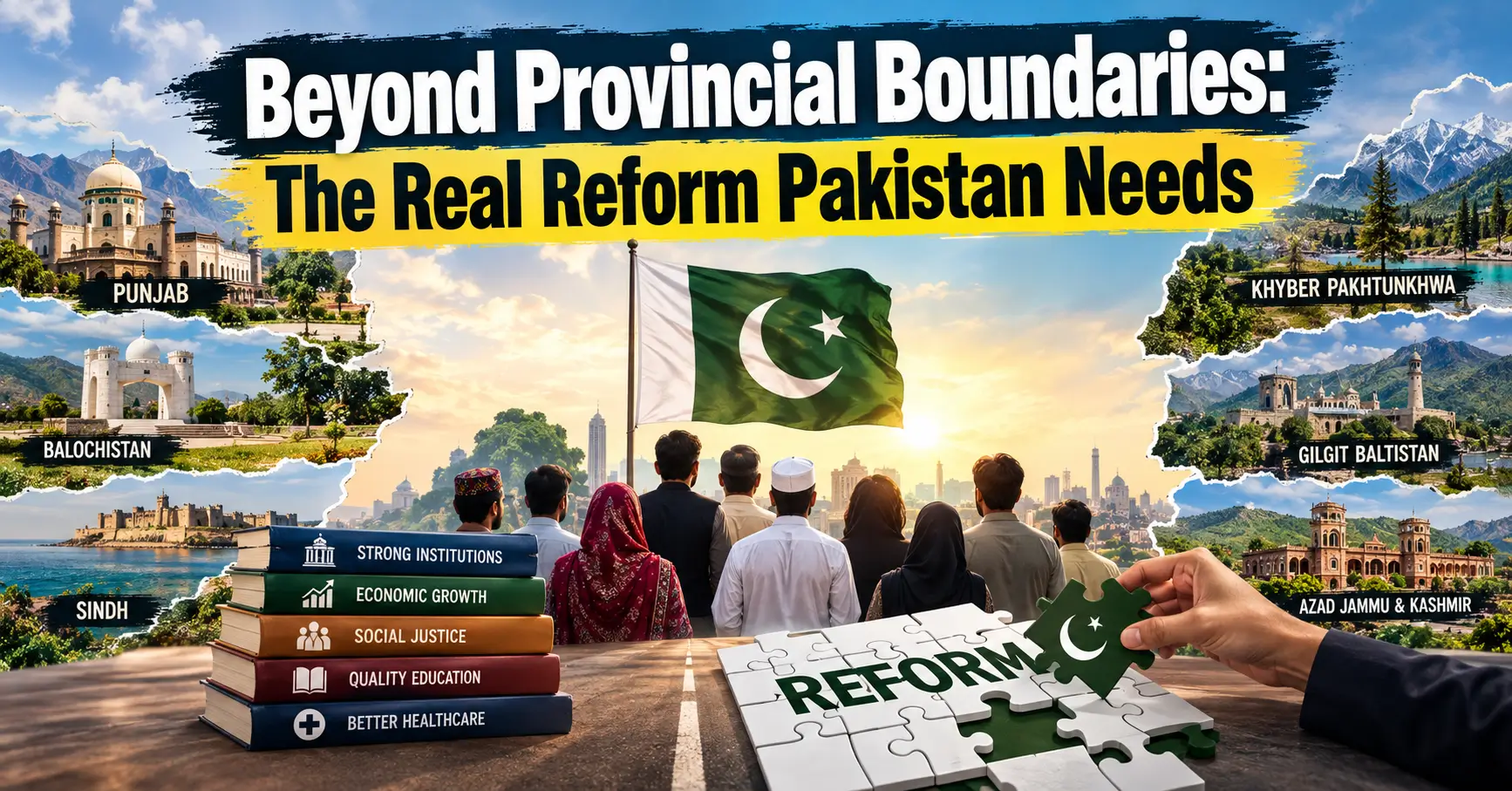
Beyond Provincial Boundaries: The Real Reform Pakistan Needs
Beyond Provincial Boundaries: The Real Reform Pakistan Needs In the month of July 2026, Interior Minister Mohsin Naqeep was speaking at the Pakistan Economic Summit in Islamabad. In his address, he criticized the old governance system that Pakistan has been based on for decades as the one that has failed the country badly, he pointed out. Mohsin Naqeep raised concern about this governance structure and urged the Government to bring about structural changes otherwise the country would be facing similar issues ten years from then. He also advised political parties to come together and make a decision on new administrative divisions, irrespective of the wording, they might eventually choose, instead of having a prolonged debate without a conclusion. The reason why his comments were treated as very significant across the country is because of his proximity with the institution so he has the view of the establishment also and the country's provinces might have grown to become too big and overly centralized to be handled properly, he said.
Administrative hierarchy of Pakistan exemplifies the problem. The country possesses one central government, four provinces, 169 districts and thousands of local units although the grassroots organizations remain the last to be empowered. In many cases, there can be hundreds of kilometers separation for the provincial centers and the people that they serve.
Rajanpur is about 545 kilometers from Lahore; Tharparkar, 400 kilometers from Karachi; Gwadar, 900 kilometers from Quetta;
Chitral, 300 kilometers from Peshawar).
In 2010, the 18th Amendment returned significant powers from Islamabad to the states, but in practice decentralization hardly went beyond that stage.
Power didn't keep coming down to the level of the district and the localities.
By the process, Pakistan essentially got rid of one centralized government only to create four provincial versions of the very same problem that it used to have. People living near the places where decisions are taken are the ones who get the benefit through the services provided. However, in Pakistan, such decisions are most of the time away from people living near where such services are needed by the locals. Beyond Provincial Boundaries: The Real Reform Pakistan Needs
The situation of the country's financial condition will not support the launching of yet another tier of hierarchy to be managed. From about Rs 2.1 trillion in FY2005, domestic debt has now increased to around Rs 54.5 trillion in FY2025, also, the costs of paying off debt from revenue taxes has been a major burden. Under such conditions, adding more provincial capitals, departments and administrative setups can add another burden to the already stressed public expenditure. Therefore, reform has to deal mainly with the ways by which government functions and resources are being given out and not just with administrative boundary multiplication.
In fact, a number of reasons are there for resistance of politicians against restructuring efforts. There is legitimate fear of the smaller area parties not gaining support if new lines of boundaries reduce the influence their members have in the provincial as well as the Senate.
In Sindh and Balochistan, national identity-oriented political groups on the one hand also regard such proposals with great caution because they see them as potential ploys to dilute regional powers or reshape the region as a political space. Beyond Provincial Boundaries: The Real Reform Pakistan Needs
When in Baloochistan the decision was made to change the boundaries, the former state of Kalat areas were affected and it became a highly emotionally charged issue where an outright walkout from the assembly was caused because of people's historical and their connection to identity.
Yet in Pakistan's political argument, we constantly mix a very fundamental aspect of political question which is, on the one hand, administrative convenience and on the other hands, regional identity and representation through political institutions.
Certain administrative measures that may seem offensive to ethnic or historical identities upon first sight should not be automatically perceived in this way. The issues are who the person responsible for a certain matter is, who the person gets funds from, and how fast the citizen is served.
Solution, then, is not only about making new boundaries. The first thing for Pakistan to do is work out which level of government controls which part of the country. Each district and tehsil must have definite responsibilities, adequate financial support, and professional administrative capacity.
Local governments need regular funding, periodic elections, and functions that are legally protected so as not to have them withdrawn at the discretion of the provincial government depending on its current political agenda.
However, new provinces can still be created based on the population size, geographical conditions, and administrative needs. Nevertheless, setting up without empowering the lower-tier institutions will be tantamount to reproducing the present dilemma in another part of the country. The main idea is that government needs to become much closer rather than to make even more governments. Beyond Provincial Boundaries: The Real Reform Pakistan Needs
Thus, the true test of the reform does not rest on the number of provinces, which the country will have but is based on the fact how fast a citizen will be able to get a road repair, a school running, a clinic equipped or a city issue fixed. It hardly makes sense if new boundaries do not help getting such services more widely available.
That is why genuine reform at the end of the day should be about reaching local level - tehsil, district and city level, rather than getting stuck in another provincial office.
Topic starter
Posted : September 16, 2026 10:54 am