
Notifications
Clear all

“Rural Women: Pakistan’s Hidden Engine of Growth”
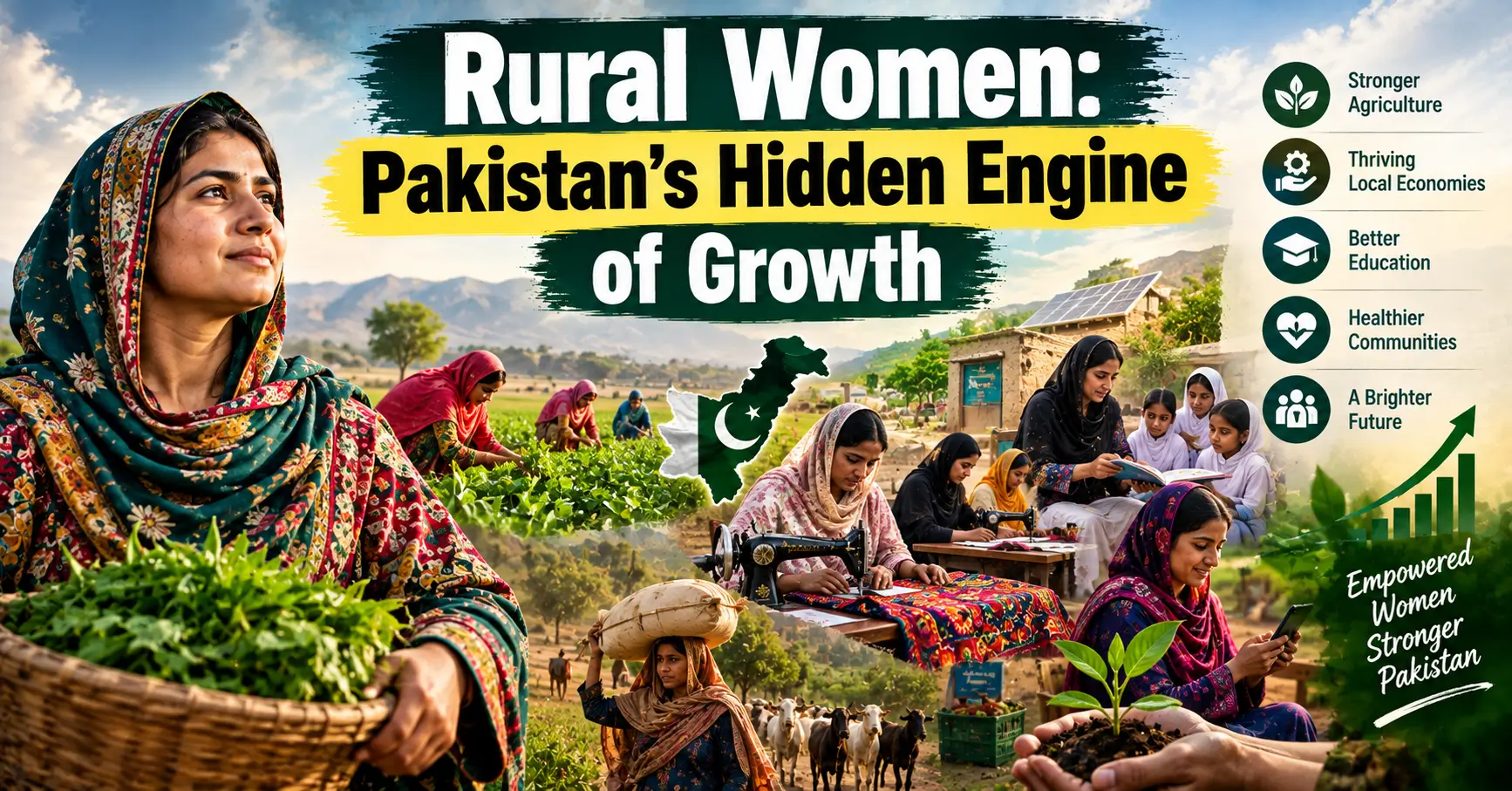
“Rural Women: Pakistan’s Hidden Engine of Growth” Pakistan’s potential powerhouse of economic prosperity
PAKISTAN is searching for enduring ways that will accelerate economic growth, open up export markets, reduce poverty, and create jobs. The national discussion naturally zooms in to industrialization, taxes, capital, and productivity aspects. However, a massive untapped economic asset, that of rural women in Pakistan, remains mainly unused. No question really remains today that women in Pakistan contribute to the country’s economy. What’s more of a puzzle is why the bulk of their work remains invisible, undervalued, not paid, or only generates a small income if at all. “Rural Women: Pakistan’s Hidden Engine of Growth”
Labour Force Survey 2024–2025 depicts a dismal female labours-force participation rate, which is merely 24.4 per cent, whereas men’s rate is a much more encouraging 69.8 per cent.
These numbers should not be a mere gender-related issue.
In economic terms, they reflect a substantial opportunity cost.
An unseen workforce: Every day in villages, thousands of mothers and wives and daughters are helping each other, working in farm-related jobs, animal husbandry, dairy industry, chicken farms, collecting harvest from fields, processing food at home, making embroidery, tailoring, needleworks including various sorts of handiworks at home or doing business from their house. Unfortunately, their activities rarely yield them enough money as women rarely have access to machines, capital, organized markets and contemporary value chain activities. So, for example, woman making dairy products, raising chickens, processing food, or designing, may get only minuscule return for their product as they are rarely offered good packing, reliable transport, quality checking, branding their products, or having the product displayed at the market place, hence limiting consumers of such products.
Hence, the focus of the policies should not be only on shifting rural women out of their homes to wage-based jobs in the factory settings as a means of economic advancement in themselves.
It will be better to make sure that the work done by them is more efficient and has a higher market value.
Pakistan’s rural women’s handcrafted arts and handicrafts that they have in them including embroidery, weaving on hand looms, garments, carpets, domestic goods textiles, handicrafts, processed goods, and honey products will be an added advantage to the world markets. However, the product in of and of itself may not be sufficient, as design, quality control, packaging, branding, digital marketing, logistics, and buyer access are all equally significant. The creation and operation of Producer Cooperatives, Enterprises led by women, Development of Digital Platforms and Supply Chains that are organized would help eliminate the dependence on middlemen while at the same time, the rural producers can be reached directly by the domestic and international customers.
The Bangladesh and India experiences as models : Pakistan does not need to make a fresh start, in a way, with this idea. By providing the right conditions, women in Bangladesh are becoming an integral part of export manufacturing and enterprise development. Meanwhile, India has used community groups for example, Self-Help Groups as well as organizations like the Self Employed Women Association to greatly increase the level of women’s access to finances, producing activities, and markets. The idea behind this paragraph is that although Pakistan has a unique set of features like their agricultural sector, livestock-based economy, traditional craftsmanship, and regional specific products, they can benefit from the success stories of Bangladesh and India. That is, without having to duplicate those very systems.“Rural Women: Pakistan’s Hidden Engine of Growth”
In the end, what matters the most is the ability to come up with a development model that is right for Pakistan. It needs to be developed on the basis of the existing characteristics of an agricultural sector, livestock economy, traditional industries and the like. “Rural Women: Pakistan’s Hidden Engine of Growth”
Finance, technology and infrastructure: One of the most effective ways of improving the economic position of rural women is through providing easy access to finance. A woman may be skilled and motivated but still not find it possible to start business like sewing, buy dairy equipments, run a poultry unit or establish a food processing business without a financial support. Hence, banks and MFIs (microfinance institutes) are to design credit and financial products catering to rural woman-headed business, with a variety of products, including small-scale loans, working capital, savings, insurance, and digital financial services. Access to credit will, in fact, only solve a part of the problem. It is necessary that finance is complemented by training, suitable technology and reliable market access. Without these elements finance may just lead to a debt trap, but not development of sustainable enterprises. The province of Punjab which has a big size in terms of rural population and agriculture-livestock sector is a good example for a lead role.
It is through commercial orientation that rural women enterprise clusters will be set up in the province so that different regions will specialize in producing such local products based on their comparative advantages for example dairy, textiles, embroidery, and food processing, among others. Government will have to develop the required infrastructure: training centres and centres for common use, digital networks, certification laboratories, facilities for cold storage and packing of goods. Whereas private companies and exporters, for example, may set up supply agreements and get market connections established. It will only be through successful enterprises created and export markets developed that the measure of success will emerge. The number of women going through training cannot be used as the only indicator of achievement, and the real success must be reflected in the numbers of women who become financially stable, start businesses, find employment through supply chains, or engage in export activity. “Rural Women: Pakistan’s Hidden Engine of Growth”
Women from being merely recipients of help to becoming active participants in the economy: It should be an integral part of all government policies to recognize and encourage rural women as producers, entrepreneurs, and exporters as well. For instance, the first thing that any government programme needs to identify should be the type of product the locality is best at producing competitively. Then, it needs to be ensured through a buyer. “Rural Women: Pakistan’s Hidden Engine of Growth”
Pakistan's economic challenge is twofold: scarce capital and human capital that is not fully utilizing the potential resources. Rural women are already working in the economy—they cultivate land, tend to poultry and cattle, grow food, make clothes, craft items or manage home businesses. What is lacking is economic infrastructure to convert this labor into more production, stable incomes, better-sized businesses and access to foreign markets. “Rural Women: Pakistan’s Hidden Engine of Growth”
Misuse of resources cannot go on any longer: Rural women should not just be considered as charity cases. It’s high time to see them not as the object of help but as creators, entrepreneurs and potential export-oriented people who are the main driving force of the economy. Supporting rural women in business is not only a moral thing to do but is, in fact, an economic one too.
Topic starter
Posted : September 16, 2026 11:07 am